Every morning I walk down Via Dario Campana without thinking.
The traffic light, the bar, the right turn. Brain on autopilot.
One day I stopped.
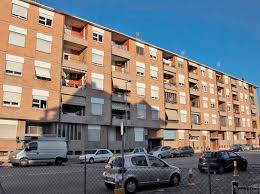
I don’t know why. Maybe the September light. Maybe the kind of tiredness that slows you down instead of pushing you forward. I stopped in front of a red-brick building and looked.
Really looked.
The arcades. The open courtyards. The exact proportions between floors. The exposed brick that didn’t feel accidental. The rough stone on the lower floors. The plastered cornices marking each storey with an almost musical precision.
I thought: who built this place?
When I found the answer, I realised I had been living inside something Rimini had never quite finished telling.
This Was No Ordinary Neighbourhood
Rimini, late 1940s.
The war had left its mark everywhere. The bombings of 1943 and 1944 had hit the city hard. Families were overcrowded. Children slept three to a room. Some people were still living in prefabricated shacks meant to be temporary that had become permanent out of necessity.
This wasn’t just Rimini. It was all of Italy.
In 1949 the government responded with a measure that would change the face of dozens of Italian cities: the INA Casa Plan, also known as the Fanfani Plan after labour minister Amintore Fanfani. Build homes for those who had none. Create jobs in construction.
But there was something more inside this law.
A philosophy.
INA Casa buildings were not dormitories. Not anonymous tower blocks. They were neighbourhoods designed by architects — with precise rules, material quality standards, a manual for dignity. And in 1949 Italy, dignity in housing was not a given.
The programme ran for fourteen years, until 1963. Hundreds of neighbourhoods were built across Italy. Many are still recognisable today — by those red bricks, by those courtyards, by that feeling of entering a place with its own identity.
For the most important project in the entire province of Rimini, they turned to a young Roman architect.
His name was Piero Maria Lugli.
The Architect Who Designed a Community
Lugli was born in Rome in 1923. When he won the commission for Rimini he was barely in his twenties. He worked with Sergio Lenci. The client was the IACP di Forli (Istituto Autonomo Case Popolari) — the province’s autonomous social housing institute.
This was not just a building contract.
It was an urban challenge.
Lugli had 8.6 hectares along Via Dario Campana. His idea: a self-sufficient neighbourhood. Not isolated. Complete. Everything needed for a good life already inside.
He laid out the scheme in a radial pattern — a central spine from which the buildings branch out, with open courtyards and semi-private green spaces. Not a grid. An organism. An internal logic you feel when you walk through it.
The central axis as a backbone. The courtyards as lungs. You are not walking between buildings. You are walking inside something that has a thought-out shape.
Materials: exposed brick facades, plastered cornices marking each floor, stone plinths at ground level. Nothing luxurious. Everything quality.
The result, completed between 1949 and 1956, is the largest public intervention in the entire province of Rimini in the postwar period.
Five hundred and twenty-six apartments. Two thousand seven hundred and twenty rooms. Three thousand residents planned.
Not a building. Not a complex.
A city within a city.
What Lugli Planned for the People Who Would Live There
Here is what was built into this neighbourhood from day one.
A nursery school. A primary school. Children could grow up without travelling kilometres every morning.
A community centre. A space for meetings, collective activities, shared life. Because living well does not just mean having four decent walls. It means having somewhere to meet.
A covered market. Bread, vegetables, meat — everything within walking distance.
Fourteen shops woven into the neighbourhood fabric. Local shops inside the neighbourhood, like any functioning Italian historic centre.
Think about that list. Then think about the year: 1949.
In an Italy still rising from the rubble, someone had imagined a complete piece of city — designed from the start with the same attention to daily life normally reserved for wealthy central districts.
This was not social housing in the derogatory sense.
It was urbanism. It was architecture. It was — to use a word that then carried real weight — dignity.
In 1978, twenty years after the neighbourhood was completed, a 700-seat auditorium was added. The community had grown. The neighbourhood adapted. It breathed.
The Neighbourhood That Split in Two and Held Together
When Lugli designed the neighbourhood, a planning constraint complicated everything. A ring road was due to cut through the area, dividing it into two separate nuclei.
Not what Lugli wanted. But the design adapted: same materials, same architectural language, same philosophy of space. If you have to cut an idea in two, at least the two halves should still speak to each other.
Then something curious happened. The ring road was rerouted. The constraint fell. Technically the two nuclei could have been reunited.
But the division remained.
Not through negligence. It remained because neighbourhoods — like families, like stories — adapt to the conditions they find. The two INA Casa nuclei each developed their own micro-identity while sharing the same origin. They look at each other from a distance. They recognise each other.
There is something very Riminese about that.
Walking Here With New Eyes
Via Dario Campana connects the INA Casa neighbourhood directly to Rimini’s historic centre. Not a peripheral road. A street that enters the city — one those arteries people travel every day without realising they are crossing seventy years of Italian housing history.
The bricks you see are not decorative. They are Lugli’s signature — his way of saying: this place was thought about, not thrown together.
The courtyards are designed to let in the sun, to create semi-private zones where children can play, where neighbours can meet.
Living here means living in one of the few parts of Rimini where someone, decades ago, asked a question that should be obvious but often is not:
How do people live well?
Not: how do we build quickly. Not: how do we fit the maximum number of apartments per square metre.
How do people live well.
And then they actually tried to answer it.
The Rimini That Does Not Appear in the Guidebooks
Talk to Rimini locals about the INA Casa neighbourhood. Almost nobody knows its story. They know it is an old neighbourhood, that it has social housing, that it is near the Marecchia river. But the story of Lugli, the Fanfani Plan, the three thousand planned residents — almost nobody knows it.
Talk to tourists. They know the Arch of Augustus, the Bridge of Tiberius, the Fellini Museum, Castel Sismondo. They know the beach and the Notte Rosa. They know the Roman and Renaissance history.
But this piece of city — 8.6 hectares designed by an architect who put dignity before numbers — has stayed off the radar.
This is not Fellini’s Rimini. Not the Rimini of Augustus and the Renaissance.
This is the Rimini of 1949. Of people who needed a home. Of someone who designed one for them with respect.
And it is one of my favourite Riminis.
How to Visit the Neighbourhood
The INA Casa neighbourhood stretches along Via Dario Campana, in the northern part of the city centre. From Piazza Tre Martiri it is about a ten-minute walk north. The neighbourhood is bounded by Via Dario Campana, Largo Gomberto Bordoni, Via Luigi Nicolo, Via Mario Capelli and Via Pagliarani.
No official entrance. No ticket booth. You just walk in. On foot, slowly: step into one of the open courtyards, look at the facades up close, notice how the corners and arcades are resolved.
- On foot from the historic centre: 10-15 minutes from Piazza Tre Martiri or the Arch of Augustus
- By bike: ideal — connects easily to the city centre cycle path network
- By car: parking along Via Dario Campana and nearby streets; check for ZTL restrictions
Frequently Asked Questions
What is the INA Casa neighbourhood in Rimini?
It is the largest public housing project built in the province of Rimini in the postwar period. Built between 1949 and 1956 to a design by architect Piero Maria Lugli, it comprises 526 apartments across 8.6 hectares, with integrated facilities including a school, covered market, community centre and 14 shops. It was built under the INA Casa Plan (Fanfani Plan), active from 1949 to 1963.
Who designed the INA Casa neighbourhood in Rimini?
The lead architect was Piero Maria Lugli (Rome, 1923-2008), working with Sergio Lenci. The client was the IACP di Forli. Lugli was barely in his twenties at the time — an early project from an architect who went on to work extensively in Italian urbanism.
Where is the INA Casa neighbourhood in Rimini?
Along Via Dario Campana, north of Rimini’s historic centre. Reachable on foot in 10-15 minutes from Piazza Tre Martiri. Bounded by Via Dario Campana, Largo Gomberto Bordoni, Via Luigi Nicolo, Via Mario Capelli and Via Pagliarani.
What makes the architecture special?
Exposed brick facades, plastered cornices and stone plinths. A radial urban layout with a central spine, open courtyards and semi-private green spaces. The defining feature is functional self-sufficiency: school, market, community centre and shops were all built into the original design — unusual for public housing of the era.
Can you visit the INA Casa neighbourhood in Rimini?
It is an active residential neighbourhood — no museum, no booking required. You visit by walking. Open courtyards and arcades are accessible. A walk suited to anyone interested in architecture, urban history, or discovering a Rimini off the usual tourist circuit.
Whenever someone asks me what there is to see in Rimini beyond the beach and the historic centre, I tell them about this place.
Not a monument. Not a cathedral. Not a museum.
A neighbourhood where real people live. Where children go to school, where old men sit in the sun, where in the morning you catch the smell of coffee from open balconies.
But also proof that, at certain moments in history, someone stopped to think before building. Thought about who would live there. Designed not just walls — but a community.
That community is still here.
And if you pass through Via Dario Campana, look around.
Stop — you too — and really look.
You know where to find me. At the Aqua Hotel, a short walk from this Rimini that never stops surprising you.