There’s a place, twenty minutes from Rimini, that the Malatesta would never have wanted you to find.
Not because it was dangerous. Not because they hid state secrets there.
Because it was the place where they went to be themselves.
The Malatesta of Rimini were, for nearly two centuries, the lords of the Adriatic. Warlords, patrons of the arts, builders. You know them from the Tempio Malatestiano — that Renaissance façade Sigismondo wanted more beautiful than any church in Italy. You know them from Castel Sismondo, the keep that still dominates Rimini’s historic center. You know them from history books, from bronzes, from coins, from names carved into the city’s stones.
But almost nobody knows Montefiore Conca.
And yet it’s been there since 1322 — the year the Malatesta purchased the castle and all the surrounding territory, making it their exclusive private property. Their retreat in the hinterland of the Valconca valley. The place where the lords of Rimini stopped being lords.
How a papal document from the 12th century ends up on a Valconca hilltop
The name of this place appears for the first time in a papal document from the 12th century. Castrum Montis Floris — the fortress of the flowery mountain. A name that already tells you everything about its position: on top of one of the highest hills in the Valconca, with views on clear days stretching all the way to the blue strip of the Adriatic Sea.
It wasn’t a random choice.
Running through that valley was the Via Flaminia Minor — one of the historic routes connecting Rimini to Rome through the Apennine mountains. Not the main Flaminia, which ran further south. This was the inland variant, shorter, more protected, used by armies, merchants, pilgrims. Whoever controlled Montefiore Conca controlled traffic between the Adriatic Sea and the mountains.
They controlled, in effect, a key to medieval Romagna.
Medieval lords knew how to choose. By 1314 the Malatesta had arrived as podestà, then as papal vicars. In 1322 they took the decisive step: buying all rights to the castle and surrounding territory. From that moment, Montefiore Conca belonged entirely to the Malatesta.
For about a hundred years, this Valconca hilltop lived its golden age.
It wasn’t a fortress. It was home.
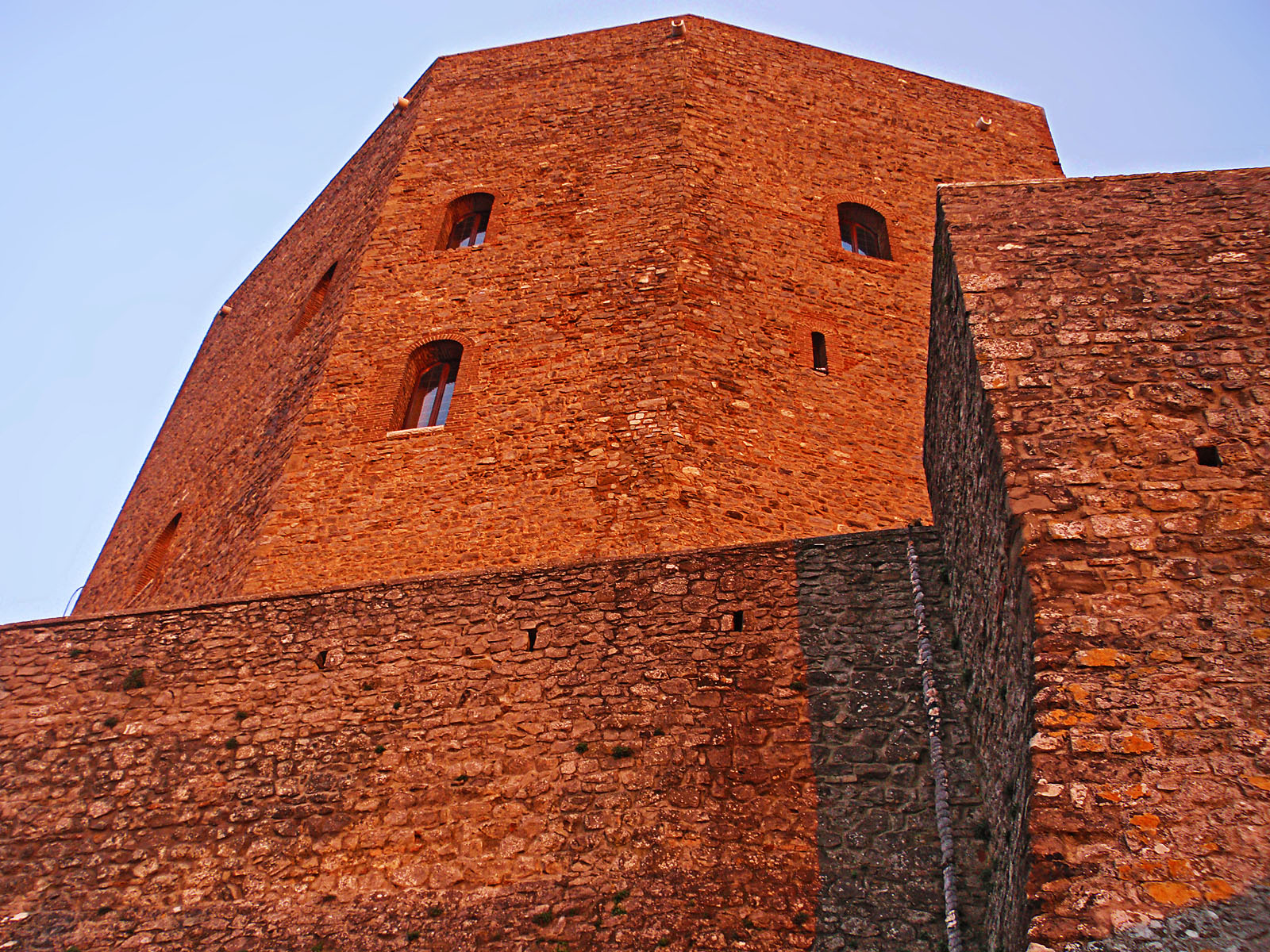
When you think of medieval castles, you think of cold places. Stone, darkness, corridors that smell of dampness and compressed history.
Montefiore Conca was different.
The castle certainly had a military function — solid walls, watchtowers, an impregnable position at the top of the hill. But it also had something rare for the time: the features of a residence. Refined rooms designed for extended stays. Halls for receiving guests. Spaces for court life far from the constant pressure of Rimini.
It wasn’t an operational base. It was a place to live.
The Malatesta came here to hunt.
The Valconca was game territory. Wild boar, deer, hares. Dense woods reaching right up to the castle’s slopes. Up here, the lords of Rimini took off their armor — not just the metal kind, but the political kind too. Rimini’s world of power was full of alliances to manage, enemies to watch, loyalties to buy and sell, calculations to make about every public word spoken.
Montefiore Conca was the place where you didn’t have to be careful.
In 1377, in this Valconca castle, Galeotto Belfiore Malatesti was born. Not in Rimini, not in one of the domain’s great cities. Here. A detail that speaks louder than a thousand documents: when a family chooses where to have their children born, they choose the place where they truly feel at home.
The village that time decided to leave in peace
You leave Rimini, take the road inland, and the plain begins to climb. The gentleness becomes slope, and the Valconca hills multiply around you.
Montefiore Conca appears suddenly.
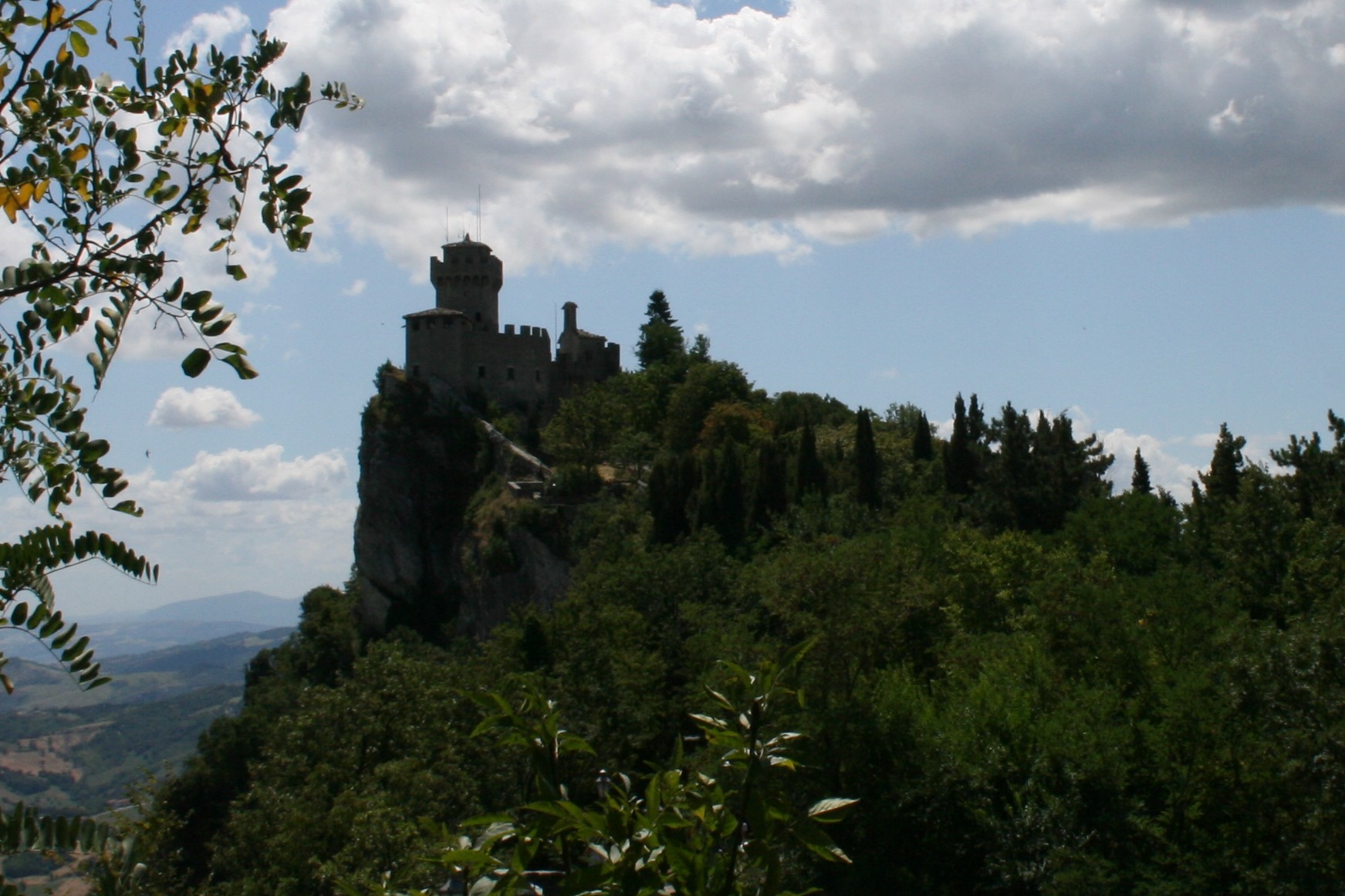
It doesn’t need signs, tourist arrows, or glowing billboards. Just look up. The rocca’s profile is there against the sky, as if someone had carved a medieval seal onto the horizon. Towers, battlements, walls dropping sheer down to the valley.
You enter the village and understand why the Malatesta chose it.
The town gathers in a semicircle, enclosed by ancient walls with medieval towers still standing. The houses press close to the castle as if seeking protection — and in the Middle Ages, that’s exactly how it worked.
The cobbled lanes didn’t widen in the twentieth century. They didn’t lose their paving stones to make way for asphalt. There are no souvenir shops every ten meters.
There’s silence.
Not the empty silence of an abandoned place. The living silence of a place that has chosen not to chase mass tourism.
The rocca dominates everything from above, preserving the original medieval layout: corner towers, inner courtyard, perimeter walls falling away down the valley. Inside, medieval frescoes that the centuries have at least partially preserved — images the Malatesta looked at while eating, receiving guests, planning their moves on the chessboard of Renaissance Romagna.
From the castle’s summit, on clear days, you can see the sea.
The Adriatic is there — that blue strip that pulses with life in summer. From up here it looks unreal. Rimini is that mass of houses and hotels reaching to the water.
It feels like another life. Another time.
The rivalry that shaped this part of Romagna
To understand Montefiore Conca you need to understand who the Malatesta really were.
Not just the lords of Rimini. They were one of two poles of a power axis that reshaped medieval Romagna for nearly two centuries. On the other pole: the Montefeltro of Urbino.
Malatesta vs Montefeltro. Rimini vs Urbino. Guelphs vs Ghibellines.
This rivalry wasn’t just military. It was cultural, artistic, almost personal. A continuous race to build more, better, more beautifully. The Malatesta financed the Tempio Malatestiano — Leon Battista Alberti as architect, marble shipped from Venice. The Montefeltro built the Palazzo Ducale of Urbino and gathered artists from across Europe: Piero della Francesca, Paolo Uccello.
Every chapel, every palace, every castle was a move in this game.
Montefiore Conca sat right in the middle of this chessboard.
After the Malatesta, the castle didn’t stay empty for long

The Malatesta’s dominion over Montefiore Conca ends like many things in fifteenth-century Italy: through political concessions, external pressure, and the advance of someone with more cannon and fewer scruples.
Between 1500 and 1503, Montefiore Conca is in the hands of Cesare Borgia. The Duke Valentino — son of Pope Alexander VI, ruthless warlord, the prince Niccolò Machiavelli studied up close — swept through Romagna like a knife through butter. Rimini fell. And with Rimini, Montefiore Conca.
Borgia didn’t stay long. After Alexander VI’s death in 1503, his star set with breathtaking speed. The Venetians took the castle in 1504 and held it until 1505, then control returned to the papal sphere.
And here the story takes a turn no one would expect.
In 1514, Montefiore Conca hosted Costantino Comneno — a prince of the imperial Byzantine dynasty. The Comneno had been emperors of the Eastern Roman Empire. But Constantinople had fallen in 1453, sixty-one years earlier. The Empire was finished. And this heir to one of the Mediterranean’s oldest dynasties ended up at Montefiore Conca, in the province of Rimini, and stayed until 1530 — sixteen years.
A Byzantine prince. At Montefiore Conca. In the Rimini hinterland.
When I tell this story to a guest at the hotel, I always see the same expression: eyebrows rising, eyes widening, head tilting to one side.
Really?
Really.
What to see in Montefiore Conca today
There are no grand museums in Montefiore Conca. No queues, no audio guides, none of those mediation instruments that so often stand between visitors and history.
The history is directly under your feet.
The castle is open to visitors, with seasonal hours. Always check the official Comune di Montefiore Conca website before you go — hours change between high and low season.
The village around the castle takes twenty to thirty minutes on foot. If you’d like to explore the Rimini hinterland more thoroughly, Montefiore Conca is the perfect starting point.
How to plan the trip from Rimini
Montefiore Conca is about 20 kilometres from Rimini center. By car on good roads, that’s twenty minutes — twenty-five if traffic on the SS16 toward Cattolica is doing what it does in high season.
There’s no convenient direct bus connection for tourists: coming by car or motorbike is the best option.
Best time to go? Spring or early autumn.
In spring — mid-April to late May — the Valconca hills are green in a way they lose by summer. In autumn the light changes. It becomes that oblique, golden light that makes everything feel slightly out of time.
The ideal day: combine Montefiore Conca with a visit to Verucchio (about 15 minutes away) or Santarcangelo di Romagna (about 20 minutes). The whole Valconca deserves a full day.
The secret Montefiore Conca has never stopped keeping
I’ve worked in tourism since 1992. The most common question guests ask me at the Aqua Hotel? “What is there to see beyond the beach?” They ask it after two days of sun. They ask it when they realize Rimini is more than beach umbrellas and piadina.
Montefiore Conca is one of the first places I always mention.
Not because it’s famous. Quite the opposite. Because it’s one of those places that gives you that rare feeling: of having discovered something you weren’t expecting. Something no travel algorithm would ever have suggested.
The Malatesta probably took half a day on horseback from Rimini. They came anyway. Every time. Because some places call you back in ways you can’t explain.
It takes less than half an hour by car. Worth the trip.
And if you want a base from which to explore this Rimini you won’t find on postcards, you know where to find me. At the Aqua Hotel, in Marina Centro.
Frequently asked questions about Montefiore Conca
Where is Montefiore Conca located?
Montefiore Conca is in the Valconca valley, in the inland area of the province of Rimini, Emilia-Romagna, Italy, about 20 km from the Adriatic Sea. From Rimini center it’s reachable by car in about 20-25 minutes via the SS16 toward Cattolica and then the inland hill roads.
What can you see at Montefiore Conca castle?
The castle — historically known as Castrum Montis Floris, first recorded in a 12th-century papal document — preserves its original medieval layout with corner towers, inner courtyard and medieval frescoes. Exclusively owned by the Malatesta family from 1322, it served both as a military stronghold and as a private residence for hunting. Seasonal opening hours apply: check the official Comune di Montefiore Conca website before visiting.
How long does it take to visit Montefiore Conca?
The village can be walked in 20-30 minutes. With a castle visit, allow 1.5-2 hours total. For a full day in the Rimini hinterland, combine Montefiore Conca with Verucchio (15 minutes away) or Santarcangelo di Romagna (20 minutes).
Did the Malatesta really live at Montefiore Conca?
Yes. The Malatesta, lords of Rimini, purchased Montefiore Conca in 1322 as exclusive private property. The castle served both as a military garrison and as a hunting residence, with refined rooms for extended stays. Galeotto Belfiore Malatesti was born here in 1377. After the Malatesta, the castle hosted Cesare Borgia (1500-1503), the Venetians (1504-1505) and Byzantine prince Costantino Comneno (1514-1530).
Is Montefiore Conca suitable for families with children?
Yes. The village is small, safe and easy to walk. The medieval walls with ancient towers and the castle structure are visually striking and engaging for children. There are no commercial attractions — it’s an authentic experience, perfect for showing children what life looked like in the Middle Ages in a place still intact.