September 3, 301 AD
A man climbs a rock.
He is not a general. He is not an emperor. He is not a noble of ancient lineage.
He is Marino. A stonecutter. Arrived from the island of Rab — in the Adriatic, in the territory now called Croatia — to build the walls of Rimini. A man accustomed to dealing with stone. To understanding where it holds and where it yields.
On Mount Titano — 756 meters above sea level, 22 kilometers from Rimini — he founded a small Christian community. He declared that this land belonged to anyone who wished to live there in freedom.
That community still exists today.
It is called the Republic of San Marino. And it is the world’s oldest surviving republic.
The man who didn’t want a kingdom — he just wanted to be free
Marino wasn’t founding a state.
He was seeking refuge.
Christians were being persecuted. The rock was difficult to reach, almost impossible to conquer. A place to survive without depending on anyone. Tradition recounts his last words before dying: “Relinquo vos liberos ab utroque homine” — I leave you free from both men. From political and ecclesiastical power.
It wasn’t rhetoric. It was a testament.
And that testament has survived everything. For over 1,700 years — through wars, invasions, pandemics, revolutions, and two world wars — the Republic of San Marino has maintained its independence without ever ceding sovereignty.
Every other political entity of the era has vanished.
The Roman Empire. The Holy Roman Empire. The Republic of Venice. The Duchy of Milan. The Kingdom of Naples. All are now history. San Marino is not.
San Marino is still here.
And you can get there from your Rimini hotel room in less than 30 minutes.
When Napoleon offered the sea — and the Sammarinese said no
In 1797, Napoleon Bonaparte was at the height of his power in Italy.
He had conquered Milan. He had redrawn the peninsula’s borders like an architect redesigning a floor plan. Every Italian state rushed to strike a deal with him or face disappearance.
He sent a diplomat to San Marino. The message was simple: the French Republic offered territorial expansion. Access to the sea. Military protection. A guaranteed future.
It was an offer no one refused.
The Sammarinese refused.
Their response — preserved in historical memory — was almost brutal in its wisdom: “Wars end, but neighbors remain.”
Napoleon, it is said, was surprised. Then he ordered that San Marino be left in peace. He even wrote that San Marino should be “preserved as a model of liberty for nations.”
It was not an admission of weakness. It was recognition.
A man who had taken almost all of Europe recognized that there was something on that small rock that could not be bought, conquered, or absorbed. And he had the wisdom not to try.
The day the Republic truly risked disappearing
But history is not always made of grand romantic gestures.
On October 17, 1739, Cardinal Giulio Alberoni — with the authorization of the Papal States — militarily occupied San Marino.
It wasn’t a long campaign. It was almost a blitz. Papal troops entered, planted their flag, and declared the centuries-old republic dissolved.
For a few months, San Marino no longer existed as an independent entity.
But something extraordinary happened.
Pope Clement XII — after examining the matter and listening to the pleas of the Sammarinese — ordered the complete withdrawal of troops. On February 5, 1740, less than five months after the occupation, San Marino was free again.
The Sammarinese established a national holiday. Saint Agatha — the saint celebrated on February 5 — became co-patroness of the Republic, alongside Saint Marino himself. It is still celebrated today as the feast of regained liberty.
Every year, on February 5, San Marino does not celebrate a military victory.
It celebrates the day it returned to being itself.
There’s an enormous difference. And the Sammarinese know it well.
Three towers, three stories, one unyielding rock
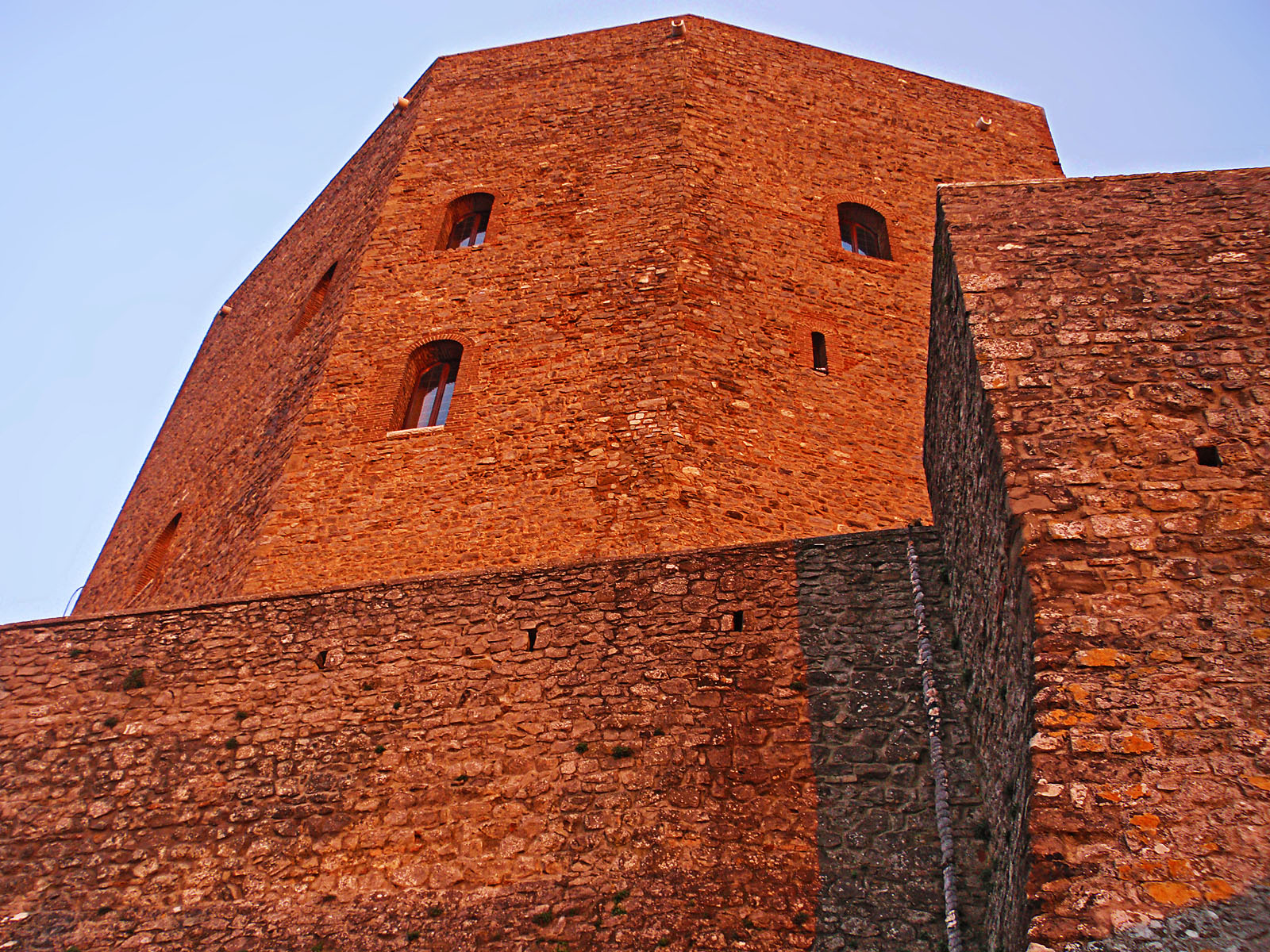
The Three Towers of San Marino — Guaita, Cesta, and Montale — are not medieval decorations left there for tourists.
They were the pulsating heart of the Republic’s defense. And they remain the most recognizable symbol of everything San Marino represents.
Guaita is the oldest. Built in the 11th century on the highest ridge of Mount Titano, it’s the tower that appears on every postcard, every stamp, every tourist guide. But being inside Guaita — walking between its thick walls, looking down towards the Romagna plain that descends to the Adriatic — is different from photographing it from afar. It’s not a museum. It’s not a set design. It’s a structure that someone truly defended.
Cesta — the second tower, built in the 15th century on the highest point of Mount Titano — holds something unexpected: a museum with over 2,000 ancient weapons. Swords, armor, halberds, crossbows, arquebuses. Everything needed to defend a republic without a professional army, where citizens themselves took up arms.
Montale is not open for internal visits. It has remained as it was: a prison tower. Six meters high, built to isolate the most dangerous prisoners. There’s nothing romantic about Montale. There’s something honest: every republic, even the freest, needed to keep some individuals outside civil society.
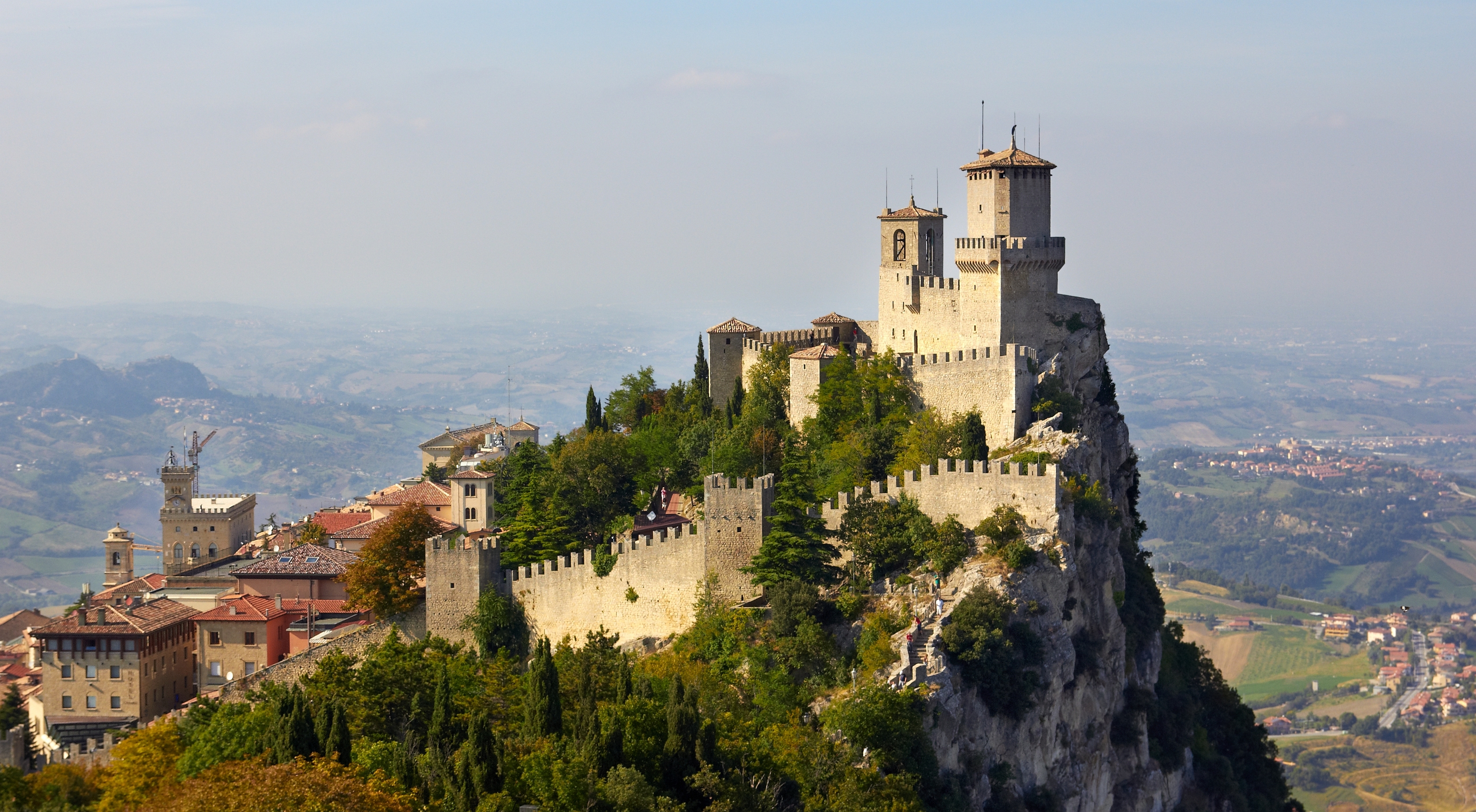
And then there’s the Passo delle Streghe (Witches’ Pass).
A 200-meter walkway between Guaita and Cesta. Walking along it — with the void on both sides, the Po Valley opening to the north and the Adriatic shimmering to the east — is one of those moments that don’t photograph well. You just experience them.
The name? “Witches’ Pass.” Because at night, it is said, it was frequented by not-so-welcome presences.
Today, tourists walk there. But the atmosphere — on certain foggy autumn days, when the towers disappear into the gray and then re-emerge — remains intact.
July 1849: Italy’s most famous fugitive knocks on the door
Giuseppe Garibaldi is on the run.
The Roman Republic has fallen. The French have entered Rome. Garibaldi has with him about 1,500 men — soldiers, volunteers, stragglers, idealists — and his wife Anita, pregnant and critically ill.
Options are very limited. The Austrians control the north. The Papal States are closed. The sea is guarded.
Garibaldi knocks on San Marino’s door.
The Republic grants asylum. But it sets a condition: neutrality. Garibaldi’s men must surrender their weapons and disband as a fighting force on Sammarinese territory.
Garibaldi accepts.
That same night — with about 200 men who remained loyal, later reduced to 150 — he manages to slip away from the trap of 12,000 Austrian soldiers surrounding him. He journeys through the night. Reaches the Adriatic coast. Sails north.
Anita would die a few days later, near Comacchio. But Garibaldi is alive.
San Marino hadn’t fired a shot. It hadn’t fought. Yet it had changed the course of Italian history.
That small republic of stonecutters had given refuge to the man who, eleven years later, would unify Italy.

The letter Abraham Lincoln wrote to a city of 10,000 people
May 7, 1861.
Abraham Lincoln signs a letter.
He doesn’t send it to London. Not to Paris. Not to Berlin.
He sends it to San Marino.
The Grand Council of the Republic had written to the American president to congratulate him on his election and offer him honorary citizenship — the only title of honor San Marino could bestow. Lincoln accepts. And replies.
The letter — preserved today at the State Museum of San Marino, in Piazzetta del Titano 1 in San Marino City — is written in English, in neat calligraphy. It contains a phrase which, taken out of context, says it all:
“Yet your State is, of all in history, the most honored.”
A country emerging from a devastating civil war — still searching for its idea of freedom and unity — looked at a small 61-square-kilometer rock on the Adriatic and saw something worth naming.
It wasn’t diplomatic flattery. It was genuine recognition.
San Marino had already accomplished in 1,500 years what the United States was trying to build in 85.
Europe’s oldest system of government — and why it still works
San Marino is not just crystallized medieval history.
It is also a political laboratory that was centuries ahead of its time.
The Captains Regent — the Republic’s two heads of state — are elected every six months. Always two concurrently, always from different political factions, always with a very short mandate. They cannot be re-elected for the next three years.
This system has existed, in its essential form, since 1243.
It hasn’t been updated because it works. It’s designed to prevent power from concentrating in the hands of a single person. Dual control. Short mandate. Mandatory rotation. An elegant solution to a problem that has destroyed much larger republics.
The first Sammarinese coin was minted in 1862 — only 280 specimens, today numismatic pieces of extraordinary rarity. The first stamp was issued in 1877, inaugurating a philatelic tradition that has made San Marino one of the most sought-after collectible subjects in the world.
UNESCO inscription arrived on July 7, 2008: the historic center of San Marino City and Mount Titano are World Heritage Sites. The UNESCO justification explicitly cites “the persistence of republican institutions for over 17 centuries.”
Not the monuments.
The institutions.
The Ostrogothic treasure the world forgot — and no one returned
1893.
In Domagnano — one of the 9 Castelli (administrative districts) of the Republic of San Marino — some farmers find something underground.
They don’t immediately understand what it is. They take the pieces around. They are sold, fragmented, dispersed.
They were 5th-century AD Ostrogothic jewels — the Domagnano Treasure. Gold fibulae with garnets and glass paste. Necklaces. Ornaments. Exquisitely crafted, worthy of a royal court. Probably belonged to a noblewoman of Theodoric the Great’s kingdom.
Today, fragments of that treasure are scattered across six museums in four different countries: the Germanisches Nationalmuseum in Nuremberg, the Museo Nazionale Romano, the Ravenna National Museum, the British Museum in London, and others.
No piece remained in San Marino.
It is one of the most striking cases of dispersion of European cultural heritage in the 19th century. And very few tourists know about it.
If you want to see what was found in the territory of San Marino, you have to buy a plane ticket to London or Nuremberg.
The rock endures. The treasure, it does not.
How to organize your visit: what to know before leaving Rimini
San Marino can be reached from Rimini in about 25-30 minutes by car: 22 kilometers along Strada Statale 72, which gradually ascends towards Mount Titano. It is also served by public buses from Rimini train station, with a transfer in Borgo Maggiore or Dogana.
Cable car: from Borgo Maggiore station (in the valley), the cable car takes you to the historic center of San Marino City in a few minutes, with panoramic views. Check availability and schedules on the official Visit San Marino website before you go.
The Three Towers — Guaita and Cesta: combined ticket, approximately €5-6 for adults (prices subject to update). Generally open 9:00 AM–6:00 PM (summer) and 9:00 AM–5:00 PM (winter). Montale can only be viewed from the outside.
State Museum — Piazzetta del Titano 1, San Marino City: houses Abraham Lincoln’s original letter, artifacts from Sammarinese history, and some items depicting the Domagnano Treasure.
The 9 Castles of the Republic: San Marino City, Acquaviva, Borgo Maggiore, Chiesanuova, Domagnano, Faetano, Fiorentino, Montegiardino, Serravalle.
Currency: Euro. San Marino is not a member of the European Union but uses the Euro under a special monetary agreement. Sammarinese coins are legal tender but extremely rare in circulation.
Border: there is no formal border control. You leave Italy and enter San Marino without stopping.
Frequently Asked Questions
How far is San Marino from Rimini?
The Republic of San Marino is about 22 kilometers from Rimini along Strada Statale 72. By car, the journey takes about 25-30 minutes. There is also a bus connection from Rimini train station, with a transfer in Borgo Maggiore or Dogana.
When was the Republic of San Marino founded?
The Republic of San Marino was founded on September 3, 301 AD by the Christian stonecutter Marino, originally from the island of Rab (present-day Croatia). With over 1,700 years of uninterrupted independence, it is considered the oldest continuously existing republic in the world.
What are the Three Towers of San Marino and can they be visited?
The Three Towers — Guaita (11th century), Cesta (15th century), and Montale — are the medieval fortresses built on the ridge of Mount Titano. Guaita and Cesta can be visited with a combined ticket (approximately €5-6); Montale is only accessible from the outside. Between Guaita and Cesta, you can walk the Passo delle Streghe (Witches’ Pass), a 200-meter walkway with views of the Romagna plain and the Adriatic.
Is San Marino a UNESCO World Heritage site?
Yes. On July 7, 2008, the Historic Center of San Marino City and Mount Titano were inscribed on the UNESCO World Heritage List. The justification explicitly cites the persistence of republican institutions for over 17 centuries — not just the monuments, but the system of government itself.
Is San Marino part of the European Union?
No. San Marino is an independent state not a member of the European Union. It uses the Euro under a special monetary agreement. There is no formal border control between Italy and San Marino: you enter and exit freely, without additional documents beyond a valid ID.
You can return from San Marino with souvenirs.
Bottles of wine. Painted ceramics. Stamps. Collector coins.
But what San Marino truly gives you doesn’t fit in a bag.
It’s the feeling of having walked on a rock that has withstood everything. Napoleon offering the sea and being told no. The Austrians surrounding Garibaldi with 12,000 men and seeing him disappear into the night. Cardinal Alberoni who thought he had won — and found himself with a papal order to go home. The centuries that bury kingdoms and leave this small rock still standing.
Stand on the Passo delle Streghe, between Guaita and Cesta.
The wind comes from the Adriatic.
22 kilometers away, Rimini. The Arch of Augustus — erected in 27 BC. Here, on Mount Titano, eight years before that arch, the rock was already inhabited.
When you descend towards the Romagna plain and the Adriatic reappears before you, gleaming and wide, you think of Marino — the stonecutter who climbed this rock 1,724 years ago and said: here one lives free.
He was not a king. He had no army. He had no alliances with great powers.
He only had the rock. And an idea.
That idea held.
You know where to find me when you return to Rimini. You know where to find me. At the Aqua Hotel, in Marina Centro. I’ll gladly tell you how to organize your day in San Marino., in Marina Centro. I’ll be happy to tell you how to organize your day trip to San Marino: what to see first, where to eat without falling into tourist traps in the historic center, and why — if you can — it’s worth staying an extra day.