The Train Mussolini Wanted and No One Remembers: the Rimini-San Marino Railway
Summer 1932. The holidaymakers getting off at Rimini station stop and stare. In front of the tracks is something they’ve never seen before.
It’s not the usual steam train with its smoke and screeching.
It’s an electric railcar. Polished. Brand new.
And it’s not heading to any of the destinations they know. Not Bologna. Not Ancona. Not Ferrara.
The train departs and starts climbing. It leaves the plain, crosses State Road 72, slips into a tunnel. And half an hour later it’s in San Marino.
It sounds like science fiction. It sounds like a modern-day project. It’s a story almost nobody tells.
August 1926
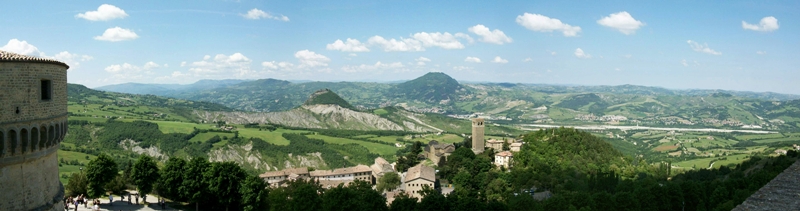
Benito Mussolini is visiting the Republic of San Marino. He has climbed to La Fratta, the highest point of Mount Titano. The view is what it’s always been: the Adriatic on one side, the Marecchia Valley on the other. Hills, fields, perched villages.
Beside him is Regent Captain Giuliano Gozi. The two men look down. Towards Rimini. About 25 kilometres as the crow flies, but the road is winding, connections are slow. Fascism needs symbols, and a direct link with the world’s oldest republic is a symbol that carries weight.
Mussolini observes. Then he says: “A railway would connect Rimini well with Serravalle.”
Gozi doesn’t need to be told twice. He seizes the opportunity and goes further:
“But, if Your Excellency wishes, the railway could go all the way to San Marino.”
Mussolini thinks for a moment. Then he promises his personal support.
It wasn’t just a promise.
It was an order.
3000 Workers in Three Shifts
It took less than two years to put it on paper. The Convention between the two states was signed in Rome on March 26, 1927. At Palazzo Chigi.
The contract was won by SVEFT — the Veneto-Emilia Railway and Tramway Company. They proposed a longer route than their competitors, but backed by a more thorough study of the terrain. They already knew geology would be the problem.
On November 23, 1928, the 25-year concession was signed. On December 3, with a solemn ceremony, the first stone was laid in San Marino.
Then the real problems began. The ground was unstable. The tunnels grew longer. The planned timeline slipped.
In September 1930, Mussolini suddenly appeared at the construction sites. The chronicles don’t say whether he was angry, but what happened next speaks for itself.
He set a date. Blunt.
“Spring 1932.”
From that day on, SVEFT deployed 3000 workers divided into three shifts. A thousand per shift. Night, day, evening. The railway never stopped.
Quarries, tunnels, viaducts and excavations advanced to cover the 31.5 kilometres separating Rimini from San Marino. The line started from the terminal inside Rimini’s main station, passed through Rimini Marina (on Via Pascoli), then climbed towards Dogana and Serravalle, finally arriving at San Marino City station.
By the time the work was finished, none of the workers could say they’d seen it all. Because to see it all — the entire route — you would have had to stay still on a hillside for two whole days.
“To the Hero of Buccari”
The inauguration date was set for June 12, 1932. The penultimate Sunday of spring.
The Duce did not attend.
The official reasons were unclear. But a week earlier, an anarchist named Angelo Sbardellotto had been stopped in Rome, in Piazza Venezia, with a pistol in his pocket. His intention, the court wrote, was to shoot the Head of Government. Perhaps it’s just a coincidence. Perhaps not.
Representing Mussolini was Costanzo Ciano, Count of Cortellazzo, Minister of Communications. A character: protagonist alongside D’Annunzio of the “Buccari stunt” during the Great War, and the father-in-law of Mussolini’s daughter (his son Galeazzo had married Edda Mussolini in April 1930).
On June 12, from early morning, there was excitement. Outside Rimini station, units of Young Fascists were deployed; hotels had provided their limousines for moving the authorities. Ciano arrived at 9:10 AM, welcomed by Prefect Dino Borri and a crowd of officials.
His first act, amid all the celebrations, was to deliver a wreath to be laid “on the plaque commemorating the martyr Luigi Platania.”
Then the procession moved: Via Dante, Piazza Giulio Cesare, Corso d’Augusto. The crowd — according to Il Popolo di Romagna of June 18, 1932 — pressed along the sides. Ciano went up to the Town Hall for the reception. The secretary of the Rimini Fascio, Giuseppe Massani, orchestrated the gathering. Flags. Hymns. Everything you’d expect from such a ceremony.
Ciano’s speech talked about Luigi Platania and said that Romagna “has given birth to the Duce, who is absent from this event but present in spirit.” The crowd sang songs and shouted “potent alalà” (the Fascist cheer). Then, finally, the ribbon-cutting.
The inaugural train departed at 9:50 AM. It ran along that brand-new track, carved through rock and earth, and after a few kilometres it was already at Dogana. Here the Sammarinese authorities were waiting. At Dogana there was another ribbon, this time white and blue. They cut that one too.
At Serravalle station, Captain of the Castle Marino Morti climbed aboard. The final stretch of the journey was a steep climb; the train passed through daring tunnels. The bells of the Pieve rang festively as the Guard of Rocca announced the arrival with ceremonial cannon fire.
When the train stopped at San Marino City, in addition to the local authorities, there were also the consuls of the United States, Poland, France and Great Britain.
It wasn’t just a railway.
It was a political operation. An alliance that Mussolini’s Italy wanted to make visible to everyone, inside and outside its borders.
Regent Gozi called it a “work of Italic brotherhood.” He said that Mussolini’s Italy “truly knows how to extend a friendly and generous hand, without insidiousness or hidden motives.” Heavy words, in a Europe already beginning to rearm.
Ciano replied: the Republic is “surrounded by the affection and watchful respect of Fascist Italy.” And then everyone went to the Basilica for the Te Deum.
At three in the afternoon, Ciano left. He visited the Rimini beach, showed interest in the marine colonies of Forlì and Bologna. The day ended there.
The train kept running.
What Remains
The Rimini-San Marino railway ran on its tracks for just over a decade. The war stopped everything. The bombings of 1944 damaged the line. Some sections were never repaired. After the war, the 25-year concession expired in 1953 and was not renewed. People had started moving by bus, by car. The train was slow, expensive, outdated.
In 1944, service had already been suspended. It officially closed shortly after the war.
Today, scattered traces of the Rimini-San Marino railway remain. A track surfacing from the asphalt on Via Pascoli. The tunnel route, still down there. Some stations converted into homes. The ruins of the Rimini Marina station. An archive of black-and-white photos showing officers in full uniform, authorities in bowler hats, the train departing between two wings of a crowd.
And the memory that, for a few years, the Adriatic Riviera and Mount Titano were connected by a thread of steel. By a train that climbed. By an idea that seemed impossible.
Frequently Asked Questions about the Rimini-San Marino Railway
When was the Rimini-San Marino railway built?
Construction began on December 3, 1928, and the line was inaugurated on June 12, 1932, after nearly four years of work.
How long was the Rimini-San Marino railway?
The railway line was approximately 31.5 kilometres long, connecting Rimini’s main station with San Marino City.
Why was the railway closed?
The line was damaged by the 1944 bombings during World War II and the 25-year concession expired in 1953 without renewal, as road transport had become preferred.
Where can you still see remains of the railway?
Traces of the route are visible on Via Pascoli in Rimini (Rimini Marina station) and along the route towards Dogana. Some stations have been converted into private homes.
How many workers built the railway?
Up to 3000 workers were employed in three daily shifts of 1000 each to meet Mussolini’s tight deadline.
You know what it’s like to look at a postcard from the 1930s and find yourself thinking: this city has a story that never ends.
Whenever I pass by what remains of the Rimini Marina station, I think about it. About that train that’s no longer there. About the idea that someone — perhaps naively, perhaps with all the boldness of an era — decided it was possible to take a train up a mountain.
And they succeeded.
The railway is gone. But Rimini — our Rimini, the real one — keeps offering stories like this one. You just need the eyes to see them.
You know where to find me. At the Aqua Hotel.