If you pass through Piazza Cavour and see those stone counters under the loggia, stop for a moment.
They’re not there for decoration. They’re not urban furniture placed to add a bit of character to the historic center. They are what remains of one of the liveliest, noisiest, and most concrete places of the Rimini of yesteryear: the Vecchia Pescheria.
Today you might walk through it after dinner, with a glass in hand, while looking for a free table between Piazza Cavour and the Piazzetta delle Poveracce. But for generations, this was the spot where Rimini brought the sea into the city.
There was no elegant silence here, as you might imagine looking at the arches. There were crates, water, voices, haggling, wet hands, fresh fish, women selling poveracce (clams), and Rimini locals coming to buy what the Adriatic had left that morning.
The Vecchia Pescheria is one of those places that Rimini puts in front of you without explaining them. It sits there, right in the center, under everyone’s eyes. And precisely because of this, you risk not truly seeing it.
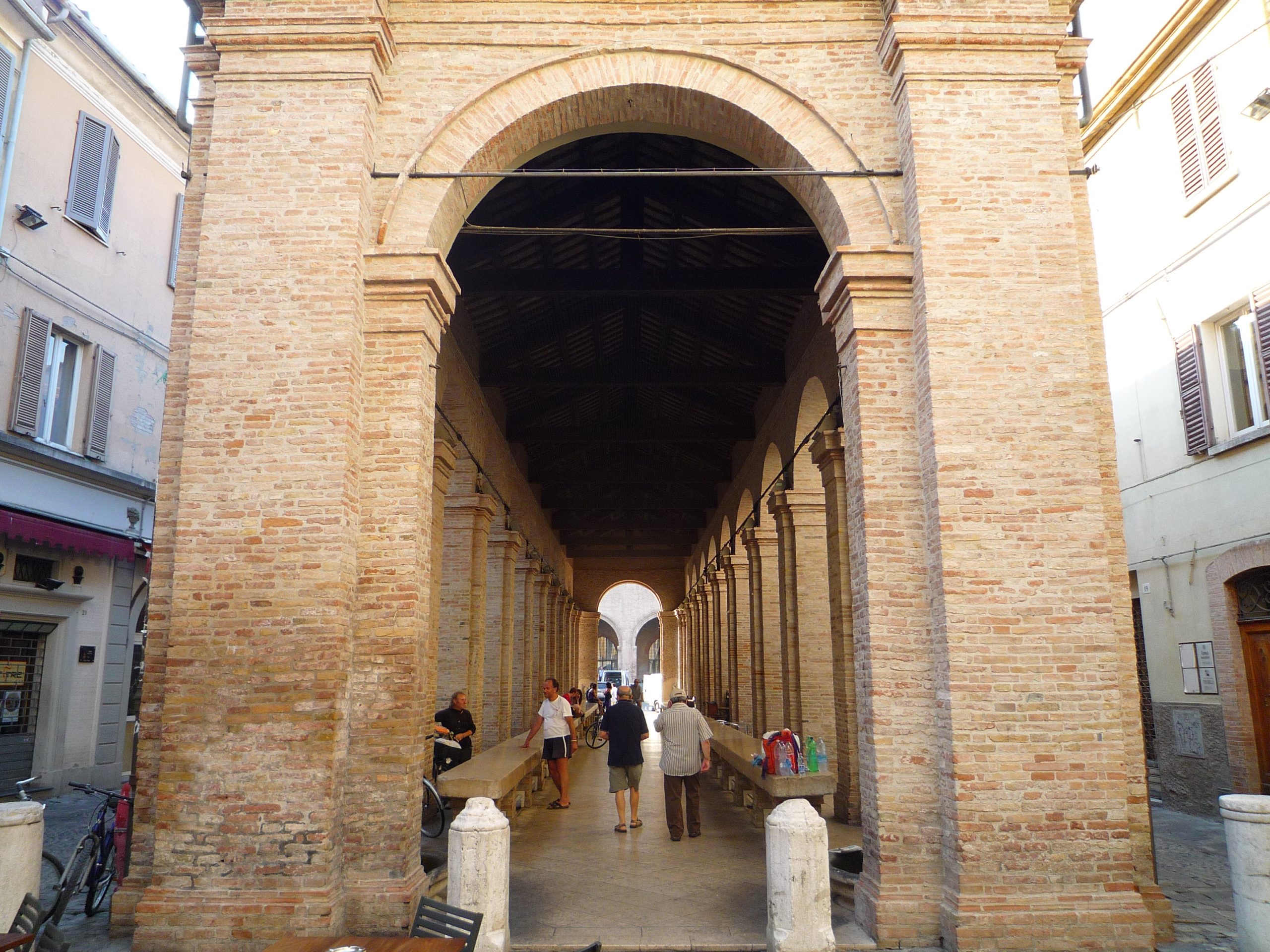
A fish market built like a small monument
The Vecchia Pescheria was built in 1747 based on a design by the Rimini architect Giovan Francesco Buonamici. We’re in the 1700s, when Rimini decided to give its fish market a more orderly, cleaner, and more suitable home for a city that also lived off its relationship with the sea.
The interesting thing is that it wasn’t built as a simple service space. An elegant loggia was constructed, with arches, stone counters, and small fountains. A practical place, certainly, but also beautiful.
And this is a very Rimini thing: even when it comes to selling fish, the city finds a way to do it in a square that feels like a theater.
The counters you still see today were used to display the catch. Water flowed from the fountains, necessary for cleaning, refreshing, and working. The openings of the loggia gave breathing room to a trade made of strong smells and quick gestures.
If you stop and look closely, you understand that this place wasn’t born to be photographed. It was born to function. And perhaps that’s exactly why it’s so beautiful today.
The Piazzetta delle Poveracce: the name says it all
Next to the Vecchia Pescheria is the Piazzetta delle Poveracce. The name might make those not from here smile, but in Rimini, poveracce are clams. Or rather, that very local way of calling them, without too much poetry and without needing translation.
The name of the little square is a small testament to how much this corner was tied to the daily life of the city. It wasn’t a living room. It wasn’t a backdrop. It was market, work, cooking, household economy.
Here passed a concrete, working-class Rimini, made of women who could spot good fish at a glance and families who built their lunch around the day’s availability.
Today, instead, the same little square has become one of the most pleasant corners of the historic center. In the evening, it fills with tables, chatter, aperitifs, couples stopping without a rush. The change is huge, but the place hasn’t lost its main function: bringing people together.
Why visit it during a vacation in Rimini
If you’re in Rimini for the sea, you might think the historic center is something to see “if you have time left over.” Mistake.
The Vecchia Pescheria is perfect precisely because it doesn’t require a long visit. You can fit it into a simple walk, maybe as a couple, between the Arco d’Augusto, Piazza Tre Martiri, Piazza Cavour, and the Ponte di Tiberio.
Arrive in the late afternoon, when the light begins to fall on the stones of the center. Look at Piazza Cavour, the Teatro Galli, the Palazzo dell’Arengo. Then turn towards the loggia of the Pescheria and find yourself in a place with a different atmosphere: more intimate, more secluded, almost hidden despite being right in the center.
It’s one of those places that work well without needing special effects. You don’t need to book. You don’t need to pay for a ticket. You don’t need to organize anything. You just need to pass through with a bit of attention.
And if you’re looking for an idea for a quiet evening in Rimini, this is a good starting point: a walk in the center, a stop at the Vecchia Pescheria, an aperitif or dinner nearby, then a stroll towards Borgo San Giuliano or the Ponte di Tiberio.
The detail that changes your perspective
The next time you pass by the Vecchia Pescheria, try to imagine it as it once was.
Don’t think about today’s tables. Think about the counters full of fish. The flowing water. The hands cleaning. The voices echoing under the arches. The square that wasn’t yet an aperitif spot, but a fundamental piece of daily life.
This is the beauty of Rimini: it often shows you two cities in the same spot. Today’s, lively and touristy. And yesterday’s, rougher, more maritime, harder to tell if you don’t stop to look.
The Vecchia Pescheria holds both together. It’s a monument, but it doesn’t act like one. It’s a piece of history, but it’s still used. It’s an ancient place, but in the evening it still feels young.
How to include it in a walk as a couple
If you want to make it a small experience, I recommend this route:
- Start from the Arco d’Augusto and walk along Corso d’Augusto at a leisurely pace.
- Stop in Piazza Tre Martiri, where Roman Rimini and modern Rimini constantly intersect.
- Arrive in Piazza Cavour and admire the Teatro Galli, the Fontana della Pigna, and the Palazzo dell’Arengo.
- Enter the Vecchia Pescheria and observe the stone counters under the loggia.
- Take a break in the Piazzetta delle Poveracce, especially towards evening.
- Continue towards the Ponte di Tiberio or cross over to Borgo San Giuliano.
It’s a short, easy route, suitable even for those in Rimini for just a weekend. But it shows you a very different city from the one along the seafront.
FAQ – Frequently asked questions about the Vecchia Pescheria in Rimini
Where is the Vecchia Pescheria in Rimini located?
It is located in the historic center of Rimini, next to Piazza Cavour and the Piazzetta delle Poveracce, a few minutes’ walk from Piazza Tre Martiri and the Ponte di Tiberio.
When was it built?
The Vecchia Pescheria was built in 1747 based on a design by the Rimini architect Giovan Francesco Buonamici.
Why is it called Piazzetta delle Poveracce?
Because in Rimini, “poveracce” are clams. The name recalls the area’s connection to the fish market and the city’s maritime tradition.
Is it worth visiting?
Yes, especially if you want to see an authentic corner of the historic center. The visit takes just a few minutes, but it changes the way you look at Piazza Cavour and ancient Rimini.
What is the best time to go?
Late afternoon or evening. During the day, you can better observe the architectural details; in the evening, the area becomes one of the liveliest and most evocative corners of the center.
The Vecchia Pescheria is this: a small, central place, easy to walk through and very easy to underestimate. But if you stop, it tells you a Rimini that isn’t in the brochures: one of work, fish, lived-in squares, and dialect words still clinging to the stones.
If you come to Rimini as a couple, include it in your historic center walk. It won’t take your time. It will give it back to you.
You know where to find me. At the Aqua Hotel.