There are mornings when Rimini gives you three free hours and you don’t quite know what to do with them.
Maybe you arrived early. Maybe your check-in isn’t until the afternoon. Maybe you’re on a beach holiday, but that morning the sun is already beating down and you feel like seeing something other than just umbrellas, sand, and the seafront.
In that case, I’d do something simple: leave the car behind and walk.
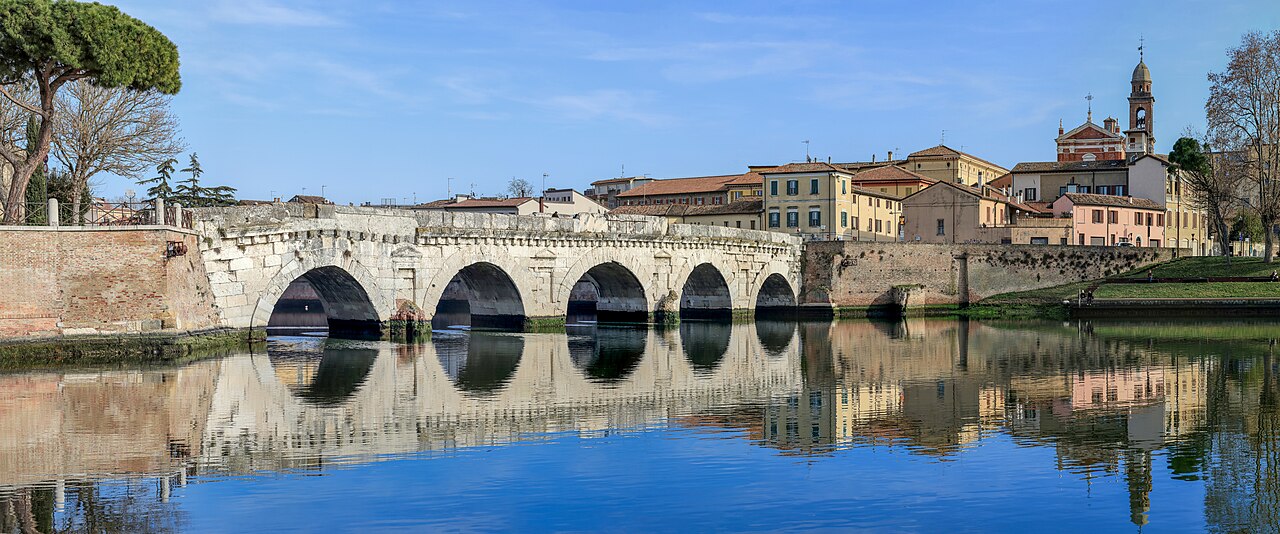
Not to see “everything.” You don’t understand Rimini by ticking monuments off a list. You understand it better when you cross it on foot, without rushing, passing from the water of the Ponte di Tiberio to the colorful houses of Borgo San Giuliano, then into the historic center and finally towards the porto canale.
This itinerary is designed just like that: a free morning, a relaxed pace, close stops, no complicated logistics. It works if you’re a couple, if you want to take photos without wasting time, if you’ve already seen the beach and want to understand a bit more of the real Rimini.
It’s not a guidebook route with fifty things to memorize. It’s a practical walk. You can do it in two and a half hours if you go straight through. It becomes a full morning if you stop for a coffee, a photo, a light lunch, or just to look around a bit more.
The Route in Brief
The ideal loop starts at the Ponte di Tiberio, enters Borgo San Giuliano, heads back towards Piazza Cavour and the historic center, passes by the Vecchia Pescheria, and then finishes towards the porto canale.
If you have more time, you can add the Arco d’Augusto or the Domus del Chirurgo. If you only have two hours, stick to the more compact route: bridge, borgo, Piazza Cavour, port.
The important thing is not to turn it into a marathon.
Rimini is a city often described in extremes: on one side the beach, on the other the Roman monuments. In between, however, is the most interesting part, made up of passages, bridges, squares, low houses, boats, and daily life. This walk is precisely about holding those pieces together.
Recommended Duration
Allow 2 and a half hours at a normal pace.
With coffee, photos, and a break in the borgo, consider 3 hours.
With a final lunch or a museum visit, it easily becomes a half-day.
Difficulty
Easy. The route is almost entirely flat and done without a car.
The distances are short. The hardest part, if we can call it that, is resisting the temptation to keep extending the walk.
Who I Recommend It For
I recommend it to anyone coming to Rimini for the first time who wants to see something beyond the sea.
I also recommend it to those who already know Rimini but have always crossed it by car, moving from one parking lot to another without ever really putting it in order.
And I especially recommend it to couples. Because it’s a slow walk, without too many explanations, with enough beautiful corners to stop at and enough substance not to feel like just any stroll.
First Stop: Ponte di Tiberio
I would start from the Ponte di Tiberio.
Not just because it’s one of Rimini’s symbols, but because it’s the right spot to understand how the city works. On one side you have the historic center. On the other, Borgo San Giuliano. Below, you have the water. Around you, a Rimini that changes face in just a few meters.
The bridge isn’t a backdrop. It’s still there, solid, crossed, lived in. It forces you to slow down. If you arrive from the center side, stop before crossing it. Look towards the borgo. Then turn around and look towards the city. At that point, you understand that Rimini isn’t just a seaside resort: it’s an ancient city that has kept on living.
The Ponte di Tiberio is often mentioned for its Roman origins and its endurance over time. But the thing that interests me most, when I pass by, is something else: it’s a bridge that doesn’t feel locked in a display case. It’s not an isolated monument. It’s part of everyday life.
Morning is the best time to see it. There’s less chaos, the light is softer, and you can cross it without feeling swept along by the flow.
If you feel like taking a photo, don’t just take it from the center of the bridge. Go down towards the water and try looking at it from the side. From there, the bridge gains depth, and the borgo in the background helps tell the scene better.
Second Stop: Borgo San Giuliano
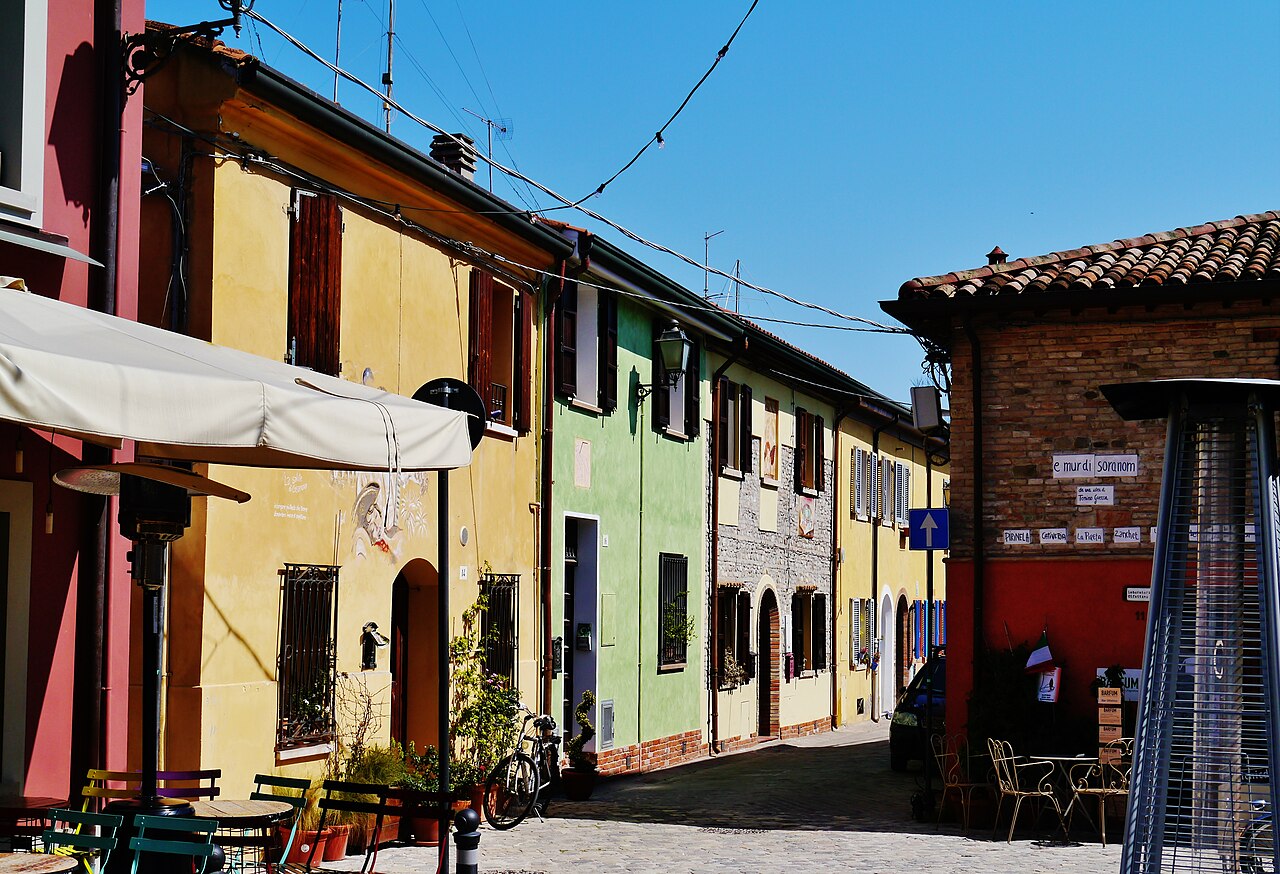
Once you’ve crossed the bridge, enter Borgo San Giuliano.
Here, the advice is simple: don’t immediately look for the perfect street. Let yourself be led by the small roads. The borgo is compact, so you’re not really at risk of getting lost. The risk, if anything, is the opposite: crossing it too quickly.
Borgo San Giuliano has a popular history, tied to the fishermen’s houses and a humbler Rimini compared to the central squares. Today it’s one of the most photographed places in the city, also for its murals and its connection to Fellini. But if you only see it as the “mural district,” you miss half its charm.
The beautiful part is the whole: low houses, colors, signs, courtyards, windows, small details. Not every corner needs to be famous. In fact, the best views are often the ones without a sign.
I’d do this: enter from the bridge, take a side street, wander without rushing, then head back towards the livelier part. If it’s early morning, the borgo still has a domestic rhythm. Someone is opening up, someone is passing by on a bike, some tables are being set up for the day.
Don’t expect a perfectly neat medieval village. San Giuliano isn’t that. It’s more interesting precisely because it has remained a place with a lived-in soul. Beautiful, yes. But not fake.
If you want to stop, do it here. A coffee in the borgo makes more sense than many rushed stops. It allows you to turn the itinerary into a real morning, not just a sequence of photos.
Third Stop: Return to Piazza Cavour
After Borgo San Giuliano, head back towards the bridge and re-enter the historic center.
Here, Rimini changes again. In a few minutes, you go from a working-class neighborhood to a monumental square. Piazza Cavour is one of the best places to read this transformation: palaces, porticoes, a fountain, city life.
You don’t have to know everything. But a few details help.
The Fontana della Pigna, for example, is one of those places many see without looking. The Comune di Rimini also recalls the visit of Leonardo da Vinci, who in 1502 observed the sound of the fountain’s water. Now, that’s the kind of detail that changes a square: it doesn’t just make it beautiful, it makes it denser.
Stop in Piazza Cavour and look at it as if it were an outdoor room. It’s not just a stop between the bridge and the rest. It’s a point where Rimini presents itself as a city, not a holiday destination.
From here, you can choose.
If you’re short on time, head towards the Vecchia Pescheria and then down towards the port.
If you have more time, you can extend towards the Arco d’Augusto or the Domus del Chirurgo. Both are useful stops for understanding Roman Rimini, but I wouldn’t necessarily fit them into a short morning. Better to do fewer things and remember them, than to do everything and take nothing away.
Fourth Stop: Vecchia Pescheria and the Lived-In Center
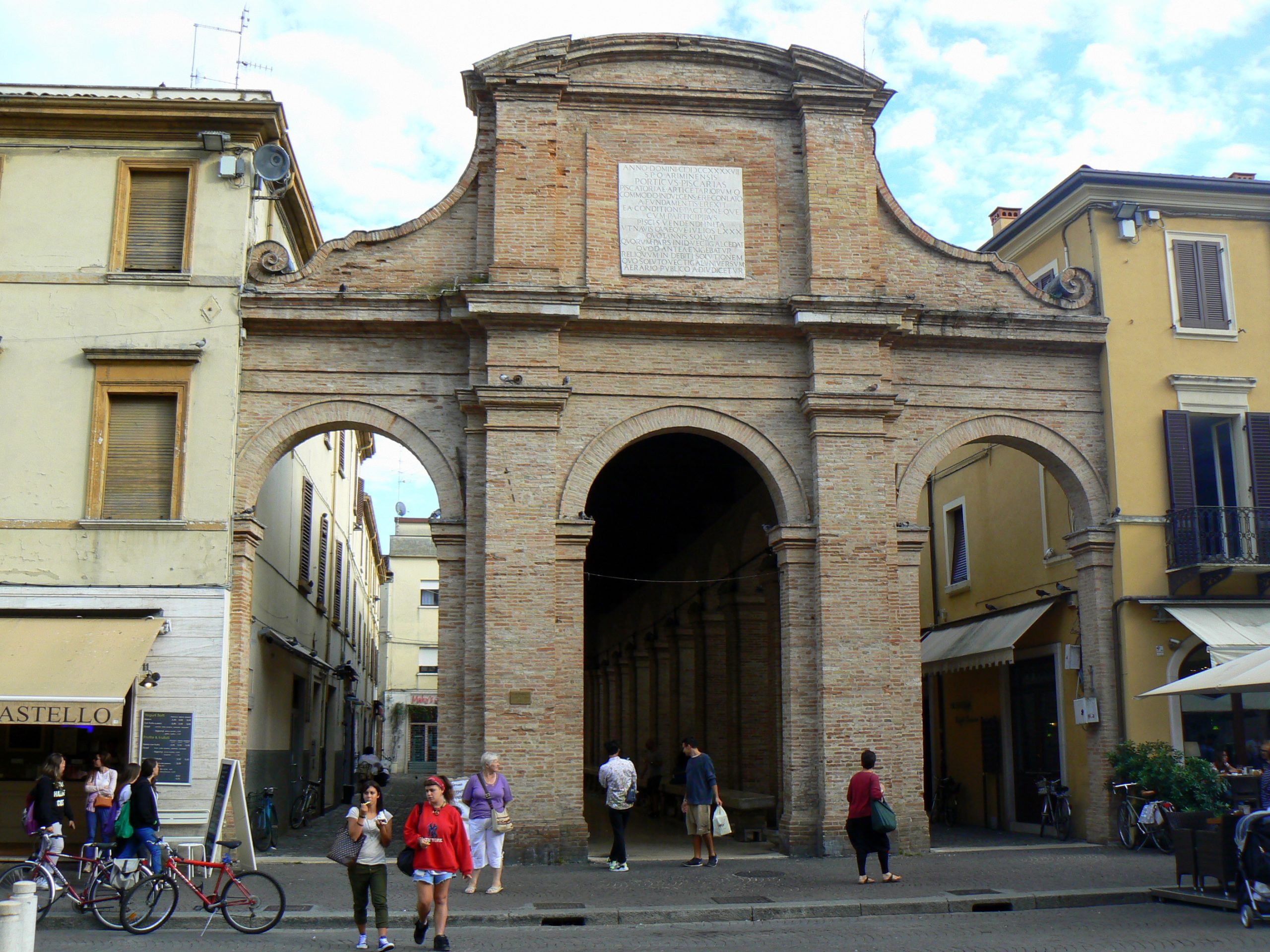
From the square, pass by the Vecchia Pescheria.
I have a soft spot for this place. Because it tells one thing well: Rimini isn’t just what it seems now. A place born for the fish market can, over time, become one of the most beautiful corners of the center. And it doesn’t necessarily lose its identity. It changes it, it layers it.
The Vecchia Pescheria is perfect for a morning walk because it lets you see the center without reducing it to shop windows and monuments. It’s a place of passage, very lively in the evening, but also capable during the day of giving you a sense of how the city has always mixed commerce, social life, and the sea.
If you’ve already read the article dedicated to the Vecchia Pescheria, you can find many details here. If you haven’t read it, just remember one thing: don’t walk through it distractedly.
Look at the structure. Imagine the fish, the stalls, the voices. Then look at what it has become today. This is one of Rimini’s keys: many places haven’t stayed the same, but that doesn’t mean they’ve stopped telling a story.
From here, you can take a short break. A coffee, a water, something simple. The free morning shouldn’t become a chore.
Fifth Stop: Towards the Porto Canale
When you’ve finished your tour of the center, head down towards the porto canale.
This ending is important to me. If you start from the Ponte di Tiberio and finish at the port, you hold together two different waters: the historic one of the bridge and the more maritime one of the canal. And Rimini becomes again what it has always been: a city of passages.
The porto canale shouldn’t be seen as just any addition. It’s the point where the walk stops being just the historic center and returns towards the sea, but without immediately falling back into the postcard of the beach.
Here you find boats, light, a more open air. If you arrive in the late morning, it can be the right place to close the loop before lunch.
The lighthouse and the port area tell a concrete Rimini, less decorative. You don’t need long explanations: just walk, look at the boats, follow the canal, and feel the change in atmosphere.
If you want to extend further, you can head towards the sea area. But for this itinerary, I’d stop before that. The strength of the route is precisely its balance: enough center, enough borgo, enough water. Without trying to cram in all of Marina Centro too.
Short Variation: If You Only Have Two Hours
If you only have two hours, cut without guilt.
Do this:
- Ponte di Tiberio.
- Borgo San Giuliano.
- Piazza Cavour.
- Vecchia Pescheria.
End.
If you’re planning a holiday in Rimini
Download the free mini guide with 7 corners to see in Rimini.
Don’t go to the port. Don’t add the Arco. Don’t try to fit in the Tempio Malatestiano, the Domus, and the seafront. Rimini isn’t going anywhere.
This short variation works well if you have a morning before check-out, if you need to get back to the hotel for lunch, or if you’re traveling with someone who doesn’t feel like walking too much.
The important thing is to keep the right pace. Each stop needs at least a few minutes to breathe. If you arrive, take a photo, and leave, everything will seem smaller than it is.
Complete Variation: If You Have Three and a Half Hours
If you have three and a half hours, you can add two detours.
The first is the Arco d’Augusto. It makes sense if you want to round out the Roman side of the city and see one of the most recognizable entrances to the historic center.
The second is the Domus del Chirurgo. It makes sense if you’re interested in a more archaeological, quieter, less immediate Rimini. On a summer morning, it can also be a smart break from the heat.
But I wouldn’t force both in at all costs. Choose one. The itinerary should remain a walk, not a race.
If you choose the Arco, the walk becomes more open and urban.
If you choose the Domus, it becomes more cultural and intimate.
It depends on what you’re looking for.
Where to Start If You’re Sleeping by the Sea
If you’re staying in the sea area, you can reach the Ponte di Tiberio on foot only if you feel like walking even before the itinerary starts. Otherwise, use the Metromare, a bus, or a bike.
Don’t complicate your life with the car if you don’t need to. The center can be inconvenient to manage with parking and traffic, especially in high season. This walk is designed precisely to be easy without a car.
If you start from Marina Centro, you can also do the route in reverse: porto canale, historic center, Piazza Cavour, Ponte di Tiberio, and Borgo San Giuliano. It works just as well.
I prefer starting from the bridge because it’s clearer from a narrative point of view. But if the port works better logistically for you, that’s fine too.
When to Do It
The best time is early morning.
In summer, starting around 8:30 or 9:00 AM changes everything. You’ll find less heat, less chaos, and gentler light. If you start at 11:00 AM in July, the walk is still possible, but it becomes more tiring and less pleasant.
In spring and autumn, you can take it more leisurely.
In winter, on the other hand, this route has a different charm. Fewer people, colder colors, a quieter borgo. It’s not the brochure Rimini, but it’s often the one that stays with you the most.
If it’s lightly raining, the walk can still work, especially in the center and borgo parts. If it’s raining hard, it’s better to postpone or turn it into a shorter route with an indoor break.
Where to Stop for a Break
I won’t give you an endless list of places, because they change, open, close, and risk making the article outdated.
Instead, I’ll give you a practical rule.
If you want a slow break, stop in Borgo San Giuliano.
If you want to stay in the heart of the center, stop between Piazza Cavour and the Vecchia Pescheria.
If you want to finish with a sea breeze, wait for the porto canale.
The choice depends on the kind of morning you want. Borgo is more intimate. Center is more urban. Port is more open.
For a couple, I’d choose the borgo or the port. They are the two moments when the walk breathes the most.
Why This Walk Works
It works because it doesn’t try to sell you a Rimini different from what it is.
It doesn’t say: forget the beach.
It says: before going back to the beach, take a morning to look at the rest.
Rimini is a layered city. Roman, working-class, maritime, touristy, everyday. If you only stay on the seafront, you see one part. If you enter the center but don’t go towards the borgo, you see another. If you reach the port, you understand that the sea isn’t just beach clubs.
This itinerary brings these things together without lecturing.
You walk and you notice.
First the bridge. Then the houses of the borgo. Then the square. Then the market turned into a living room. Then the port.
It’s a readable Rimini. Not complete, but readable.
Practical Information
Recommended start: Ponte di Tiberio.
Recommended end: Rimini porto canale.
Duration: 2 and a half hours, 3 hours with a break.
Approximate distance: about 3-4 kilometers, depending on detours.
Difficulty: easy.
Recommended transport: on foot.
Best time: spring, early summer, September, or early morning in the height of summer.
Cost: free, except for any museums, coffees, or extra visits.
Parking: better to avoid the car if you’re already starting from Rimini’s seaside or a served area. If coming from outside, look for parking on the edges of the center and then move on foot.
With children: doable, but this itinerary is mainly designed for adults and couples. With small children, plan more frequent breaks and cut the port if they are tired.
FAQ
What to see in Rimini in one morning?
If you have just one morning in Rimini, choose a compact route: Ponte di Tiberio, Borgo San Giuliano, Piazza Cavour, Vecchia Pescheria, and, if you have time, the porto canale. It’s an easy walk, all on foot, that lets you see the historic center, the borgo, and the maritime identity without needing a car.
How much time do you need to visit the center of Rimini on foot?
For a first tour of the center of Rimini, allow at least two hours. If you want to include Borgo San Giuliano, a coffee break, and the porto canale, consider three hours. With museums or indoor visits, the walk becomes a half-day.
Can you visit Rimini without a car?
Yes. The historic center, the Ponte di Tiberio, Borgo San Giuliano, and the porto canale are well suited for a walking itinerary. If you’re staying in the sea area, you can reach the center by public transport, bike, or a longer walk.
What is the best time to do this itinerary?
In summer, it’s best to start early, between 8:30 and 9:00 AM. You avoid the strongest heat and find a quieter Rimini. In spring and autumn, you can do it later too. At sunset it works well, but it becomes more of an evening stroll than a free morning.
Is the itinerary suitable for a couple?
Yes, it’s one of the best ways to experience Rimini as a couple without organizing a complicated day. The route alternates beautiful views, history, borgo, squares, and water. It’s not too long and leaves room for spontaneous breaks.
Where is the best place to stop for a break?
For an intimate break, choose Borgo San Giuliano. To stay in the city’s heart, stop between Piazza Cavour and the Vecchia Pescheria. To finish with a sea breeze, wait for the porto canale.
Sources Used
- Rimini Turismo, Ponte di Tiberio e Borgo San Giuliano: https://riminiturismo.it/ponte-di-tiberio-borgo-san-giuliano
- Rimini Turismo, Borgo San Giuliano: https://riminiturismo.it/cosa-vedere/arte-e-cultura/borghi/borgo-san-giuliano
- Rimini Turismo, Faro e antico porto canale: https://riminiturismo.it/cosa-vedere/arte-e-cultura/fontane-ponti-canali/il-faro-e-lantico-porto-canale
- Comune di Rimini, Fontana della Pigna: https://www.comune.rimini.it/vivere-il-comune/luoghi/area-archeologica/la-fontana-della-pigna
- Travel Emilia Romagna, Rimini in 10 tappe a piedi: https://www.travelemiliaromagna.it/rimini-cosa-vedere-in-10-tappe/
Conclusion
A free morning in Rimini can become something small and beautiful.
You don’t have to fill it up too much. You don’t have to see everything. You just have to choose a thread and follow it.
The Ponte di Tiberio starts you off from ancient Rimini. Borgo San Giuliano takes you into a popular, colorful Rimini. Piazza Cavour and the Vecchia Pescheria put you back in the heart of the city. The porto canale gives you back the water, the boats, the open air.
In a few hours, you take away a more complete Rimini. Not definitive, of course. But more yours.
And then you can go back to the sea with a different idea of the city.
You know where to find me. At Aqua Hotel.