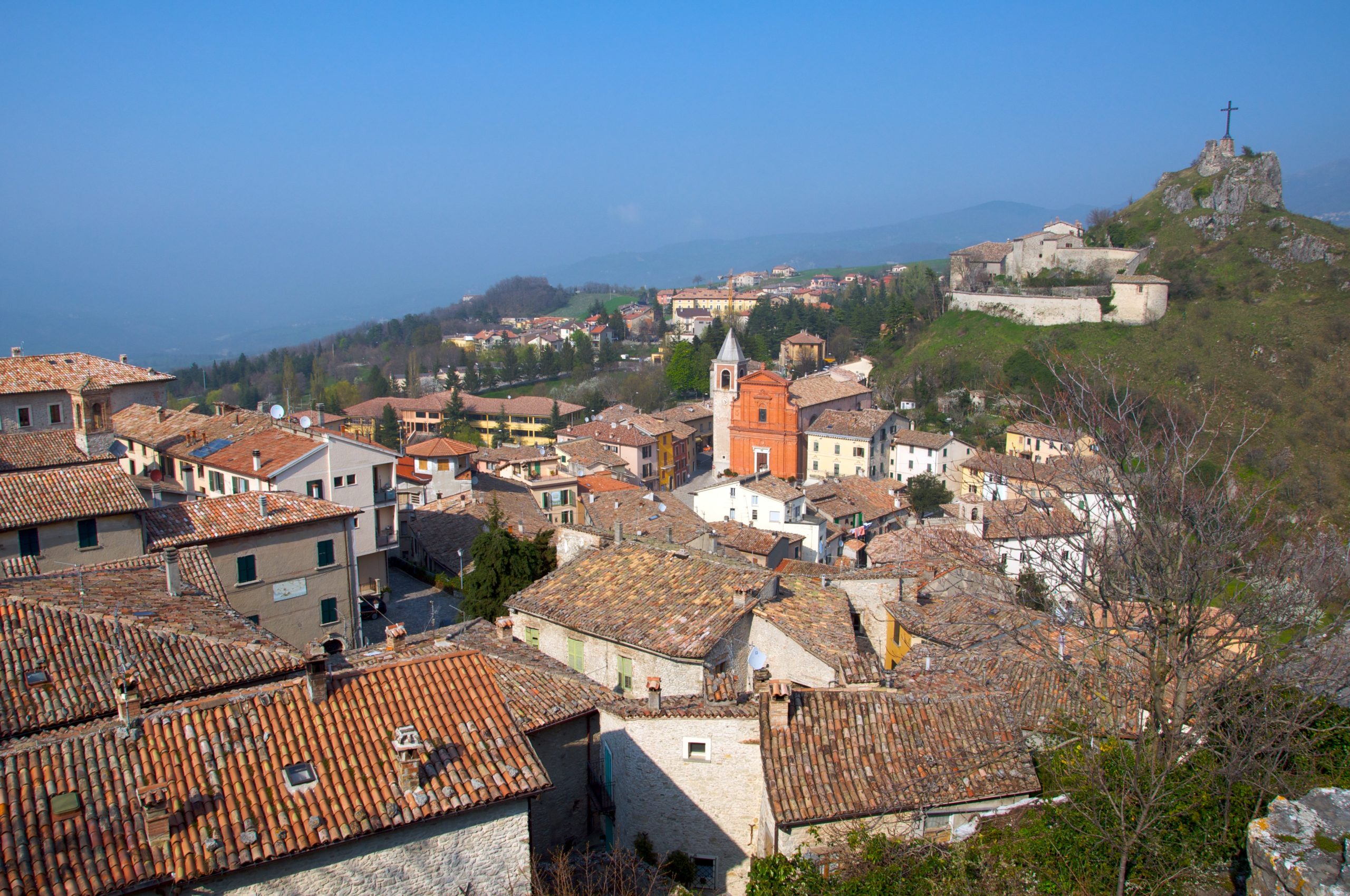
There’s a place, at the top of the Marecchia Valley, 629 metres above sea level, where two hills grip each other like the fingers of a hand holding a secret.
It’s called Pennabilli. La Penna in Romagnol dialect. The name itself tells you everything: two steep hills, two communities born on the rock, a story that comes from afar.
The second highest town in the province of Rimini after Montecopiolo. The second southernmost in all of Emilia-Romagna, preceded only by Casteldelci. 2,705 inhabitants, 69.66 square kilometres of territory. A density of 38 inhabitants per km² — here, space is not lacking.
The area is part of the Sasso Simone and Simoncello Regional Nature Park and the Alta Valmarecchia Mountain Community. Green, rock, wind. The most authentic landscape of the Rimini Apennines.
Few know it. Almost no one passes through by chance. And yet — and this is the beautiful part — if you look at the face of the most famous duke of the Renaissance, the one that thousands of tourists photograph every day at the Uffizi, Pennabilli is there.
On his face.
Federico’s Moles
Take Piero della Francesca’s Double Portrait of the Dukes of Urbino. Oil on panel, 47×66 cm, dated between 1465 and 1472. Federico da Montefeltro in profile, aquiline nose, steady gaze, an infinite landscape behind him. Battista Sforza on the other side. It is the icon of the Renaissance, you know it, you have seen it a thousand times.
Look closely. Next time you pass by, stop.
On Federico’s face there are moles. Small dark marks on the painted skin. They are not there by chance. Piero della Francesca did nothing by chance. He was a painter, yes, but he was also a mathematician. A geometrician of light. The first to write a treatise on perspective. Nothing in his paintings is decorative.
In 2019, a study entitled The Face of Montefeltro. Federico Duke of Urbino and Piero della Francesca proved something that sounds absurd. It took an entire book (ISBN 9788898843909, author Nicola Mordini) to explain it: the moles painted on Federico’s face, if overlaid on a map of Montefeltro, perfectly match the cities. Every mole is a place. Urbino. San Leo. Pennabilli. Carpegna, Cantoniera Pass. Places that were fundamental in the duke’s life.
One of those moles represents Pennabilli. Because Pennabilli represented Federico da Montefeltro’s definitive victory over his greatest enemy: Sigismondo Pandolfo Malatesta.
Piero della Francesca tattooed Pennabilli on Federico’s face. Four centuries before tattoos existed.
Penna and Billi: Two Hills, One Village
But the story of Pennabilli begins long before Federico. Long before everything.
The first human settlements in the area date back to Etruscan and Roman times. Archaeological finds confirm this. Then the barbarian invasions came, and the people living along the Marecchia River fled, seeking refuge higher up. Two steep hills became their shelter. Today we call them Roccione and Rupe. Back then they had no name yet.
On one of these, Penna is born. From Latin pinna: peak, summit. On the other, Billi grows. From bilia: treetop. Two place names that tell the conformation of the hills better than any description.
Penna develops as a village, with its houses, its square, its people. Billi becomes a Malatesta stronghold. Two separate communities. Two castles. Two stories watching each other from afar.
The first official mention dates to 962. We are in the heart of the Middle Ages. Emperor Otto I of Saxony grants the area as a fief to the counts of Carpegna. The two villages then pass under the jurisdiction of the Massa Trabaria, an ancient territorial district of Montefeltro.
Then, in 1350, something extraordinary happens.
Penna and Billi decide to unite.
Not through war. Not through a forced marriage. Not through a treaty imposed by a lord. No. They place a stone in the market square that lies between the two settlements, right in the middle of the two hills. They call it the stone of peace. From that day on, a single circle of walls encloses the inhabited centre. Penna and Billi become Pennabilli.
The town’s coat of arms still bears a Montefeltro eagle perched on two towers. Two towers, one eagle. A symbol that says it all: unity in diversity, two becoming one. The coat of arms is used by the municipality even without a formal decree of concession. The banner is a flag divided into blue and white. A monastery was built on the ruins of the Billi fortress.
Malatesta, Montefeltro, Medici, Papal States
If there is one constant in the history of Pennabilli, it is that someone always wanted it.
First the Malatesta, lords of Rimini, who hold Billi as a fortified outpost in the valley. Then the Montefeltro of Urbino arrive and drive them out. It is here that Federico da Montefeltro obtains his definitive victory over Sigismondo Malatesta. A battle that decides the fate of the region.
Then the Medici arrive. Then the Papal States. Pennabilli changes hands, changes masters, but remains there, on its two hills, watching time pass.
The turning point comes in 1572. Pope Gregory XIII decides to move the bishop’s seat from San Leo to Pennabilli and grants it the title of city. From that moment, Pennabilli becomes the moral capital of Montefeltro. It is still the seat of the Diocese of San Marino-Montefeltro today. A diocese that extends over two states: Italy and the Republic of San Marino.
The centuries pass. Pennabilli grows, changes, accumulates stories.
In united Italy, the municipality is assigned to the Marche region, province of Pesaro and Urbino. It stays there for almost one hundred and fifty years. Then, on 17 and 18 December 2006, the citizens vote in a referendum. They want to return to Emilia-Romagna, province of Rimini. The transfer takes place on 15 August 2009, together with six other municipalities of Alta Valmarecchia. The Marche region appeals to the Constitutional Court. The Court rejects it. Pennabilli comes home.
On 20 May 2010 it enters the Italian club of the Orange Flag, the Touring Club Italiano’s tourism quality mark.
In the first half of February 2012, the territory is one of the worst hit by an exceptional snowfall. The snow reaches three metres in the town centre. Three metres. Imagine Pennabilli under three metres of snow.
What to See Today
Today Pennabilli is a town that stands on its own. Without needing to shout.
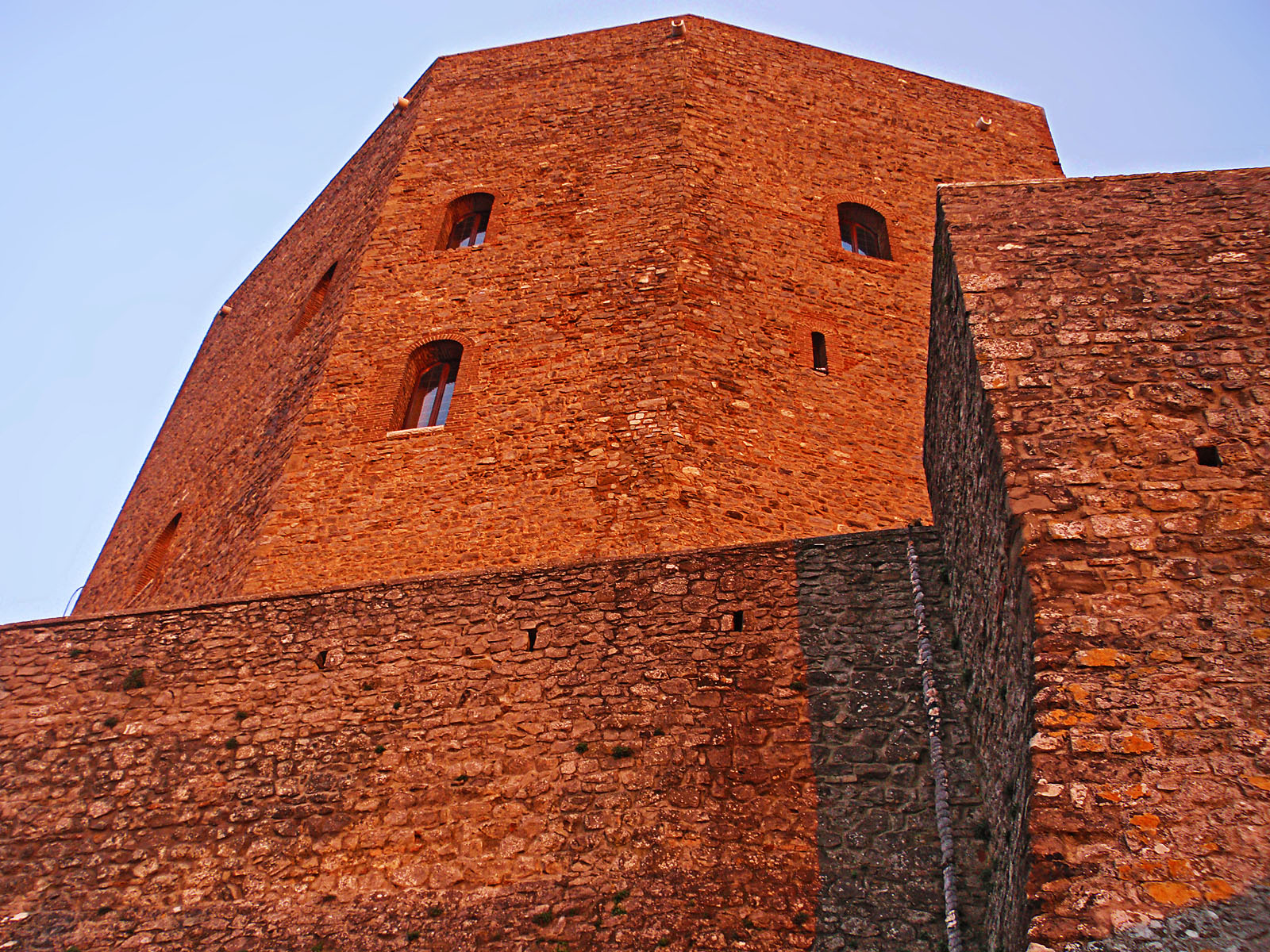
The historic centre stretches between the two original hills. On one side the Roccione, with the Malatesta walls and the tower that still rises. On the other the Rupe, with the ruins of the Billi fortress and a cross at the top. In between: porticoed squares, narrow alleys, stone palaces. Time here has a different speed.
The Cathedral of San Pio V (the Duomo) is the main church of the Diocese of San Marino-Montefeltro. Next to it, the Sanctuary of the Blessed Virgin of Grace, whose origins date back to between the 12th and 16th centuries. Further up, in the Bascio area, the Hermitage of Madonna del Faggio, part of a complex that also includes the church of San Lorenzo deacon and martyr.
Wandering around you will find:
Palazzo della Ragione, called Le Logge, with its characteristic portico. The former town hall, also with a portico. Palazzo del Bargello. Teatro Vittoria. The baronial palace of the princes of Carpegna, now a ruin, in the Scavolino hamlet. The ancient village of Molino di Bascio.
Via dei Pensieri Sospesi (Street of Suspended Thoughts). The name alone is worth the photograph. It is dedicated to Tonino Guerra, the poet and screenwriter of Fellini who fell hopelessly in love with Pennabilli.
The Malatesta walls run along via della Vigna, via dei Pensieri Sospesi and via del Roccione. The tower is particularly noteworthy. The so-called Castle of Penna is a characteristic section of the Malatesta Walls. Then there is the Tower of Maciano, in the hamlet of the same name, and the Tower of Bascio, in the Molino di Bascio area.
The Museums
Pennabilli has a museum heritage you would not expect from a town of 2,700 souls.
Mateureka — Museum of Calculation. One of the few museums in the world and the only one in Italy dedicated to the history of mathematics and calculating instruments. Housed in the halls of the ancient town hall. A unique place, worth the trip on its own.
Diocesan Museum of Montefeltro “A. Bergamaschi”. Also housed in the ancient town hall.
Natural History Museum of the Sasso Simone and Simoncello Park. To understand the nature surrounding Pennabilli.
The World of Tonino Guerra. Museum located in the premises of the church of the Misericordia. Dedicated to the great poet and screenwriter from Santarcangelo who chose Pennabilli as his adopted homeland.
The Places of the Soul
And then there is the masterpiece. The diffused museum “Places of the Soul”, conceived by Tonino Guerra. Seven artistic installations scattered around the town and its surroundings. Free admission every day.
The Garden of Forgotten Fruits. Artistic installations coexist with varieties of fruit trees that no farmer cultivates anymore: cuccarina, quince, jujube, gooseberry, biricoccolo. Fruits of a bygone era, which almost no one remembers anymore.
The Street of Sundials. Seven sundials placed on the facades of some buildings, each representing a different method of measuring time in past centuries.
The Shelter of Abandoned Madonnas.
The Sanctuary of Thoughts. Houses seven stone sculptures created by Tonino Guerra.
The Angel with the Moustache. An installation representing an angel. Next to it, verses by Tonino Guerra. It is located inside a church.
The Petrified Garden. In the Castello di Bascio area. At the base of a tower, seven ceramic art rugs decorated by Giovanni Urbinati have been placed.
The Madonna of the Snow Rectangle. In the Poggio Bianco area.
And then there is the connection with Tibet. Father Francesco Orazio della Penna, a Capuchin friar who left Pennabilli in the 18th century to found a Catholic mission in Lhasa. He brought the first movable-type printing press to Tibet. He wrote the first Italian-Tibetan dictionary, later also translated into English. In 1994, Tenzin Gyatso — the 14th Dalai Lama — visited Pennabilli to celebrate the 250th anniversary of the missionary’s death. He unveiled a plaque on the facade of the friar’s birthplace. He returned a second time in 2005 to inaugurate a metal structure on the hill overlooking the town: a bell (a cast of the original from the mission in Tibet) flanked by three Tibetan prayer wheels, manikorlo, freely operable by visitors. The wheels bear the Buddhist mantra Om Mani Padme Hum in relief. A bell and three prayer wheels on the Romagnol Apennines. Something you would not believe.
Events and Traditions
Artists in the Square. International festival of performing arts. Since 1997 it takes place every year between the end of May and the beginning of June. Street artists from all over the world.
National Antiques Market Exhibition. One of the most important historical exhibitions in Italy. Since 1970 it takes place every July, in the shops and palaces of the historic centre.
Procession of the Jews. Re-enactment of the Via Crucis that takes place on Good Friday. The procession starts from the church of the Misericordia and parades from the castle of Penna to that of Billi. At the end, the representation of the passion of Jesus. A tradition that has been repeated for centuries.
In the area, craft activities are widespread: embroidery and weaving, with the production of rugs and woollen blankets embellished with decorative elements inspired by the pastoral world.
Travel Notes
Getting there: From Rimini, take the Valmarecchia road (SS258). About 50 kilometres, one hour by car. The road climbs, winds, offers curves and glimpses of the Marecchia River. You arrive and the air is already cooler, your breath changes.
Where to eat: Romagnola mountain cuisine. Mushrooms, truffles, cheeses. Ask for passatelli in broth and fossa cheese. Here you eat like real farmers, not like tourists.
When to go: In spring, when the Garden of Forgotten Fruits is in bloom and the colours of the Sasso Simone Park explode. Or in July, for the National Antiques Market Exhibition. Or in June, for Artists in the Square. Or in February, if you have the courage to face three metres of snow.
The surroundings: The Marecchia Valley deserves a full day. San Leo with its fortress. Verucchio, homeland of the Malatesta. Santarcangelo, the city of Tonino Guerra. And Pennabilli, up there at the top, waiting.
If you feel like seeing Pennabilli with your own eyes, I understand. I live an hour away by car, and when I can I sneak up there. It is one of those places that get inside you without you even noticing.
Then, for the night, you know where to find me.
At the Aqua Hotel in Rimini, on the way back. A hot shower, a comfortable bed, and the next morning you are off to explore another piece of the hinterland. I will arrange it for you.