You walk down Corso d’Augusto. You pass under the Arch. You grab a coffee, maybe glance at the paper.
You have no idea you’re walking across a battlefield.
Right here, in the summer of 1944, the longest and most costly battle in Italy since Monte Cassino was fought. Thirty days of fire. One million four hundred and seventy thousand artillery shells. Eleven thousand five hundred air sorties in a single month.
And almost nobody in Rimini ever talks about it.
Numbers that should stop you cold
Try this. Picture a football pitch. Now imagine it carpeted with shell casings — every centimeter covered.
It wouldn’t be enough. They wouldn’t fit.
1,470,000 artillery shells were fired at Rimini and its surroundings between August 25th and September 21st, 1944. That’s the official figure, drawn from Allied war diaries. But behind every number is a house collapsing, a street disappearing, a neighborhood that ceases to exist.
Air sorties? 11,510 in thirty days. Nearly 400 a day. Every two minutes, a plane flew over this city.
And the dead. At least 12,000 soldiers killed — Allied and German — in four weeks of fighting on the Rimini front. Plus 6,668 civilian casualties.
These were numbers that, in September 1944, had a precise name: Operation Olive.
The operation nobody explains
On August 25th, 1944, Operation Olive was launched. It was the Allied plan to break through the Gothic Line — the German defensive fortification that Field Marshal Albert Kesselring had built across the Apennines, from La Spezia to Pesaro, to stop the advance into northern Italy.
Rimini was the key. The gateway city that opened the Po Valley.
If Rimini fell, the road to Bologna and the Po was open. If Rimini held, northern Italy would remain in German hands through another winter.
The Allies knew it. Kesselring knew it. Every soldier marching toward the Adriatic coast in that hottest August of the century knew it.
What didn’t know was the city itself. Rimini had been largely evacuated. Those who remained — the poor, the elderly, those with nowhere to go — hid in cellars, listening to the artillery grow closer in the night, and waited.
The forces: a whole army for one city
On the Allied side: the 1st Canadian Corps — with the 1st Canadian Armoured Division and the 5th Infantry Division. Alongside them, the 2nd New Zealand Division, veterans of Africa and Cassino. And then — a detail few people know — the 3rd Greek Mountain Brigade.
Men from three different continents, coming to liberate a city most of them had never heard of before that summer.
On the other side, the Wehrmacht. Elite German divisions dug into the hills, the houses, the churches. The Panzer Grenadier Regiment 104. The 1st Parachute Division — the Green Devils, as the Allies called them. Experienced, motivated soldiers fighting for every meter of ground.
The German command knew Rimini was the key. And had no intention of giving it up.
Thirty days, kilometer by kilometer
The Allied advance started from the sea. The Canadians pushed up the Adriatic coast, under German artillery fire from the Marecchia hills. The New Zealanders attacked from the west. The Greeks fought in the center.
Every stream became a defensive line. Every hill, a fortress. The Germans fell back only when they had no choice — retreating in good order, leaving rearguards and anti-tank mines on every road.
The Battle of Rimini wasn’t a blitz. It was an exhausting month-long close-quarters fight.
San Fortunato della Collina. Coriano. Croce. Santarcangelo. Names of villages that in 1944 became military objectives, theaters of battles that cost hundreds of lives for a few kilometers of advance.

On September 13th, the Canadians reached San Fortunato. From there, you could see Rimini. But it would take another eight days to get there.
The city that was no longer there
When the first Allied soldiers entered Rimini on September 21st, 1944, they found a city that barely existed anymore.
82% of buildings were destroyed or severely damaged. Not rhetorical exaggeration — the official estimate from Allied military engineers, recorded in Canadian Royal Engineers’ reports.
The historic center was rubble. Corso d’Augusto — the same street where you grab coffee today — was unrecognizable. Via Gambalunga, Via Vittime Civili, Piazza Ferrari — street names that in September 1944 were piles of debris.
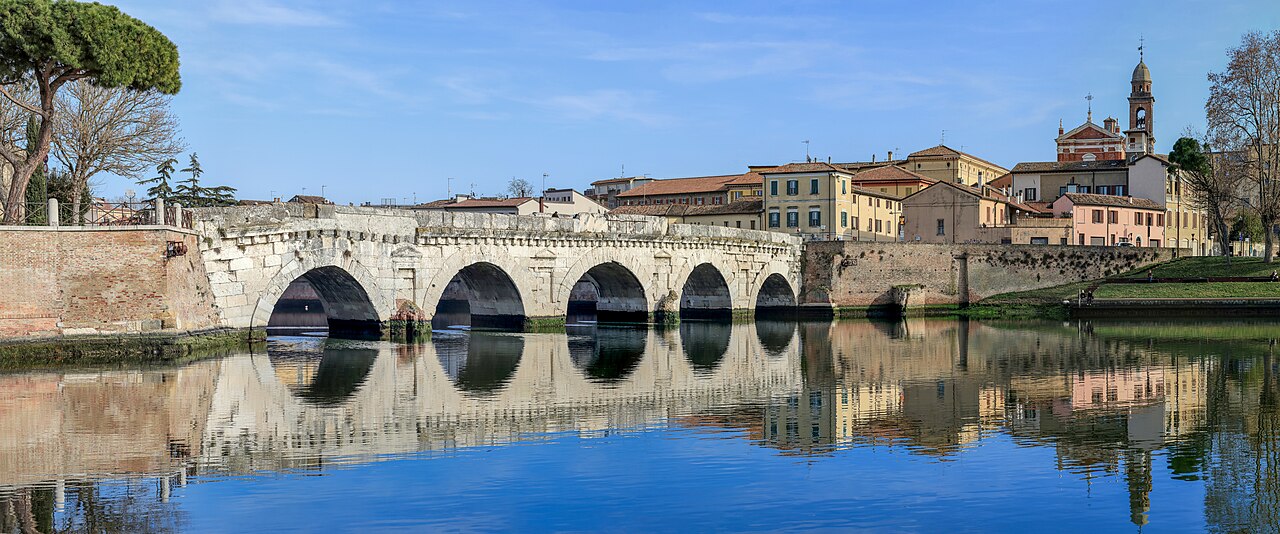
The Arch of Augustus, almost miraculously, was still standing. As was the Bridge of Tiberius. As if Roman history refused to disappear even under the bombardments of modern history.
But the rest of the city was gone.
373 air raids in six weeks. Bombs falling with the precision possible in 1944 — which is to say, very little. Every military target took a civilian neighborhood with it. Every factory, a piazza. Every strategic intersection, a church.
The silence that weighs
I did something a few weeks ago. I walked through the center of Rimini and asked people I know: “Do you know how many shells were fired at this city in 1944?”
Nobody could answer. Some guessed “a lot.” One person said “well, there were bombings.”
Nobody — nobody — knew the number. 1,470,000. One million four hundred and seventy thousand.
It’s not their fault. Rimini 1944 isn’t taught in schools. In Italian history books, the Gothic Line is a footnote. Operation Olive isn’t in the curriculum.
They taught us Cassino. They taught us Normandy.
But Rimini — the city that paid the highest price in Italy to open the road north — has no place in the collective narrative of the Second World War.
That silence weighs on me.
Where memory still holds
But the places are there. The ones that speak, if you know how to listen.
Largo Giulio Cesare: a bronze plaque, inaugurated in October 2004 with 200 Canadian veterans. Also present was Adrienne Clarkson, Governor General of Canada. A head of state coming to Rimini to remember her fallen. The text etched in bronze lists the units, the days, the numbers. It’s there, every day, while people walk past without looking up.
Parco Cervi: along the Roman walls, another memorial stone. Less visible, more tucked away. Few seek it out. But those who find it understand: this city was the border between two worlds.
The Rimini War Cemetery: on the Covignano hill, the British Commonwealth cemetery holds 617 fallen. Graves lined up, name by name, age by age. Twenty-three, twenty-seven, nineteen. Men who came from the other side of the world to liberate an Italian city.
And there’s the piazza in front of the Arch of Augustus. If you stop here in the evening, when the tourists are few and the light is low, you feel something different. I can’t explain it rationally. It’s the weight of what happened here. The sense that this place has already seen the worst — and survived.
Why it matters to remember now
This isn’t military nostalgia. It’s not a glorification of war.
It’s that a city that doesn’t know its own history risks not understanding who it is.
Rimini today is a normal city — lively, loud in summer. But beneath the tiles of the center, beneath the asphalt of Corso d’Augusto, something of that September 1944 remains. The layer of ash and rubble that surveyors found when building new apartment blocks in the 1950s and 60s.
The city was rebuilt brick by brick. That wasn’t a given. It could have not made it.
It made it because someone — thousands of someones, from Canada, New Zealand, Greece, Poland, South Africa — decided it was worth fighting for.
1,470,000 shells. 11,510 air sorties. 12,000 fallen.
For this city. For this piazza. For this morning coffee under the Arch.
Maybe it’s worth looking up, every now and then, at that bronze plaque.
FAQ — The Battle of Rimini 1944
When did the Battle of Rimini take place in World War II?
The Battle of Rimini took place from August 25th to September 21st, 1944, as part of Operation Olive — the major Allied offensive to break through the German Gothic Line on the Adriatic front.
How many shells were fired during the Battle of Rimini?
1,470,000 artillery shells were fired at Rimini and its surroundings, along with 11,510 air sorties over approximately thirty days — one of the most intense bombardments of the entire Italian campaign.
Who liberated Rimini in 1944?
Rimini was liberated on September 21st, 1944 by an Allied force composed primarily of the 1st Canadian Corps, the 2nd New Zealand Division, and the 3rd Greek Mountain Brigade. The German surrender was signed by Captain Apostolakis before Colonel Tsakalotos.
How much of Rimini was destroyed during the war?
82% of Rimini’s buildings were destroyed or severely damaged by the end of the battle in September 1944, according to official Allied military engineering estimates. The city suffered 373 air raids between 1943 and 1944.
Where are the monuments dedicated to the Gothic Line in Rimini?
The main memorial sites of the Gothic Line in Rimini are: the bronze plaque at Largo Giulio Cesare (inaugurated in October 2004 with 200 Canadian veterans), the memorial stone in Parco Cervi along the Roman walls, and the British Commonwealth War Cemetery on the Covignano hill with 617 fallen.
You know where to find me. At the Aqua Hotel, in Marina Centro. If you’re coming to Rimini to discover this history — and there’s enough of it to fill a whole week — you’ll have a good base to start from.