The fog always comes at night.
In the film, old Titta’s grandfather steps outside. He knows these streets — he’s walked them all his life, the streets of the Borgo, the streets of a Rimini in the 1930s that still carried the layers of a medieval city beneath its twentieth-century arcades. He walks. He turns. He stops.
The fog is thick. That Romagnol fog that arrives from the Marecchia river in winter and swallows everything — the street lamps, the walls, the voices.
And he — bewildered — thinks he doesn’t seem to be anywhere at all.
It’s a scene from Amarcord. One of those that stays with you even if you’ve never been to Romagna, even if you don’t know what it means to walk in November when the sea is grey and the plain is white with nothing.
Fellini never filmed that scene in Rimini.
He never filmed anything in Rimini.
Not a single metre of film in his hometown. Everything rebuilt at Cinecittà, in Rome, in the studios where he’d worked for decades. Yet — and this is the paradox that still fascinates me, after more than twenty years living in this city — when you walk through Borgo San Giuliano, you remember that fog. As if you were inside it.
The memory ignites.
That’s what the Borgo does.
The neighbourhood the Bridge gives you as a gift
Start from the Ponte di Tiberio — the Tiberius Bridge. The one you see in every postcard of Rimini: five white stone arches over the Marecchia river, built in AD 14 under Augustus and completed in AD 21 under Tiberius. Two thousand years on this same spot. Roman soldiers crossed it. The Malatesta lords crossed it. Napoleonic troops crossed it. Resistance fighters crossed it. Today, tourists with backpacks cross it, and locals walking their children to the park.
But don’t stop on the bridge.
Cross it.
From the medieval city side, you step onto the stone surface, look down at the Marecchia — green-grey, with gulls doing what gulls always do. Then you look up. On the other side of the river, the buildings change. The colours change.
And you arrive.
Borgo San Giuliano is right there, pressed against the ancient bridge — the “suburbio”, the suburb, the part of the city that sat on the other side of the river. Not large. Not imposing. It doesn’t greet you with a triumphal arch or a square that takes your breath away.
It gets inside you slowly.
Like certain memories you don’t know where they come from, but that have always been there.
The Provincia di Rimini’s guide to Fellini’s places calls it “one of the most Fellinian spots in Rimini.” It’s the most accurate description I’ve ever read. Not because there’s a museum, a plaque, a ticket to buy. But because when you’re inside it, something activates. Something you can’t name but recognise immediately — if you’ve seen Amarcord even once in your life.
It’s the same atmosphere. The same slanted light on the walls. The same dead-end alleys that finish on a courtyard, a wall, or — suddenly — the water of the Porto Canale.
It is a tangle of alleyways, small squares and blind alleys where the atmosphere feels like another time altogether.
The same Rimini Fellini carried inside him.
When the walls started speaking
Imagine being in the Borgo in the 1980s.
Houses were houses. Walls were walls. Osterie were osterie — places where you ate piadina (the local flatbread) on paper tablecloths and played cards until three in the morning, not restaurants with natural wine lists.
The Borgo was a working-class neighbourhood. One of those places where the Porto Canale people lived — the fishermen, the boatmen, those who worked with their hands and came home with dirty hands. Narrow houses pressed up against each other. Walls flaking where the river damp arrived every winter. Washing strung between windows. The noise of the port threading through the alleys.
It wasn’t the postcard.
It was life.
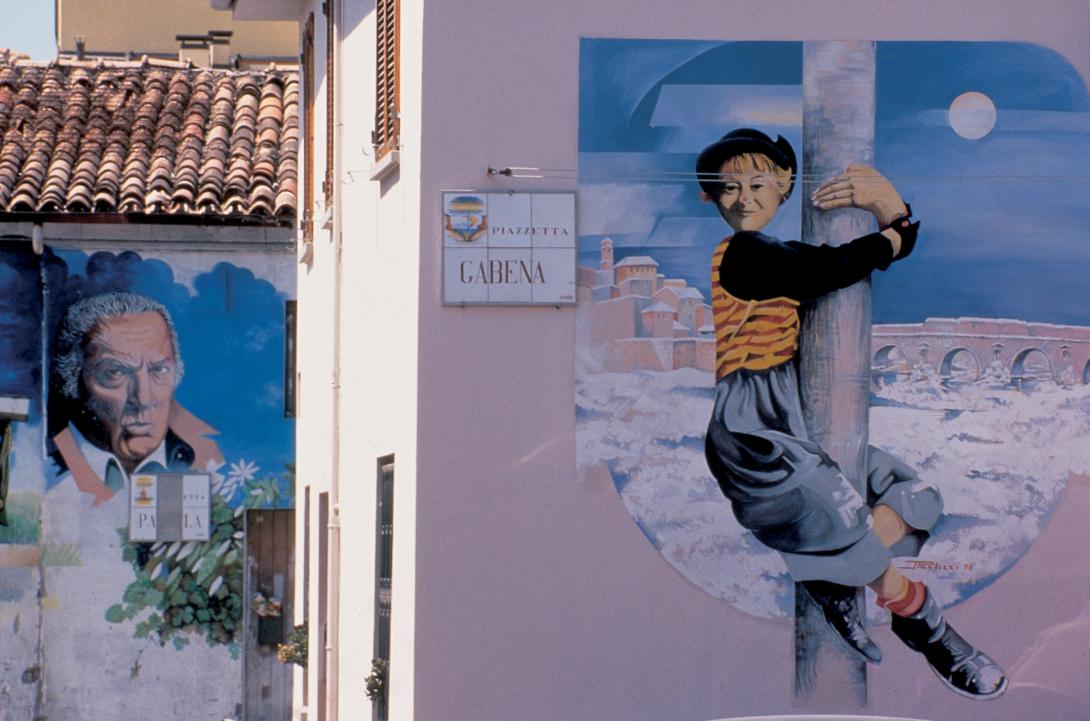
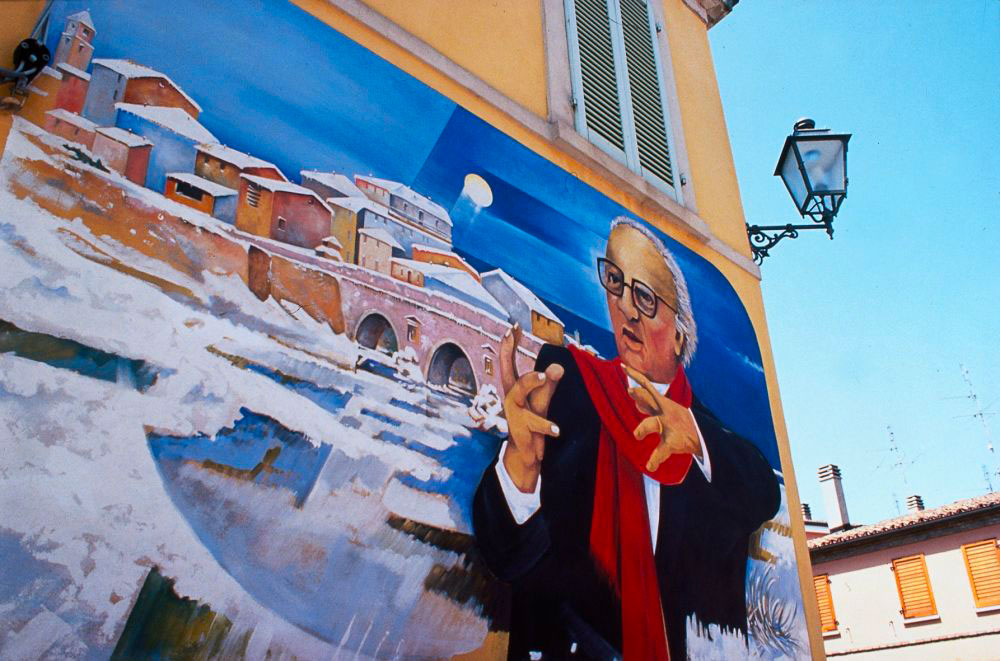
Then, on those facades — on those walls that time had worn away — the murals began to appear.
Not just any murals.
The characters from Amarcord.
It’s no coincidence they chose these walls, in this neighbourhood. Borgo San Giuliano is the Rimini that most resembles the Rimini Fellini carried within him. The one he rebuilt at Cinecittà brick by brick, character by character, nickname by nickname — fed by decades of Romagnol memory that doesn’t erase.
And so the film’s characters arrived on the walls of the Borgo.
The Rex — that enormous, white, unreal ship that appears in the film in the middle of the sea during a night celebration, while everyone rows out in their boats to watch, silenced. That ship is painted on a facade of the Borgo. Enormous. It looks like it’s about to burst out of the wall.
Ciccio Ingrassia, playing the Matto — the Madman — of Amarcord, the character who escapes from the asylum, climbs a very tall pine tree and shouts “Voglio una donna!” — I want a woman! One of the most iconic scenes in post-war Italian cinema. He’s there too, on a wall of the Borgo, watching you with that face of his that’s never completely just crazy.
And then there’s the “Scurèza ad Corpolò” — a nickname in Romagnol dialect, that habit of abbreviating, twisting, making affectionately ridiculous the names of people and places that Fellini immortalised in Amarcord. The film is full of nicknames like this. They’re the signature of the real Romagna — the one you don’t find in history books but still hear today in Riminese families when they talk among themselves.
For a while, there were also plaques on the streets of the Borgo. Plaques with the characters’ nicknames — those dialect names Fellini had gathered from his childhood and slipped into the film like an archive of Romagnol memory. Then the renovations came, the difficulty of maintaining paintings exposed to the open air, time always working against outdoor colours.
Some things were lost.
But not everything.
The alleys remain. The colours of the houses remain — that deep ochre, that brick red, that warm yellow that seems to come straight from the palette of someone who spent a lifetime watching how the light changes on the Romagnol sea from dawn to dusk. The atmosphere remains — what the official guide calls “magical and evocative” and what I would simply call: the feeling of being somewhere real.
The house with the creaking gate
In Amarcord, the protagonist is called Titta Benzi. He’s not Fellini — but in a sense he is. He’s the Riminese boy of the 1930s, the one who grows up in a typical Romagnol family, who gets into trouble at school, who dreams, who laughs, who has that fierce and slightly reckless curiosity of boys that age in that province.
Titta’s house was in the Borgo.
With the creaking gate.
With the steps in front of the front door.
It wasn’t a house invented from nothing. It was a house you could trace — or imagine tracing — walking through the streets of the neighbourhood. Inside and outside, in the spaces of the Borgo, the story of a typical Romagnol family of yesterday unfolds. When slaps were really given to unruly children, when the angry father snatched the tablecloth with everything on it, when mornings started with someone shaving while belting out opera from memory.
And then there’s the grandfather’s scene.
In the fog.
Titta’s grandfather goes outside. He can no longer find the way. He walks. He turns. He stops. The streets he has known all his life no longer exist in the fog — or perhaps it’s he who can no longer see them. And, bewildered, he thinks he doesn’t seem to be anywhere at all.
That scene was never filmed here. It was never filmed in Rimini.
But when you walk through the Borgo in November — with the wind coming off the sea, the Porto Canale silent, the neighbourhood almost empty — you understand that scene. Not the way you understand a quotation you’ve studied. The way you understand something you’ve lived.
That’s the power of real places.
A man who never returned — and never left
Here’s what has always struck me about Fellini and Rimini.
He left at eighteen. First to Florence, then to Rome. And in Rome he stayed. His whole life. The films, the fame, the Suite 315 at the Grand Hotel where he returned each summer to watch the sea from the window. But for work — he always worked in Rome. At Cinecittà, in the studios, in front of a microphone or a monitor.
He built his Rimini in Rome.
The Rimini of Amarcord. Of I Vitelloni. Of 8½, where the childhood spa becomes a feverish dream. Of Lo Sceicco Bianco, where photo romances and the Adriatic sea mix into something that is simultaneously satire and nostalgia.
A Rimini of papier-mâché and memory.
More real than real — paradoxically, more Riminese than any documentary actually filmed in Rimini.
He never filmed a single metre of film in his hometown.
And yet he’s the most famous Riminese in the world. He’s the one who, when you say “Rimini” to a film lover in Paris, Berlin or Tokyo, triggers the immediate association — that snow scene, that white ship, that Madman up a pine tree. He’s the one who put Rimini on the map of world culture — not the nightclubs, not the beach umbrellas.
How do you explain it?
You don’t. You feel it.
“Rimini is a dimension of memory,” Fellini wrote. Not a geographical place. Not a city on a map. A dimension — the kind of place that exists above all in the mind, in the body, in the capacity to remember that makes us human.
Borgo San Giuliano is perhaps the place in Rimini where this sentence becomes tangible. Where you walk and memory ignites — not necessarily your own. The memory of a man who died on 31 October 1993, the day after his wedding anniversary with Giulietta Masina, and who never really returned — except through the walls of this neighbourhood.
Churches, streets, bridges, palaces. Borgo San Giuliano, the jetty at the Porto Canale. They’re still there, in their place.
The memory ignites.
The transformation that didn’t erase what matters
I won’t describe the Borgo as if it had stayed frozen in the 1950s.
It hasn’t. And it would be dishonest to describe it that way.
The old osterie have become upscale restaurants. The houses have been renovated — walls repainted, facades redone, balconies rebuilt. The homes that once housed the port’s fishermen and boatmen now house those with more — professionals, artists, people who chose the Borgo for its charm and who have lived alongside that charm by changing it.
This happened in so many neighbourhoods in Italian cities. It’s the story of every beautiful place that gets discovered.
But — and this is the point — something held.
Not the flaking walls. Not the old osterie. Not the washing between windows.
What held was the form. The scale — that human scale of narrow streets, dead-end alleys, houses that almost touch at the top. The light — that particular light that arrives sideways between the buildings and creates shadows that change every hour.
What held was the atmosphere.
And it’s that atmosphere — which the official guide calls “magical and evocative” and which I would simply call real — that you still find today when you enter the Borgo with a clear head and open ears.
It’s the same atmosphere as the opening section of “I Clowns” — that documentary-dream Fellini set in Rimini, where the streets of a borgo, the faces of passers-by, the quality of the morning light seemed to come directly from something ancient that still breathes.
Not a dream of escape.
A dream of return.
How to live the Borgo (without looking like a tourist)
One practical piece of advice: don’t come to the Borgo in the middle of August.
Not because it’s not worth it. But because the Borgo in high summer is different from what I want to tell you about. There are people, restaurant terraces, tourists with backpacks and cameras. It’s good even then. But it’s not the real Borgo.
The real Borgo is in April. In October. On a Sunday morning in March when the sun is already warm but the streets are still empty and only the bars that feel like opening are open.
Start from the Ponte di Tiberio. On foot, necessarily — the Borgo isn’t a place to experience by car. Cross the bridge slowly. Look down at the Marecchia, where the water has that green-grey colour that changes with the seasons and the light. Watch the gulls. Look at the five stone arches that Emperor Tiberius completed in AD 21 and that are still there, doing what they were built to do.
Then cross. Enter the Borgo.
Don’t take the main street. Everyone shows you that. Turn left, look for the alleys — the ones where the buildings lean so close at the top that light arrives sideways, grazing the coloured walls, and for a few seconds it feels like you’re in a southern Italian town or a Moroccan village rather than Romagna.
Walk without hurry. Look at the murals calmly — don’t take a photo straight away. First look. Try to remember the scene from the film. Then, if you feel like it, shoot.
Look for the house with the gate — even if you don’t know exactly which one. Look for the dead-end alleys. Look for the internal squares that don’t appear on Google Maps. The Borgo is small but it reveals itself in layers, and each successive layer gives you something more.
If you’ve come out of season, with a bit of luck the neighbourhood is almost entirely yours. A local walking a dog. An elderly woman coming down the stairs with a shopping bag. A cat on a windowsill. Everything that’s disappearing from Italy’s historic neighbourhoods — and that here, in the Borgo, still holds on.
Then head towards the bottom. Towards the Porto Canale.
The water that closes the circle
From the Borgo, following the streets towards the port, the perspective changes completely.
You see the neighbourhood’s row houses from the water — from the other side of the Porto Canale. And the view is the one you’ll end up looking at longer than expected: the narrow facades, the colours, the sky above. A postcard that doesn’t look like a postcard, because nobody built it thinking about how it would look in a photograph.
It came out this way because it was made to be lived. Not photographed.
Fellini’s port — what he called “la palata”, the jetty where the canal opened to the open sea — is close by. The green-grey water, the fishing boats, the lighthouse at the mouth. Places that were the destination of Federico’s childhood walks. Places that return, transfigured, in his films — not as geographical documentation but as pure emotion, distilled from decades of nostalgia.
This isn’t a museum. There’s no plaque that tells you “Fellini walked here.”
It’s not needed.
You just know.
Practical information
How to get there: Borgo San Giuliano is a ten-minute walk from Rimini’s historic centre — cross the Tiberius Bridge and you’re there, on foot from Teatro Galli or Piazza Cavour. If you’re coming from outside Rimini, park in the centre. The Borgo isn’t a place to visit by car — the streets are narrow and the real experience is on foot.
When to go: All year, but at its best out of season. April, May, September, October — when the Romagnol light is at its right quality and the neighbourhood still breathes at its normal rhythm. In summer it’s more crowded but all the restaurants are open, if you want to stop and eat.
What to look for: The Fellini murals on the facades — the Rex, Ciccio Ingrassia’s Madman, the Scurèza ad Corpolò. The view of the Borgo from the Porto Canale. The Tiberius Bridge seen from the Borgo side, with its arches reflected in the Marecchia. The internal alleys that don’t appear on standard tourist maps.
How long: An hour if you’re in a hurry. Half a day if you want to do it properly — combining it with the Tiberius Bridge, the Porto Canale, and perhaps the Cinema Fulgor (now the Fellini Museum) ten minutes’ walk away in the historic centre.
Good to know: Entrance to the Borgo is free. The murals are outdoors and always visible. Some have been repainted over the years, others have lost detail through renovations — it’s the nature of things. The neighbourhood’s atmosphere, though, hasn’t yet given way.
The Rimini you didn’t expect
I’ve met hundreds of guests at the Aqua Hotel arriving in Rimini for the first time.
Most thought it was beach, sun umbrellas, nightclubs on the seafront. And that part exists — and it has its own logic and history, and I have no intention of dismissing it.
But when I told them about the Borgo, the Bridge, the Amarcord murals — and about that paradox in which Fellini never filmed in Rimini yet Rimini is entirely in his films — I would see their expressions change.
That look of someone who found something they weren’t expecting.
“I didn’t know all this was here.”
Nobody did, often. Because Rimini is good at hiding its best things. It makes you believe it’s all bikinis and late nights. But underneath that surface, there’s a city with two thousand years of history, an ancient neighbourhood that reflects in the water of a Roman canal, walls painted with characters invented by a man who left at eighteen and never stopped, his whole life, coming back.
Borgo San Giuliano is one of the places where this Rimini shows itself most clearly.
It’s not the most famous monument. It’s not the UNESCO site. It’s not the first thing to appear in travel guides.
But it’s one of the places where Rimini is most itself. Where history, memory, street art and everyday life blend into something without a precise name but that you recognise immediately — in your chest, before your head.
It’s Fellini’s Rimini.
It’s our Rimini.
The one he built at Cinecittà brick by brick, that he released in cinemas around the world, that exists in a parallel dimension where memory has no fear of the fog.
Come and find it.
It’s still there, in its place.
If you want someone to tell you where to start — or simply a base from which to set out in the morning with the right mindset — you know where to find me. At the Aqua Hotel — in Rimini, close to the Borgo, close to the sea, close to everything this city has to give you when you look at it the right way.