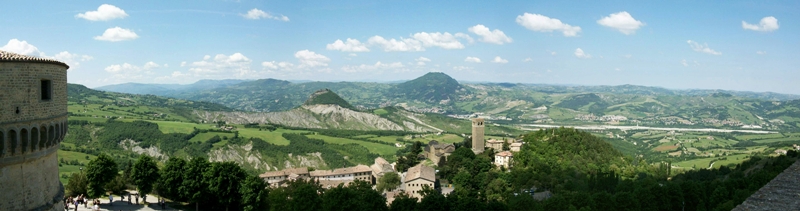
Think about it. You’re at the beach. Sand, umbrellas, the sound of the waves. A few steps away, under the sun, there’s a river that cuts through the city, heads straight northwest, enters a valley, climbs. And after a few kilometres of tarmac and dirt — you’re in the hills. After a few more kilometres — you’re among the badlands. After a few more — you’re in Montefeltro, at 800 metres, your breathing changes and the view stretches across three regions.
You start from the sea and end up in the mountains. On foot. Without ever taking the car.
It’s not an idea. It’s not a project in a drawer. It’s a bike-pedestrian path that already exists. It’s called the Marecchia trail, and those who walk it know: it’s the opposite of a Riviera holiday. It’s the Riviera holiday you didn’t know you could have.
The path that starts where the asphalt ends
We start from Rimini. Not from the historic centre. From the green heart of the city: the Marecchia park, where the city opens its arms and leaves room for the riverbed. Locals know it well. On Saturday afternoons they fill it with families, kids on bikes, happy dogs, barbecues in the shade of the poplars. There’s a small bar, a lawn, a picnic area. It already looks like the countryside, yet the centre is ten minutes away.
From here the trail starts. Smooth tarmac, clear signage, southwest direction.
The first surprise: the mouth of the Marecchia is an ecosystem. Where the river meets the sea, migratory birds nest, reeds grow, sand mixes with pebbles carried by floods. Few tourists know this. Almost no one walks there. Yet it’s point zero of an itinerary that takes you all the way to Montecopiolo, to Pennabilli, following the traces of the Montefeltro.
You walk and the landscape changes. Slowly. As if someone were turning the volume knob of nature.
First the warehouses, then the cultivated fields. The noise of cars fades. You enter the territory of Santarcangelo. Suddenly: silence.
From Piazza Ganganelli to the Marecchia bridge it’s less than 2 kilometres. From the bridge upwards, 9 kilometres to Ponte Verucchio. A stretch you can do in an hour and a half on foot, half an hour by bike. The path runs alongside the river, past small lakes, vineyards, a golf course. In spring the colours explode. In autumn the leaves fall on the water and the river becomes a mirror.
But the real surprise comes when you leave the tarmac and take the dirt road inland.
The unexpected stop: the Ca’ Brigida Oasis
At a certain point, the path forks.
If you go straight, you arrive at Ponte Verucchio, and from there to Verucchio, the Malatesta village, cradle of the Villanovan civilisation. But if you take the left path, in the Il Doccio area, you enter another dimension.
The WWF Ca’ Brigida Oasis.
17 hectares. Woods, meadows, hedges. A stream that crosses the reserve for a long stretch. A Butterfly Garden. A park of ancient plants with traditional varieties of olive trees. And a network of paths: 2,500 metres exactly, all walkable, all designed for those who walk, look, listen.
It’s not just nature. It’s archaeology. Here there are traces of the Villanovan civilisation of Verucchio — very ancient settlements, pre-dating the Etruscans, that used the springs of the Rio Felisina to live. It’s a place where you can feel the past under your shoes.
The wildlife? Roe deer, porcupines, badgers, foxes. Diurnal and nocturnal birds of prey. Amphibians, reptiles, so many butterflies and dragonflies you feel like you’re in a documentary. The visitor centre, a renovated old farmhouse, houses an exhibition hall with Natural History finds from the Valmarecchia and the WWF “Bruno Marabini” Library. Guided tours, educational activities, work camps are available. There’s also a guesthouse with kitchen for those who want to stay more than a day.
Ca’ Brigida is a hub. Not just geographically. It’s the point where you realise that Valmarecchia is not an accessory of the Riviera. It’s a world of its own, with its own identity, its own history, its own wildlife. And you can reach it on foot, starting from the beach.

Ponte Verucchio and the path to Madonna di Saiano
You resume the route and arrive at Ponte Verucchio. Here the landscape changes again: the water flows faster, the riverbed narrows, the hills become walls.
From Ponte Verucchio, a path climbs up.
2.5 kilometres of dirt road, 300 metres of elevation gain. It’s not a flip-flop walk — you need proper shoes, breath, a desire to climb. But at the top there’s the Sanctuary of Madonna di Saiano, perched on a rocky spur overlooking the valley. A pilgrimage destination for centuries. A place where silence has a different weight.
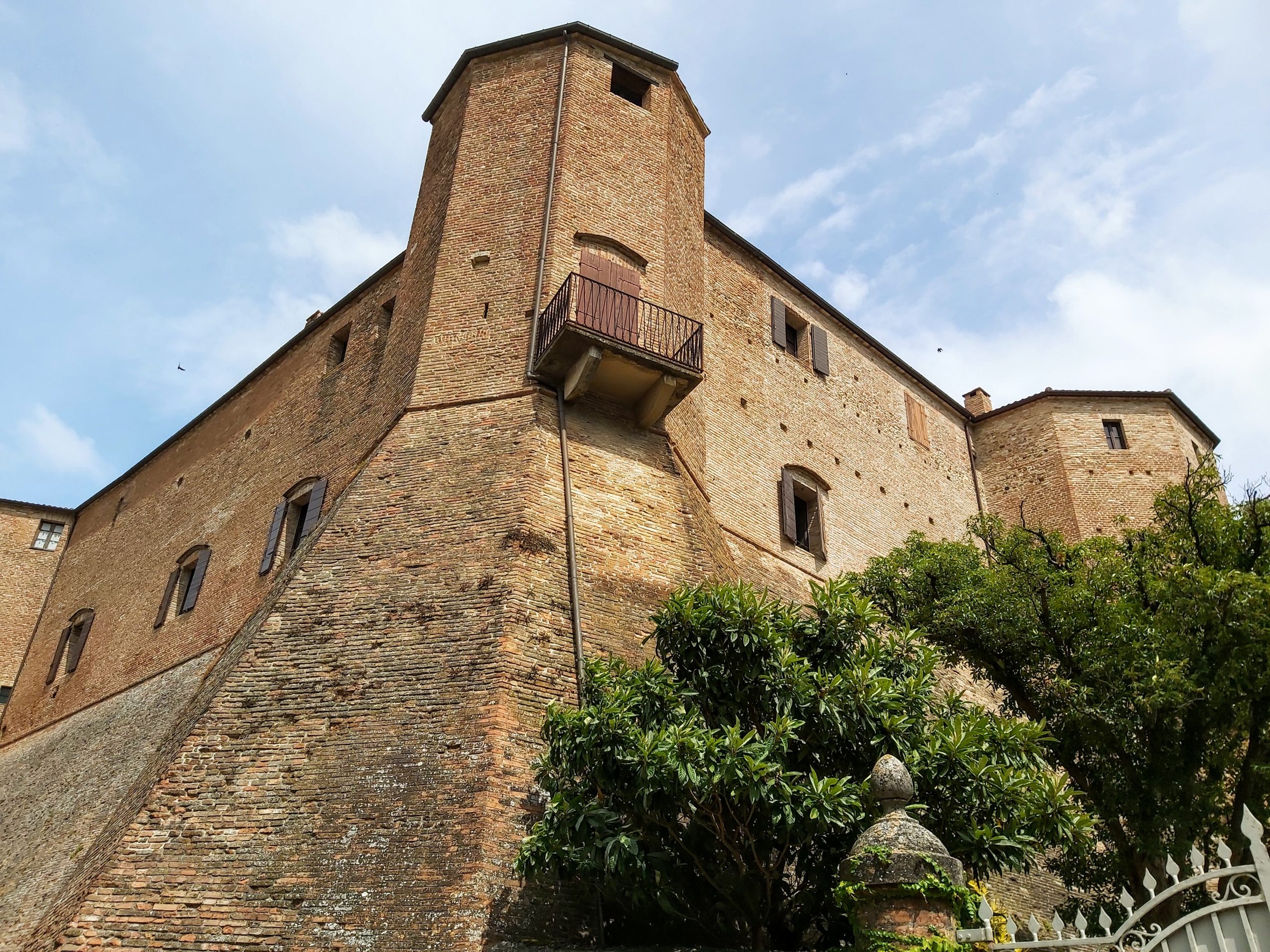
The more experienced continue further. Another 2 kilometres, more elevation, up to Montebello. A tiny village, a castle that looks like it’s from a fairy tale, the Natè Naturalistic Oasis behind it. Here you stop and look back: you’ve walked for hours, you’ve left the sea below you, and now you’re at 400 metres, surrounded by woods, with only the sound of the wind in the leaves.
Escaping the Riviera has never been this easy. Yet almost no one does it.
The green corridor to Montefeltro
You continue. The trail takes you straight towards Novafeltria, the heart of the upper Valmarecchia. Once the railway passed here, today the cycle path does. It’s a route that seems designed: fields, vineyards, small lakes, and then the river that accompanies you like a silent friend.
The beauty of this itinerary is that you don’t have to decide everything in advance. You can stop in Novafeltria, have lunch in one of the villages, visit a castle. Or continue, because the road doesn’t end. From the Sasso Simone and Simoncello Park onwards, every metre is a gift.
Sasso Simone and Simoncello Park: the wild heart
4,991 hectares of protected nature. An area that embraces Emilia-Romagna and the Marche, dotted with villages: Carpegna, Frontino, Montecopiolo, Piandimeleto, Pennabilli, Pietrarubbia.
The park takes its name from two limestone masses that emerge from the hill like stone giants. Sasso Simone and Simoncello. Colossi with flat peaks, arrived here from another geological era — millions of years ago, when the Apennines weren’t yet born and the sea covered what we now call Montefeltro.
Prehistoric men settled on Sasso Simone. Then the Romans. Then the Benedictine monks. Every era left its mark. Today families, school groups, hikers of all kinds come here. The trails are signposted, the rest areas equipped, the view — from up there — embraces three regions.
One trail, among many, deserves a special mention: the one that starts from the Cantoniera di Carpegna and goes into the forest. A cool walk even in summer, among centuries-old beech trees, plays of light, and that deep silence that only real woods can give.
Here you no longer hear the city. You no longer hear the traffic. You hear nothing, except your own breath.

Valconca and Onferno: the natural extension
If you have time, the route widens. The Conca Valley, south of Rimini, is another possibility: from Cattolica inland, crossing San Giovanni in Marignano, Morciano, Montefiore Conca. The Valconca cycle path is gentle, suitable for everyone, immersed in a landscape that alternates cultivated fields and ancient chestnut groves.
And then there’s Onferno. A gem.
The Onferno Nature Reserve, in the municipality of Gemmano, is one of the most fascinating karst complexes in Italy: the Onferno Caves, a UNESCO heritage site, with over 750 metres of galleries carved by water in gypsum rocks. More than 6,000 bats live there. An underground, parallel world that you can visit with a guide and a headlamp.
If the Marecchia itinerary is the corridor upwards, the Valconca is the corridor inwards. Two different ways of discovering that the Riviera is not just the coast.
Why do it now
Slow tourism is not a trend. It’s a necessity. Cities are full of noise, beaches full of umbrellas, days full of commitments. Walking in silence, following a river, entering a forest, arriving at a castle — it’s the opposite of all this. It’s the luxury of time.
And Valmarecchia is perfect for this. Because it’s close. Because it starts where you already are. Because you don’t have to organise anything, book anything, leave at dawn. Put on your hiking shoes, leave the hotel, walk. In one hour you’re among the badlands. In two hours you’re at Ca’ Brigida. In half a day you’re in Montefeltro.
Locals know this. They call it “going up”. Going up, towards the valley, towards the cool, towards the real Romagna. The one of hills, villages, silence. The one tourists often only see from car windows, on their way to San Marino or Urbino, without ever stopping.
Stop. Get out. Walk.
Frequently asked questions about the Rimini-Montefeltro trek
Where does the Rimini-Novafeltria bike path start?
From the mouth of the Marecchia river, in Rimini, at the Marecchia park. The entrance is signposted, with parking and a equipped picnic area. From here the trail goes up the valley to Novafeltria.
How long is the Marecchia cycle path?
The main route from Rimini to Novafeltria is about 30 km long, entirely doable on foot or by bicycle. The sections are paved in the lower part and unpaved in the upper part.
Can you visit the Ca’ Brigida Oasis without a guide?
Yes, the Oasis can be explored independently through the network of signposted trails (2.5 km total). For guided tours and educational activities, it’s advisable to contact the Visitor Centre.
Which villages are along the route?
Santarcangelo di Romagna, Verucchio, Torriana, Montebello, Novafeltria, Pennabilli, Carpegna and the villages of the Sasso Simone and Simoncello Park. Each stop deserves a pause.
Is the route suitable for families with children?
Yes, the bike-pedestrian path is flat up to Ponte Verucchio and suitable for everyone. The trails towards Montebello and Madonna di Saiano require a minimum of fitness. The Ca’ Brigida Oasis is perfect for families.
Advice from a local
Every now and then someone asks me: but what is there to do in Rimini, besides the beach?
I always say: leave the hotel, go towards the river, and walk. That’s all you need. Comfortable shoes, a light backpack, curiosity. The valley does the rest.
If you want to leave early and be back for dinner, the itinerary is perfect. If you want to stay overnight, if you want to taste the truffle of Sant’Agata Feltria or the bread of Maiolo, if you want to get lost in the places of the soul of Tonino Guerra in Pennabilli — you just need more time.
But to start, four hours on foot is enough.
And you know where to find me, if you’re passing this way. At the Aqua Hotel, a stone’s throw from the sea. Ask for me, and I’ll tell you which way to go.