The sun is already beating down at eight in the morning.
The streets of Ariminum — ancient Rimini — are packed. Not tourists. People who live here. Merchants, artisans, soldiers on leave, servants with a rare free day. Families with children on their shoulders. Women arguing over prices. Old men who walk without hurry because they already know what they’ll find.
Ten thousand people heading in the same direction.
The structure is visible from a distance. Tall, massive, built to last. Four concentric rings of stone descending twenty-one meters below street level. Inside: the arena, seventy-six meters by forty-seven. Enough space for everything a man can do to another man in front of ten thousand witnesses.
This is the second century AD. Ariminum is one of the most important cities in the peninsula. And this amphitheater — occupying over ten thousand square meters at the edge of the city center — is the beating heart of public life.
Today, in that exact spot, there’s a school. And a few meters of ancient wall holding on between modern buildings.
Almost no one knows what lies beneath.

When Rimini Was the Edge of the World
To understand why someone built something like this here, you need to understand where Ariminum sat on the map of the Empire.
Rimini wasn’t just any city. It was the precise point where two essential roads met. The Via Flaminia arrived from Rome, straight as a blade through the Apennines. The Via Emilia departed from here toward the northwest, crossing the Po Valley all the way to Piacenza. Whoever controlled Rimini controlled the movement of people, goods, and armies between northern and central Italy.
This was a place where decisions were made.
A place where the Empire needed to show its best face — and its hardest one.
An amphitheater isn’t just a venue for entertainment. It’s a message. It says: we’re here, we’re organized, we’re powerful. It says: look at what we can build. It says: sit down, watch, go home satisfied. Come back to work tomorrow without asking questions.
This isn’t entertainment. It’s politics carved in stone.
Dimensions: 117.7 meters long, 88 meters wide. Almost two football pitches side by side, built in stone across four levels, in an era when cranes didn’t exist and every block was carried up by hand. The central arena: 76 by 47 meters. Large enough for a battle.
This isn’t grandeur for its own sake.
It’s a demonstration.
But the size isn’t the most impressive part.
Ten Thousand Voices Beneath the August Sun
The number that changes everything is this: ten thousand.
Ten thousand people entering, sitting, screaming, sweating, eating, weeping, and applauding — all together, in the same place, at the same moment. For a city like Ariminum in the second century, ten thousand spectators meant more than one in ten inhabitants could be there simultaneously.
Think about what that means.
This isn’t a hall. It isn’t a theater. It’s a mass event in the literal sense — a moment when the city stops being a collection of individuals and becomes a single thing, with one voice, one direction of gaze, one collective reaction.
What happened in the arena was brutal and precise.
Gladiators were professionals, not random killers. They trained for years. They had specializations, techniques, categories. The retiarius with his net and trident. The murmillo with the fish-shaped helmet. The secutor, built to chase. Every fight was choreographed to a point — then reality took over.
There were also venationes: hunts with exotic animals brought specifically into the arena. Lions, bears, leopards. Animals ordinary people would never see in their lives. The Empire showed you how vast it was simply by letting you watch a lion die in the middle of your city.
The psychology of the space did the rest.
Those four concentric rings — 21.8 meters deep — created natural acoustics that amplified every sound. The noise of ten thousand people screaming is a physical force. It enters you. It changes how you feel things. You leave the amphitheater different from how you arrived.
The Colosseum, for comparison, held fifty thousand. But the Colosseum was Rome — the absolute symbol. The Rimini amphitheater was the local version of that same idea. Proof that the Empire didn’t end in Rome. It reached here. It came right to your door.
Then the Empire retreated.
And the amphitheater was left alone.

The City That Ate Itself
Great structures don’t collapse overnight. They transform.
First comes abandonment and adaptation. In the late Empire, as barbarian invasions made it necessary to reinforce Ariminum’s defenses, the amphitheater was incorporated into the city walls. The outer arcades — sixty-three meters of open facade facing the world — were sealed to create a continuous barrier. The amphitheater stopped being a public space and became a piece of the city’s defensive armor.
It was no longer a place people went to.
It was a wall to hide behind.
This is the exact moment when civilization stops building and starts barricading itself.
Then came the Middle Ages. And with the Middle Ages, the logic of daily survival. The amphitheater’s stones were perfect — squared, solid, already cut to the right size. Why build from scratch when you have enough material right there for a church, a palace, a bell tower?
The Romans had built too well.
Every stone block was worth a day’s labor. Every arch was a free materials depot. Over the centuries, the Rimini amphitheater was literally dismantled piece by piece and distributed across the city. Its stones ended up in dozens of medieval buildings. Walking through Rimini’s historic center means, in a sense, walking through the remains of the amphitheater — without knowing it.
But the most paradoxical moment came afterward.
What remained standing — the foundations, the underground passages, the subterranean structure — became a lazaretto. A place to isolate the sick during epidemics. The arena where people once fought for glory became the place where people died in shadow, in quarantine, far from the city.
From theater of courage to place of abandonment for the contagious.
The place doesn’t change. The power does.
Layer by layer, the city built over it. Houses, alleys, shops, gardens. The amphitheater disappeared beneath Rimini the way all things disappear when they stop serving a purpose. It wasn’t destroyed. It was simply forgotten.
For centuries, no one knew where it was anymore.
A Bricklayer, a Spade, and a Secret That Had Waited a Thousand Years
The story of the rediscovery begins very simply.
In 1763, a bricklayer named Stefano Innocenti was digging for routine construction work in an area east of Rimini’s center. The spade hit something hard. Then again. Then the outline of something that wasn’t earth.
It wasn’t just any wall.
It was part of something much larger.
Innocenti’s first discoveries opened a question the city of Rimini couldn’t ignore: what was down there? The intuition was there. The resources to answer it, not yet.
They had to wait until 1843. That year, Luigi Tonini — a Rimini historian (1807–1874), one of the most serious intellectuals the city ever produced — conducted the first systematic excavations. Tonini didn’t just dig. He documented, measured, cross-referenced ancient written sources. He understood that what he had before him wasn’t a random fragment but the main structure of a large Roman amphitheater.
It was an important discovery.
It was also an uncomfortable one.
The city had grown over it. Dismantling the city to free the monument was neither simple nor affordable. It took another seventy years — until 1913 — before the amphitheater received official protection as a designated monument. Before that date, legally, anyone could continue building over it.
Between 1926 and 1938, new excavations arrived, deeper and more systematic. The structure became clearer — the four rings, the actual dimensions. But even then, the site wasn’t fully freed.
The most striking paradox came after World War II.
On the area of the amphitheater — or part of it — the Centro Educativo Italo Svizzero (CEIS), an Italian-Swiss educational center, was built in the postwar years. Not out of bad faith or ignorance: in 1945, Rimini was on its knees after the bombing campaigns, and priorities were the living, not the buried. The CEIS was — and still is — an important institution for the city.
But the result is this: a school sits on top of a second-century Roman amphitheater.
Only in the 1960s did systematic programs for the site’s valorization begin. Since then, work has continued intermittently, as always happens when history meets bureaucracy and public funding.
What You Can See (and Feel) Today
Get there early in the morning, before the traffic builds up.
Rimini’s amphitheater sits in the eastern part of the historic center, close to the coast. It’s not in the monumental heart of the city — not Piazza Cavour, not the Bridge of Tiberius. It’s in a more lived-in, less touristy part of Rimini. Apartment blocks, ordinary streets, everyday life.
And then — suddenly — the walls.
What you see today is part of the original perimeter. Not the full amphitheater — that’s still buried beneath the city, and will probably stay that way for a long time. But what emerges is enough to grasp the scale. Enough to stop and think that beneath your feet, beneath the road, beneath the foundations of that postwar building, the structure of a second-century Roman edifice still stands.
The stone blocks hold.
Two thousand years, and they hold.
The amphitheater today hosts cultural events and performances — a return, on a small scale, to its original function. Not gladiators, obviously. But music, theater, local initiatives. The city has learned to use it again.
For up-to-date opening hours, admission prices, and event schedules, check the Rimini municipality website and RivieraMusei — details change season by season.
Best time to visit? Early morning or late afternoon, when raking light brings out the texture of the ancient stones. And don’t rush. This isn’t a place to pass through. It’s a place to stop.

The Weight of What You Can’t See
Rimini has a strange relationship with its history.
It doesn’t ignore it. It lives on top of it — literally. The amphitheater’s stones are in the walls of medieval churches. The Bridge of Tiberius still carries traffic after two thousand years. The Surgeon’s House is buried under Piazza Ferrari. The Arch of Augustus gives its name to a neighborhood that most people walk through without looking up.
History here isn’t in museums.
It’s underfoot, inside the walls, around the corners.
The amphitheater is perhaps the most extreme example. A structure for ten thousand people — larger than any modern venue in the city — practically invisible. Covered by a school, roads, houses. Partially recovered, never completely.
There’s something vertiginous about this.
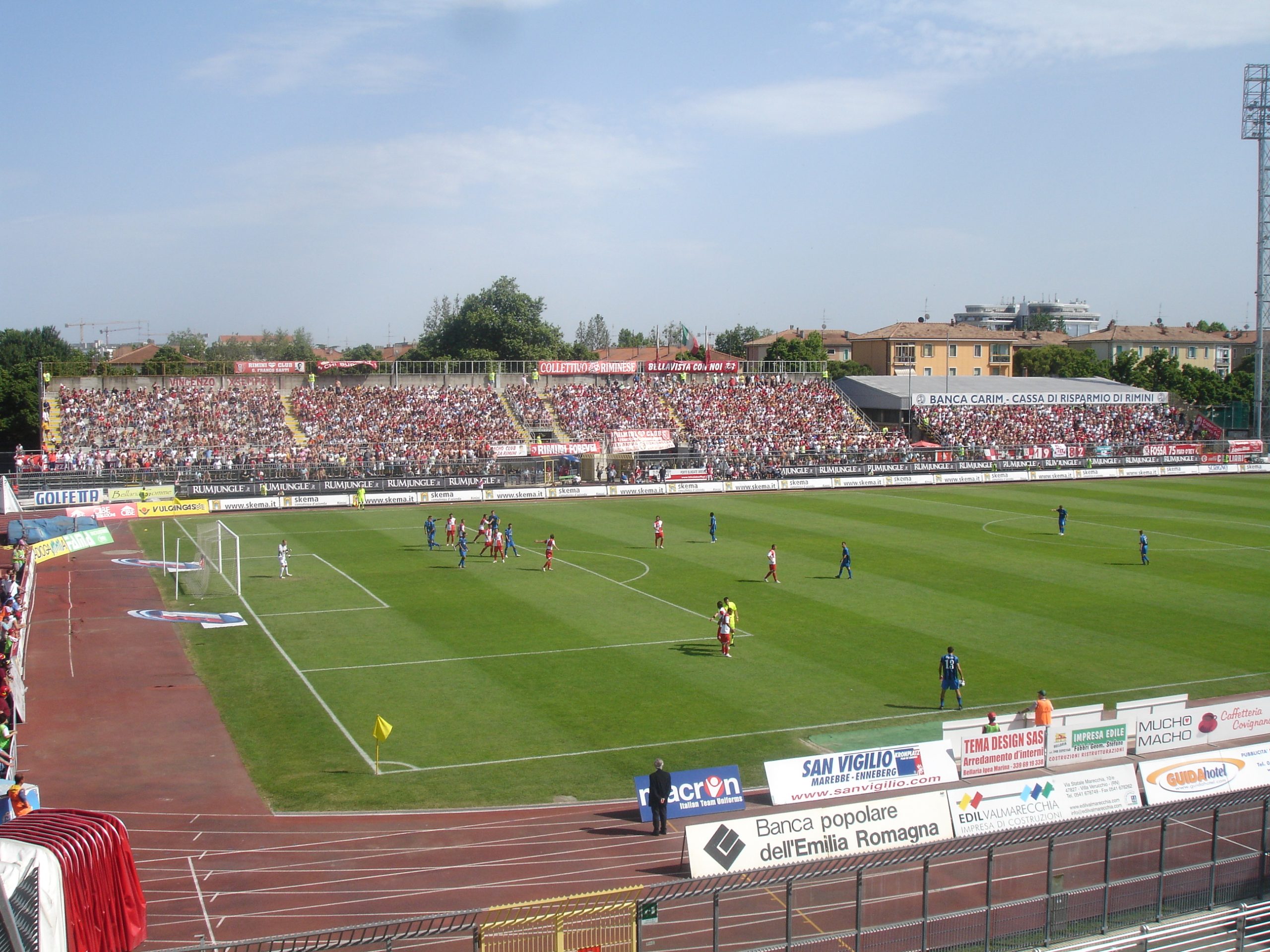
Thinking that in the second century, in this same city, ten thousand people gathered in one place. That the structure had a larger capacity than Rimini’s Romeo Neri stadium today. That it was here for two thousand years — used, dismantled, forgotten, rediscovered — and now someone walks over it every morning on their way to school without knowing what’s underneath.
It isn’t neglect.
It’s how cities survive: by burying the previous layers and building on top. Rimini has been doing this for two thousand years. It will keep doing it.
The difference is that we — now — know what’s buried. And we can choose to go and look.
When guests at the hotel ask me what to see in Rimini, I usually start with the Bridge of Tiberius or the Arch of Augustus. Those are non-negotiable. But I always add the amphitheater — and I see the surprise on their faces. “I didn’t know there was a Roman amphitheater in Rimini.”
Almost no one does.
And yet it’s been there for two thousand years.
If you want to discover the real Rimini — not the brochure version, but the one that built great things and then lived on top of them — you know where to find me. At Aqua Hotel, in Marina Centro.