THE FACADE: A DIALOGUE BETWEEN THE ANCIENT AND THE NEW
Initial advice for a better visit to the Malatesta Temple: arrive at 9 in the morning.
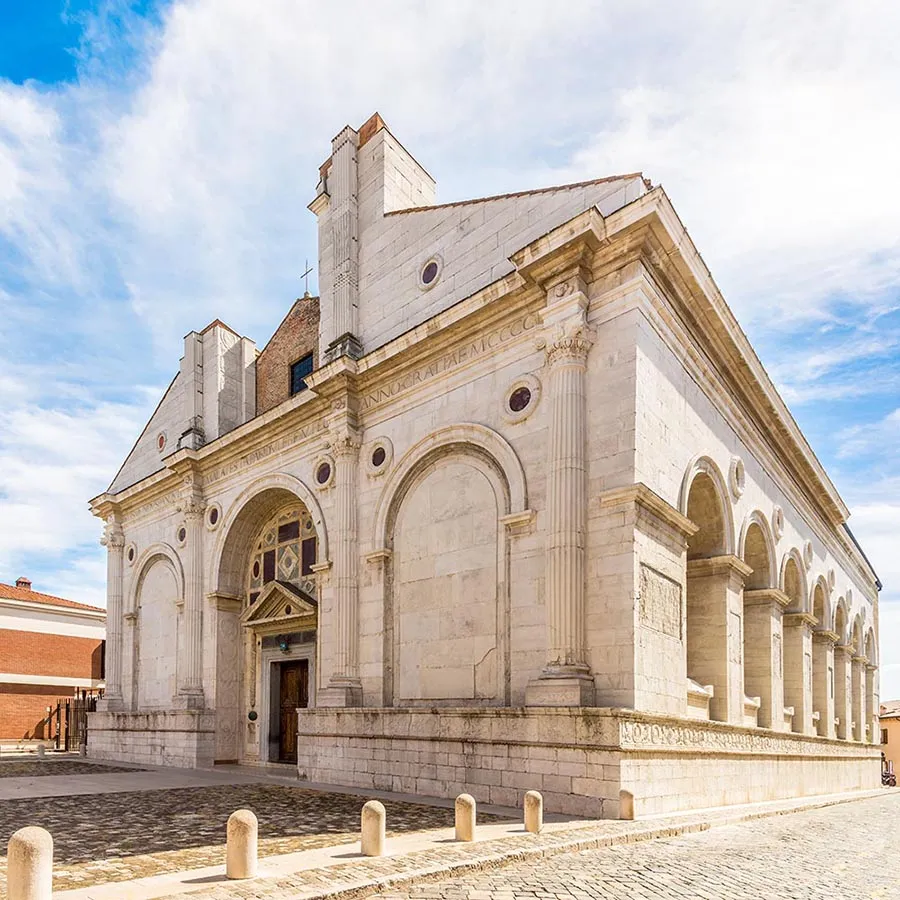
The sunlight illuminates the white facade made of Istrian stone, offering a unique spectacle.
See that majestic facade?
It hasn’t always been like this.
It was once a simple Franciscan church.
Then came Sigismondo Malatesta, the lord of Rimini.
And he changed everything.
Imagine the scene: it’s 1450. Sigismondo calls Leon Battista Alberti, the greatest architect of the Renaissance.
He says to him, “I want to transform this church into something the world has never seen.”
Alberti does something ingenious.
He builds a “shell” of marble around the old church.
Like a precious box protecting a treasure.
If you look closely, you’ll see that the facade doesn’t even touch the original walls.
Look up at the inscription above the entrance: “SIGISMUNDUS PANDULFUS MALATESTA DEDICAVIT DEO IMMORTALI ET URBI.”
Let me translate it for you: “Sigismondo Pandolfo Malatesta dedicates this temple to the immortal God and the city.”
Here’s a detail that my guests love.
See those arches?
They resemble the Arch of Augustus here in Rimini.
It’s not a coincidence.
Alberti wanted to create a bridge between ancient Rome and the Renaissance.
THE HEART OF POWER: THE CHAPEL OF THE PLANETS

Let’s enter together into the most mysterious part of the Temple.
Look up at the ceiling.
Do you see those planets sculpted in stone?
It’s not just decoration.
It’s the sky of 1450, frozen in time by skilled stonecutters.
Now let me reveal a secret that I love to share with my guests.
Do you see that gigantic crab (Cancer) dominating the scene?
It’s not there by chance.
It was Sigismondo Malatesta’s zodiac sign.
A brilliant way to say: “I am the one who protects Rimini.”
And right below Cancer, there’s something special.
The oldest view of Rimini ever created.
Look closely: the walls, the towers, the harbor.
Our city under the protection of its Lord.
But there’s more.
In this chapel, you’ll be able to admire something unique.
Renaissance artists created a masterpiece where two worlds coexist: the world of ancient astronomy and that of Christian faith.
The planets, represented according to classical tradition, intertwine with religious symbols in a silent dialogue that has lasted for centuries.
Do you know what always strikes me?
How the Malatesta managed to create a place where the knowledge of the sky and spirituality meet.
Where art transforms stone into a book of ancient wisdom.
Here’s an insider tip: come back here in the late afternoon.
The light filtering through the windows creates shadow plays on the bas-reliefs.
It’s the perfect moment to take unforgettable photos.
THE LOVE STORY: ISOTTA’S CHAPEL

Let me tell you a love story that has marked Rimini forever.
You are in the chapel dedicated to Isotta degli Atti, the third wife of Sigismondo.
Their story is so important that Sigismondo dedicated this sacred space to her, officially titled to Saint Michael the Archangel.
Isotta’s sarcophagus is a masterpiece of Renaissance elegance.
Look at it closely: it tells the story of the power of the Malatesta family through their heraldic symbols.
Here, you can see the elements that identify the family:
- The elephant, emblem of the Malatesta
- The chessboard, present in many of the family’s coats of arms
- The four-petaled rose, a recurring symbol in the decorations
One of the most interesting aspects are the initials “SI,” the personal signature Sigismondo used, and which we also find in this sacred space.
A detail that speaks to the deep bond between the two.
There’s a magical moment in this chapel.
Come here when the sun is high in the sky: the natural light filtering through the windows creates a special atmosphere, allowing you to appreciate every detail of the decorations.
THE MASTERPIECE OF PIERO DELLA FRANCESCA

This fresco continues to move me every time I look at it.
You are about to admire one of the most precious treasures of the Temple.
What you see is much more than just a religious painting.
It is a work by Piero della Francesca from 1451, and it hides a fascinating play of identities.
The man you see is Saint Sigismund, king of the Burgundians.
But there is a second layer of meaning: he also represents Emperor Sigismund of Luxembourg, the same one who knighted our Sigismondo Malatesta in 1433.
Look carefully at the two dogs at the feet of the figure.
They are not just decorative animals.
They represent two types of loyalty: loyalty to religion (fides cattolica) and loyalty to the civic mission (fides publica).
A powerful message for those who knew how to read it.
The artist’s signature is still visible: “pietro de burgo,” Piero from Borgo San Sepolcro, as Piero della Francesca used to sign.
A detail that makes this work even more precious.
The technique is extraordinary.
Notice how the light shapes the face of the saint, how the colors still maintain their vividness today.
This is what made Piero della Francesca one of the greatest artists of the Renaissance.
If you position yourself three meters away, slightly to the left, you will be able to best appreciate the perspective of the work.
It is the viewpoint that the artist imagined for his viewers.
THE MYSTERY OF THE MISSING DOME

The Malatesta Temple hides one last secret: it was meant to be much more imposing than what you see today.
The original project included a majestic hemispherical dome, inspired by the Pantheon of Rome.
But it was never built.
Do you want to see how it was supposed to look?
There’s a little treasure in the City Museum of Rimini: a medal created by Matteo de’ Pasti.
It shows the complete design of the Temple with its soaring dome.
A precious image that helps us imagine the grandeur of the original project.
But why was it left unfinished?
History tells us of wars, financial difficulties, and the downfall of Sigismondo Malatesta.
The dream of creating the “Pantheon of Rimini” was interrupted.
Yet, this incompleteness makes the Temple even more fascinating.
Like a book missing the last chapter, it leaves room for the imagination.
Nevertheless, the Malatesta Temple remains one of the most important monuments of the Italian Renaissance.
A place where art, power, and faith intertwine in a unique way.
The greatest artists of the 15th century worked here: Leon Battista Alberti, Piero della Francesca, Agostino di Duccio.
They created what Antonio Paolucci called “the Sistine Chapel of 15th-century Italian sculpture.”
Today, the Temple continues to enchant visitors from around the world.
A jewel that tells the greatness of Rimini in the Renaissance.
Do you want to discover the Malatesta Temple and all the wonders of Rimini?
At Aqua Hotel, a unique experience awaits you, with special packages for art and culture lovers.
👉 Book your stay now: link to Aqua Hotel’s special offers
I look forward to seeing you in Rimini.