December 1943. Rimini is already on its knees.
German soldiers have dug into every alley of the city centre. Families who could leave have gone. The streets at night are empty — empty as they had never been in ninety years of the city’s history. And above the rooftops of Piazza Cavour, above the gilded boxes and the curtain showing Julius Caesar crossing the Rubicon, the bombs arrive.
They were not precision bombs. They did not distinguish between a military command post and a theatre. In minutes, the stage roof collapses. The rear façade tears open like paper. The boxes where Rimini’s families had spent their finest evenings become rubble.
The Teatro Galli dies that night.
Or at least — everyone thinks so.
The Man Who Wanted a Greek Temple on Piazza Cavour
Luigi Poletti was not just any architect.
He was the architect of the Papal States. He had already worked on Santa Maria Maggiore in Rome. He understood stone, proportion, the weight of a building designed to outlast centuries. When Rimini handed him the commission for its new municipal theatre in 1843, Poletti already had one thing in mind.
Not a theatre. A temple.
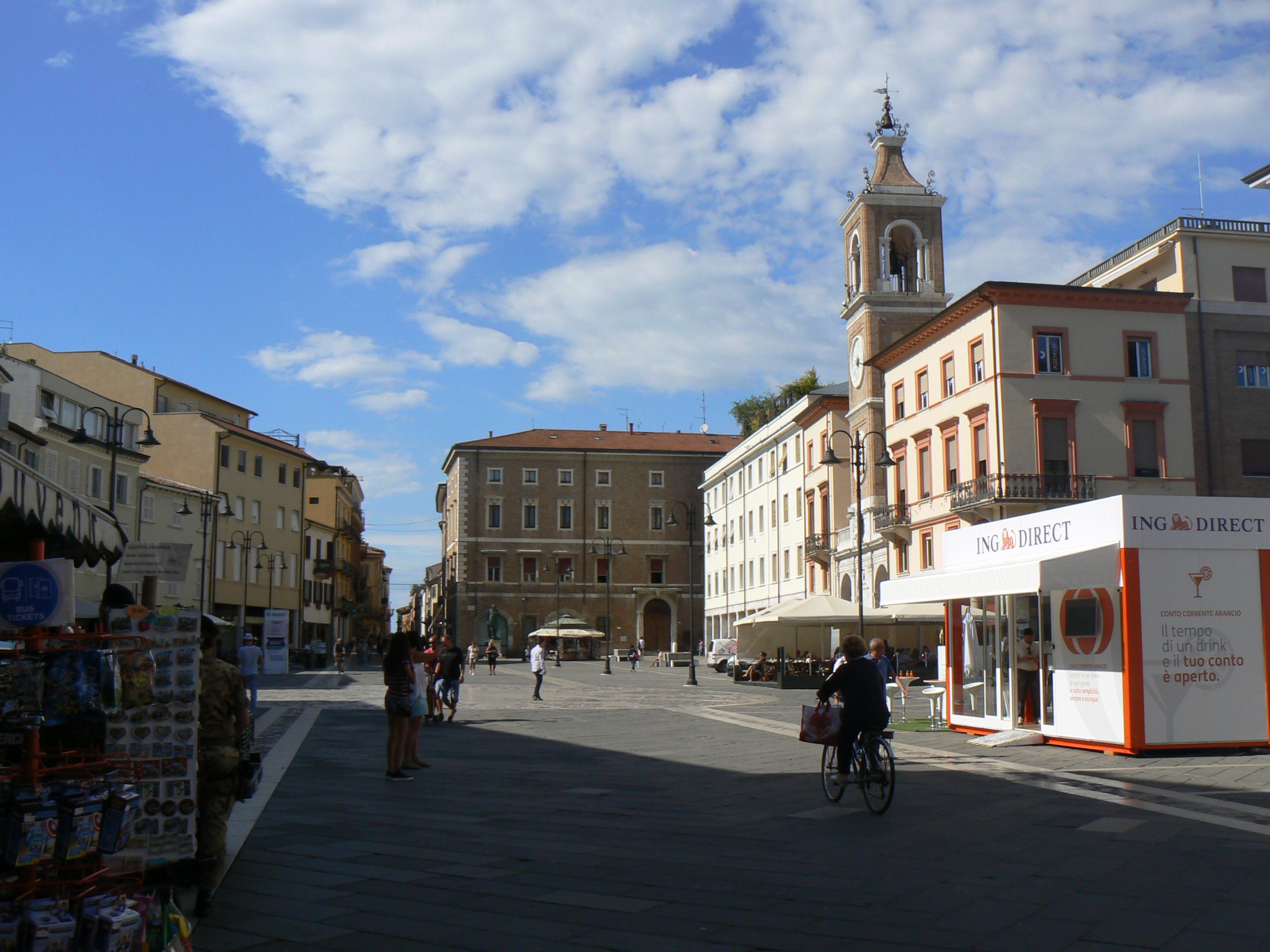
The style he chose was neoclassical — but not the frivolous neoclassical of some period buildings. His was severe, monumental. The lines recalled Greco-Roman temples. The façade on Piazza Cavour had a solidity that almost intimidated: six columns in Istrian stone, a pediment gazing down at the square like an eagle watching a valley.
Mid-nineteenth-century Rimini was a provincial city of the Papal States. Not Rome, not Venice, not Milan. It had the sea, the Roman historic centre, its ancient history — but it did not yet have a theatre worthy of its name. The old municipal theatre was not enough. The city wanted something different. Something that said who Rimini was, what it aspired to be.
Poletti gave it to them.
Work began in 1843, financed partly by the municipality, partly by shareholders — the city’s notables who bought the right to a box and became, without quite intending it, patrons of something larger than themselves. It took fourteen years. By 1857 the theatre was ready.
And Rimini — which had expected something beautiful — was left speechless.
The Evening Verdi Stepped onto the Podium
Summer 1857. The curtain of the new theatre rises for the first time.
It is not an ordinary evening. This is not an opera already known, already tested on other stages. It is the world premiere of a new work. And on the podium stands Giuseppe Verdi himself.
The opera is called Aroldo. Technically a revision of Stiffelio, but Verdi considers it something new. And he chooses Rimini for the debut. He chooses this newborn theatre, this provincial city on the Adriatic, to baptise his creation before an audience.
It is the only case in Italy of a Verdi world premiere outside the great theatres — outside La Scala, outside La Fenice, outside the circuits that count. Why Rimini? The exact reasons were known only to Verdi and whoever negotiated with him. But the fact is there, in the archive records, undeniable.
On stage that evening are the finest performers of the moment. Marcellina Lotti Della Santa — soprano. Emilio Pancani — tenor. Gaetano Ferri — baritone. Conducting alongside Verdi is Angelo Mariani, one of the most respected musicians in Italy. In the stalls and the boxes — eight hundred seats, across three tiers of twenty-three boxes each plus the gallery — is all of Rimini. Those who count, and those who do not but refuse to miss it.
The auditorium is not merely beautiful. It is extraordinary.
The walls are covered in stuccowork by Giuliano Corsini. The gilding was applied by Pasquale Fiorentini — with the patience of a goldsmith, gold laid by hand over every centimetre of cornice. The ceiling paintings are by Andrea Besteghi and Michele Agli. The sculptures — those that seem to observe the audience with a certain quiet distance — are by Pietro Tenerani, the same man who had worked in the Pantheon in Rome.
And then there is the curtain.
A painted curtain showing Julius Caesar at the precise moment he crosses the Rubicon. Not mere decoration — an allegory. It is Rimini telling its own story: a city born on a border, a city that has watched history pass from one side to the other. The Rubicon flows just a few kilometres from here. Caesar really did cross it. And the theatre remembers this at every performance, every time the curtain rises.
That first evening, that music, that curtain. Rimini understood it had something rare.
Eighty Years of Applause (and an Earthquake That Changes Everything)
For nearly a century, the Teatro Galli is the beating heart of Rimini’s cultural life.
It is not just a place to hear opera. It is where the city gathers. Where families show themselves, where generations meet, where Saturday evenings acquire a different weight. It is where you go when you are from Rimini and want to feel part of something.
Seasons come and go. The great names of Italian opera alternate on the stage. The theatre ages well — as things built with intention, with the right materials, with a vision beyond the moment tend to do.
In 1916, the first serious blow arrives.
An earthquake. Not catastrophic, but violent enough to seriously damage the structure. The theatre closes. Rimini loses its drawing room for years — years in which the city feels the absence of something it had not known it possessed until it was gone.
It reopens in 1923 with Riccardo Zandonai’s Francesca da Rimini — a deliberate choice: a Romagnol composer, an opera bearing in its title the name of one of the figures most dear to local tradition. A return that carries the weight of a symbolic act.
The twenties and thirties are the second golden age. Impresario Ciro Ragazzini has the skill — and the right contacts — to bring the names that matter to Rimini. In 1926 Pietro Mascagni takes the podium — the composer of Cavalleria rusticana, one of the most recognisable faces of Italian opera in the world. Then come Beniamino Gigli and Aureliano Pertile, the most celebrated tenors of the era. The boxes are full. The city is proud. The theatre is more alive than it has ever been.
And then — slowly, almost imperceptibly — the war arrives.
The Last Butterfly
Spring 1943. Italy has been at war for three years.
On the stage of the Teatro Galli, Puccini’s Madama Butterfly is playing. Spectators sit in their boxes. The soprano sings. The orchestra plays in the pit. Outside, the world is burning — but in here, for a few hours, everything still feels ordinary. Still normal.
Nobody knows it is the last time.
Nobody knows there will be no next season. That the curtain with Julius Caesar will close that evening and not reopen for seventy-five years. That Cio-Cio-San waiting on the Galli stage is — without anyone yet knowing it — a farewell.
Puccini had written Butterfly as a story of abandonment and long waiting. Of someone waiting for a return that never comes. Of something that holds on, in silence, not knowing whether it will ever receive an answer.
He could not have chosen a more fitting opera.
The Night of 28 December
Rimini has already changed by the time the mass bombardments arrive.
The Germans control the city. Families who could have left have gone towards the hinterland, towards Santarcangelo, towards the hills. The streets at night are empty as they had never been. Piazza Cavour — the square the Teatro Galli has watched for ninety years, the square that had seen Verdi arrive by carriage — is silent.
On 28 December 1943, the bombs.
The stage roof collapses. The rear façade opens. The boxes — those same ones where Rimini’s families had spent their best Saturday evenings, where they had sat to hear Gigli, where Mascagni had moved them — fill with rubble. Corsini’s stuccowork, Fiorentini’s gilding, Besteghi’s paintings: everything buried under dust and plaster.
It was not just a building. It was the memory of eighty years of city life.
But — and here is something difficult to explain — not everything dies.
The façade on Piazza Cavour holds. The six columns of Istrian stone remain standing. The foyer survives almost intact. As if the theatre had decided, in that chaos, to hold firm on something. As if it already knew it would have to wait.
And it waits.
Post-war demolitions worsen what the bombs left standing. What the war did not destroy, the necessities of reconstruction dismantle in part.
The result is a shell. A façade, a foyer, four walls. And inside — nothing.
Seventy Years of Silence
Rimini rebuilds quickly. That is its nature.
The city raises its houses again, reopens its hotels, reinvents itself as the capital of the Italian summer. The economic boom of the sixties arrives like a wave and carries everything with it: tourists from northern Italy, from Eastern Europe, from Germany. Rimini becomes famous across Europe for the sea, for the nightlife, for that distinctly Romagnol capacity for celebration.
But the Teatro Galli stays there — still, motionless, empty.
It is not that nobody thinks about it. Restoration projects pile up in municipal drawers. Debates repeat themselves for decades, with minimal variation. Every time something fails to add up: money, priorities, bureaucracy, technical disagreements about methodology.
The years pass. They become decades.
In the meantime, at least, someone gives it a name. In 1947 the theatre is dedicated to Amintore Galli — a composer born in Rimini in 1845 and died in 1919, who devoted his life to music and musical teaching. A gesture of respect, towards a man and towards a building. But the name is not enough to fill the silence.
The seventies. The eighties. The nineties.
The theatre stays closed. It sits like a missing tooth in the smile of Piazza Cavour. Whoever passes by glances at it. Photographs it. Thinks about it for a moment, then walks on. Asks: when?
The answer — finally — comes in 2010.

The Building Site That Held Its Breath
In 2010, the Municipality of Rimini finally makes a decision.
Not a project. Not a feasibility study. A real decision: the Teatro Galli will be restored faithfully to Poletti’s original. No modern reinterpretation, no architectural compromise. A return to the origin — with all the constraints that entails in 2010: safety regulations, contemporary acoustics, fire codes, lighting systems.
The total budget exceeds 36 million euros. The municipality covers 31.7 million. The Emilia-Romagna Region adds the remaining 4.7 million. Significant sums for a medium-sized city. But not money wasted: an investment in something Rimini had been waiting for over seventy years.
Work begins in the spring of 2014.
The building site becomes — for four years — one of the most watched in Italy. Not only by experts. By the people of Rimini. By families who stop to look at the scaffolding. By elderly residents who remember their parents’ stories of entering the theatre before the war. By young people who have never seen it open and cannot imagine it as anything other than that skeleton with a standing façade.
Every phase is a meticulous return.
The stuccowork is recreated using nineteenth-century techniques. The colours are researched beneath layers of plaster accumulated over a century. The curtain with Julius Caesar at the Rubicon is restored thread by thread. The acoustics are studied for weeks — measurements, computer models, on-site verification — to reach the parameters a theatre of this kind demands.
This is not a reconstruction. It is a resurrection.

28 October 2018
Seventy-five years after the bombings, the Teatro Galli reopens.
It is 28 October 2018. Piazza Cavour is full as it has not been in decades. People wait outside, in line, looking up at the façade lit by the evening lights. The same façade that had withstood the bombs. The same six columns of Istrian stone that Poletti had imagined in 1843.
The opera chosen for the reopening is Rossini’s La Cenerentola.
Rossini. Not Verdi — that 1857 premiere was unrepeatable. But Rossini is the right choice: Italian music, lightness built on precise architecture, and a finale that overturns everything that seemed lost. A Cinderella returning home after years of abandonment. It could not have been better chosen.
Inside, the theatre is Poletti’s theatre.
Not a copy — the theatre. Corsini’s stuccowork, the gilding, the boxes with their red velvet, the painted vault. The curtain with Caesar at the Rubicon. And the acoustics — that balance between space and sound that you understand only by being inside, hearing the first note rise from the orchestra pit and reach the top box of the third tier without losing anything along the way.
Whoever enters for the first time stays silent for a few seconds. Not a studied reaction. The natural response to something working exactly as it should.
In the months that follow, the New York Times lists the Teatro Galli among the world’s greatest destinations. Not just recognition for a successful restoration. A statement about Rimini: a city too often dismissed as the place of discos and beach umbrellas, which has instead returned to the world one of the finest theatres in Europe.
What the Teatro Galli Means Today
The Teatro Galli is not a museum.
It is not a place where dead things are preserved. It is a living theatre — with an opera and drama season that draws audiences from across Italy, with events, with concerts, with that continuous presence that turns a building into a place.
But it is also something else.
It is proof that Rimini is more than it appears. That beneath the lights of summer, beneath the beach bars and the evenings on the seafront, there is a city with two thousand years of history that has never stopped being itself. A city that watched Julius Caesar pass, that hosted Verdi, that withstood the bombs and waited seventy years to return to what it was.
It is what you look for if you come to Rimini and want to truly understand where you are.
Not the seafront. Not the Ferris wheel. Not the Pink Night.
This. A square, a façade in Istrian stone, six neoclassical columns. And inside — if you are lucky enough to enter on an evening of performance — something you will not forget.
Practical Information
The Teatro Amintore Galli is located in Piazza Cavour, in Rimini’s historic centre. It can be reached on foot from the station in about fifteen minutes, or by car with parking close to the square.
Guided tours are organised periodically — the updated calendar is on the official website teatrogalli.it. For performance evenings, tickets sell out quickly: book in advance, especially for opening nights and the main concerts of the autumn season.
The main season runs from October to April. If you are in Rimini in summer, the theatre also hosts special events — worth checking even out of season.
A Note Before You Go
Every time I walk through Piazza Cavour in the evening and see that illuminated façade, I stop for a second.
I think about that night in December 1943. About how easily everything could have been lost. About those seventy years of silence in which the theatre waited, façade standing and nothing inside, as though it knew that sooner or later someone would return.
Rimini waited. It argued, procrastinated, debated for decades. But in the end it did the right thing.
If you come here and want to take something real home — something you will not find in glossy travel guides — book an evening at the Galli. Sit in one of the red boxes. Wait for the music to rise.
And when you want to stay a few more days and live this city without rushing, you know where to find me. At the Aqua Hotel.