Unveiling the Veil of Mystery: When True History Meets Legend
Do you know that feeling when you enter a place and sense something in the air… something inexplicable?
Well, if you visit Montebello Castle, that’s exactly what happens.
Maybe it’s the ancient stones. Or the too-perfect silence. Or perhaps it’s that story everyone immediately tells when you ask, “Who is Azzurrina?”
There, in the quiet halls and under low ceilings, the legend takes shape.
But today, I want to share something rarely mentioned in guided tours.
Because, yes, Azzurrina is a captivating name. And the mystery of the child who disappeared during a storm while chasing a ball into the icehouse gives you chills.
But behind that story is much more.
There’s a real child. A family. A whole era.
To me, this is even more striking than the ghost itself.
The child’s name was Guendalina Malatesta.
And she truly existed. It was 1375, and she was the daughter of Ugolinuccio, lord of the castle.
Here’s a twist.
When you hear “Azzurrina,” you think of something ethereal, undefined—a presence.
But when I say “Guendalina,” the legend cracks. Reality sets in. Real life appears.
And here comes the interesting part.
Guendalina was albino.
White hair, very pale skin, clear eyes. In a time when these traits instilled fear.
They weren’t just “different”; they were seen as omens, signs, even curses.
Her parents—let’s imagine them as perhaps not even cruel—decided to protect her.
Or perhaps hide her? Who truly knows?
They kept her within castle walls, away from prying eyes, always watched.
Here’s where the distortion of the tale begins.
A hidden child, different, silent… then that stormy day. The ball drops. She runs down. Silence. A scream. And then… nothing.
Every Legend Grows from a Seed of Truth
Over time, that seed grows, morphs, becomes distorted—like “Chinese whispers” from childhood.
The story spreads. A word changes. A detail is added. Another lost.
Thus, an albino child from the 1300s, hidden in a castle for protection from judgment, becomes a ghost crying every five years on June 21, during a storm.
Interestingly, that voice, that crying, was reportedly recorded in 1990—or so they say.
Believe it or not, that’s the charm.
What draws us isn’t whether the ghost exists. It’s the allure, the desire to believe, the emotion involved.
Because deep down, we enjoy thinking that the story doesn’t end on the last page.
Guendalina: A “Different” Child in the Context of the 14th Century
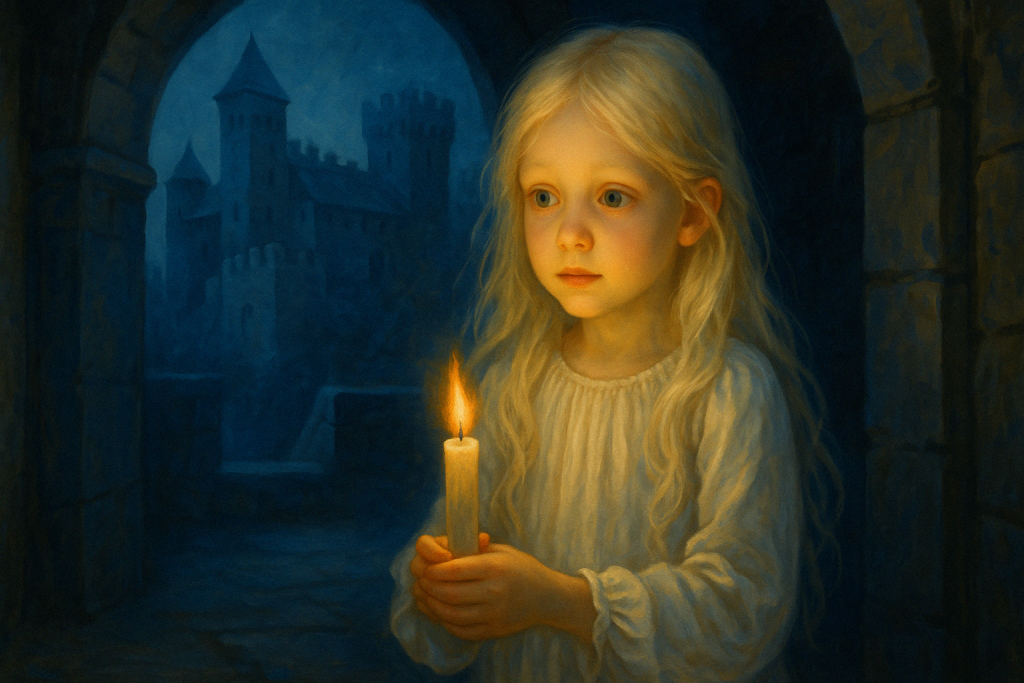
Albino child sitting in a stone room, dressed in a light-colored gown, illuminated by natural light entering through a window in Montebello Castle – artistic representation of Guendalina, the real Azzurrina.
Try to imagine this scene.
A medieval castle lost amidst the green hills of Romagna.
Outside, the sound of swords clashing during training. Inside, the muffled silence of a room where light barely filters through a narrow window.
In that room, a child.
Her skin pale, almost transparent. Her hair? White like the lime on the walls. Her eyes? Clear, liquid, like still water.
She has no disease.
She is not a witch.
She is simply albino.
Today we’d call it a rare genetic condition, affecting only a handful out of tens of thousands.
But in the 1300s?
In the 1300s, it meant just one thing: different.
And if you’re different in a world that doesn’t ask questions, you’re a problem.
In the Middle Ages, anything out of the ordinary was immediately labeled.
Albino? You’re a sign of the devil, or worse, the manifestation of a hidden sin.
It didn’t matter that you were only a child.
Superstitions were everywhere. Fears, stronger than reason.
And so Guendalina—yes, the real child behind the legend of Azzurrina—was locked within the walls of Montebello Castle.
For safety, they said.
But safety from whom? The world or herself?
This is the part of the story that hurts the most.
Because the truth is, nobody knows if it was an act of protection or shame.
No one knows if her parents, Ugolinuccio Malatesta and his wife, truly loved her… or if love was a feeling too risky to show openly in front of a “cursed” child.
What we know is Guendalina never went outside.
No one saw her.
She was always watched.
She lived a life of walls, cold corridors, and whispered voices.
Now stop for a moment.
A life where the world was always “out there”—and she, always “inside.”
Try to see this through today’s eyes.
Imagine a child locked away because her appearance might scare people.
It tightens something inside, doesn’t it?
Here the legend stops being a fairy tale.
Here Guendalina stops being a distant name and becomes real.
She becomes a representation of all the times the “different” has been locked away.
And let’s say it clearly: we still turn that key today, every time a child is teased for how they speak, how they move, their skin, or their eyes.
Every time we think something or someone should be “kept apart.”
Guendalina was a child. A child who perhaps only wanted to play, run in the courtyard, feel free.
But everything was taken from her, only because of appearances no one could explain.
Yet, despite all this, she has survived in stories.
Certainly, as a ghost.
But the fact that her name has reached us, seven centuries later… that must mean something.
Perhaps we couldn’t hear her voice.
But today, we can tell her story.
We can restore to her what was taken away: the dignity of being a person, not just a legend.
Guendalina: A “Different” Child in the Context of the 14th Century
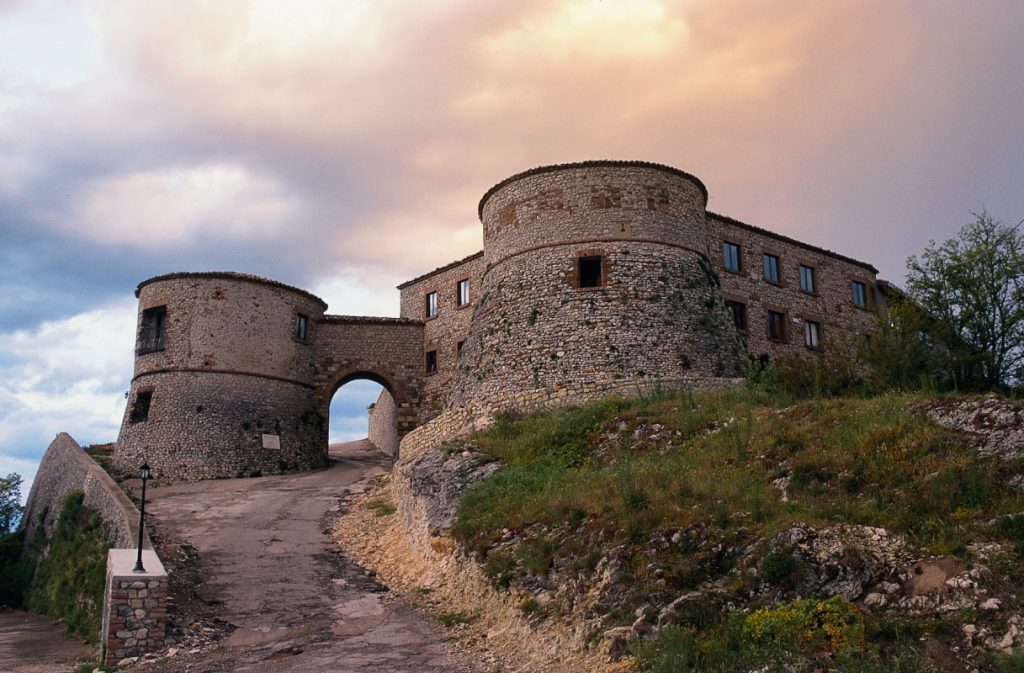
Albino child sitting in a stone room, dressed in a light-colored gown, illuminated by natural light entering through a window in Montebello Castle – artistic representation of Guendalina, the real Azzurrina.
Try to imagine this scene.
A medieval castle lost amidst the green hills of Romagna.
Outside, the sound of swords clashing during training. Inside, the muffled silence of a room where light barely filters through a narrow window.
In that room, a child.
Her skin pale, almost transparent. Her hair? White like the lime on the walls. Her eyes? Clear, liquid, like still water.
She has no disease.
She is not a witch.
She is simply albino.
Today we’d call it a rare genetic condition, affecting only a handful out of tens of thousands.
But in the 1300s?
In the 1300s, it meant just one thing: different.
And if you’re different in a world that doesn’t ask questions, you’re a problem.
In the Middle Ages, anything out of the ordinary was immediately labeled.
Albino? You’re a sign of the devil, or worse, the manifestation of a hidden sin.
It didn’t matter that you were only a child.
Superstitions were everywhere. Fears, stronger than reason.
And so Guendalina—yes, the real child behind the legend of Azzurrina—was locked within the walls of Montebello Castle.
For safety, they said.
But safety from whom? The world or herself?
This is the part of the story that hurts the most.
Because the truth is, nobody knows if it was an act of protection or shame.
No one knows if her parents, Ugolinuccio Malatesta and his wife, truly loved her… or if love was a feeling too risky to show openly in front of a “cursed” child.
What we know is Guendalina never went outside.
No one saw her.
She was always watched.
She lived a life of walls, cold corridors, and whispered voices.
Now stop for a moment.
A life where the world was always “out there”—and she, always “inside.”
Try to see this through today’s eyes.
Imagine a child locked away because her appearance might scare people.
It tightens something inside, doesn’t it?
Here the legend stops being a fairy tale.
Here Guendalina stops being a distant name and becomes real.
She becomes a representation of all the times the “different” has been locked away.
And let’s say it clearly: we still turn that key today, every time a child is teased for how they speak, how they move, their skin, or their eyes.
Every time we think something or someone should be “kept apart.”
Guendalina was a child. A child who perhaps only wanted to play, run in the courtyard, feel free.
But everything was taken from her, only because of appearances no one could explain.
Yet, despite all this, she has survived in stories.
Certainly, as a ghost.
But the fact that her name has reached us, seven centuries later… that must mean something.
Perhaps we couldn’t hear her voice.
But today, we can tell her story.
We can restore to her what was taken away: the dignity of being a person, not just a legend.
June 21, 1375: A Storm, a Game, and a Disappearance Wrapped in Mystery
There are days that begin like any other.
And then something happens.
A crack. A turning point. A moment etched in memory, one that no one can forget, even after centuries.
On June 21, 1375, at Montebello Castle, it was the day of the summer solstice.
Long daylight, heavy air, the oppressive heat of the hills.
But also—as often happens here—a sky that quickly shifts mood, threatening rain in the middle of the afternoon.
Guendalina was there, in the castle. She held her rag ball, one of those simple, innocent games meant to distract, to imagine a lighter world.
Yes, despite everything, she played.
Occasionally, between whispered prayers by a servant and the distracted gaze of the guards, she was granted a few minutes of freedom.
Not true freedom. Controlled, silent, supervised freedom. But better than nothing.
That ball, hand-sewn by one of the servant women, had become her little talisman.
She threw it against the wall, caught it mid-air. Then she’d run across the stone floor, chasing it with quick, almost joyful steps.
Until that moment.
Because on that day, suddenly, the ball rolled away.
It slipped down the stone steps leading to the underground icehouse, a cold room beneath the castle used to store food and wine, but also to hide everything that needed to remain unseen.
The two guards watching her saw her run down. They didn’t shout. She was just a child retrieving her toy.
But seconds later, something inexplicable happened.
A scream.
A sob.
Then silence.
The guards rushed down with torches.
They checked every corner, every chest, every crack. They called other servants. They searched shelves, barrels, even through straw.
But no trace of Guendalina.
Nor of the ball.
Nothing.
As if she had vanished into thin air.
The storm exploded at that very moment. A sudden roar, a lightning bolt cutting through the valleys, heavy rain pounding the towers.
The castle seemed to weep with them.
Day turned into night. The search lasted hours, then days.
But Guendalina was never found again.
And with her disappeared the only thing that truly belonged to her: that small rag ball, symbol of a fragile, broken everyday life.
That’s when the story changed shape.
Because a tragic, inexplicable event, destined for silence, began to be told.
Whispered in kitchens. Repeated to children. Passed from mouth to mouth until it left the castle and became legend.
From that moment, Guendalina became Azzurrina.
No longer a child. No longer a daughter.
But a presence. A ghost. An echo.
A voice that, according to some, is still heard today—every June 21, every five years, when the storm returns knocking—from the icehouse.
A laugh? A cry? A call?
We don’t know.
And perhaps that’s exactly what makes her immortal.
But how does a legend really come about?
In the next chapter, I will tell you how the voice of Guendalina traveled through the centuries, through word-of-mouth and suggestion, becoming one of the most fascinating mysteries in all of Romagna.
From Word of Mouth to Eternal Myth: How Guendalina’s Story Became the Legend of Azzurrina
Every legend begins with a whisper.
And then, like a game of telephone, every voice adds something.
A detail.
A shadow.
An emotion.
The story of Guendalina Malatesta, who disappeared in 1375 in the icehouse of Montebello Castle, was no exception.
In the days, months, and centuries following her disappearance, her story was not only remembered.
It was told.
And with each retelling, the memory took on new shades.
From “an albino girl who vanished mysteriously,” it became “a special child,” “a presence still felt,” “a restless soul that appears every five years, on June 21, during thunderstorms.”
All of it tied to a name that no one could ever erase:
Azzurrina.
Visitors to the castle, guides, local farmers, even religious figures… they all had their own version.
And as often happens with oral traditions, the more time passed, the harder it became to distinguish fact from fiction.
But there’s more.
In 1990, during one of the usual recordings made inside the icehouse, something truly unexpected happened.
At the end of the tour—on June 21, right in the middle of a summer downpour—some technicians reported having recorded unexplainable sounds.
A cry? A laugh? A voice calling?
The tape is still debated today. Some hear a wail, others a song, others nothing at all. But it’s precisely this ambiguity that further fuels the collective imagination.
Because the supernatural, when uncertain, draws us in.
Mystery is part of our nature.
We like to believe there’s “something more.” That the past is not just dust, but presence.
That there is a place where history and myth hold hands.
And Montebello Castle is perfect for this.
A real child, an unexplained event, an evocative name, mysterious sounds…
All the ingredients are there.
But what we often forget is that at the center of it all, there’s always her: Guendalina.
A fragile, “different” girl, who lived in a harsh time.
A daughter loved or feared—we’ll never know.
A voice that today, more than frightening us, moves us.
Because the true heart of the legend of Azzurrina isn’t the ghost.
It’s the story of a girl who just wanted to live.
And that’s exactly why it’s worth going to Montebello. In person.
Not just for the legend.
But to hear the silence in those rooms.
To look deep into the icehouse.
And maybe—if your heart is open and your ears are tuned—you might still hear the echo of a ball rolling across the floor.
And if you’re on vacation in Rimini, or planning to return, Montebello is less than an hour away.
You should definitely take the opportunity.
Plan a day trip into the hinterland, among medieval villages, castles, and mysteries. And in the evening, unwind by the sea.
Check out the offers at Aqua Hotel Rimini, perfect for families, couples, and curious travelers like you.
Here, you’ll find true hospitality, traditional Romagnol cuisine, and a perfect base to explore the entire region.
👉 Discover the offer → Aqua Hotel Rimini – Current Offers
And who knows… maybe after reading this story, on the night of June 21, you’ll hear it too.