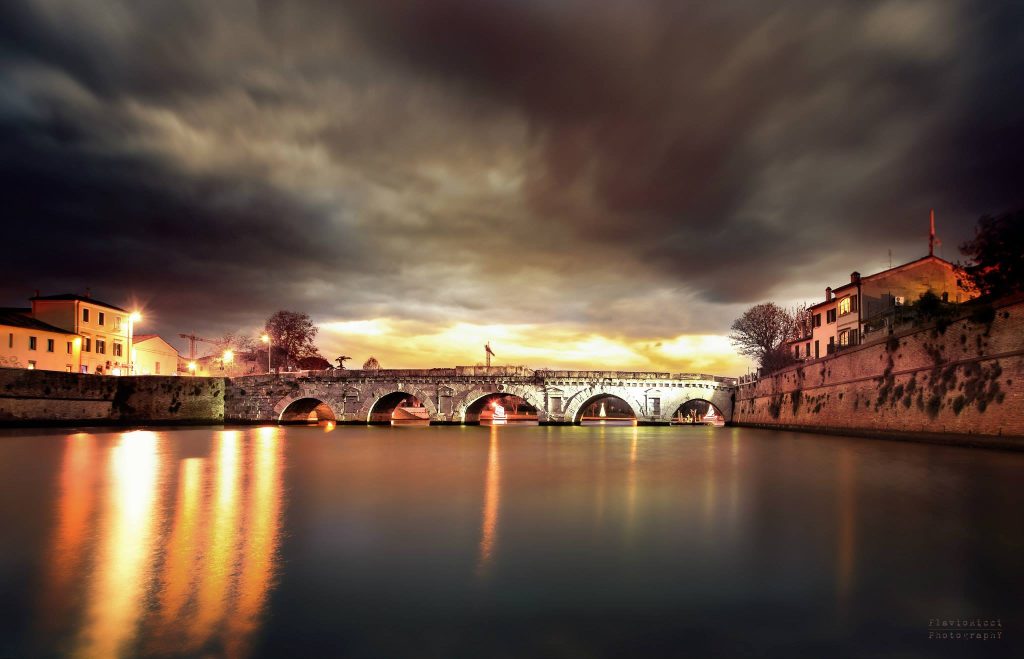
September 1944. Night envelops Rimini as German Marshal Trek Esere holds in his hands an order that could erase two thousand years of history. The spaces for mines had already been carved into the arches of the Tiberius Bridge—still visible today—ready for the explosives that were supposed to destroy this millennia-old monument during the Nazi retreat.
But that night, Marshal Trek Esere carried out an act of silent rebellion. He disobeyed the order to blow up the bridge, thereby saving one of the city’s most precious symbols. A brave gesture that allows us today to admire this masterpiece of Roman engineering, as resilient as the Istrian stone it was built from.
Did you know that this wasn’t the only crucial moment in the bridge’s history? In the next paragraph, I’ll take you back in time to the 6th century, when during the Gothic War, the bridge faced one of its most dramatic challenges…
The Scar of the 6th Century: A Story Written in Stone
Crossing the Tiberius Bridge, if you look up toward the arches, you’ll notice one that’s “different”. It has a slightly ogival shape, while the others follow the classic Roman semicircular arch. This “imperfection” is actually a page of history carved into stone.
It’s the year 552 A.D., during the Gothic War. In those dramatic days, one of the bridge’s arches was deliberately demolished. The reconstruction that followed couldn’t replicate the harmonious perfection of the Roman architects, leaving that distinct shape which we can still observe today.
It’s as if the bridge itself were telling its own story through this architectural scar. A detail that bears witness to the monument’s ability to survive and be reborn after each challenge.
But the story of this arch doesn’t end there. In 1672, a violent earthquake once again tested the resilience of our bridge…
When the Earthquake Shook History
The earth trembled violently that day in 1672. The arch of the Tiberius Bridge, the same one that had stood for more than a century after its medieval reconstruction, collapsed completely, plunging into the waters of the Marecchia River. It was as if the river itself wanted to swallow a piece of our history.
But the citizens of Rimini did not surrender. Eight years later, architect Martinelli from Ferrara came up with a solution both ingenious and daring: to use the stones from the San Vito Bridge to reconstruct the fallen arch. A “loan” from history to save history.
And do you want to know a curious fact? Those original stones, which had fallen into the river during the collapse of 1672, remained submerged for over three centuries. Only during a careful restoration between 1989 and 1991 were they finally recovered, and today you can admire them in the Marecchia Park, silent witnesses of this incredible story.
But fate was not yet done testing our bridge. Another two and a half centuries would have to pass before its most dramatic trial, when a Nazi order threatened to erase this monument forever…
The Disobeyed Order: When a Man Saved the Bridge
During the final phase of World War II, the Tiberius Bridge was once again at risk of disappearing forever. The mine slots had already been carved into the arches—you can still see them today—ready for the explosives that were supposed to destroy the monument during the German retreat.
But Marshal Trek Esere, who had received the order to destroy the bridge, made a decision that would change history: he disobeyed. An act of courage that allowed the bridge to continue telling its two-thousand-year story.
Historical sources don’t tell us why the marshal chose to spare the bridge. We only know that thanks to his decision, this monument—which is such a deep part of Rimini’s identity that it appears in the city’s coat of arms, alongside the Arch of Augustus—is still here to bear witness to two thousand years of history.
Today, by walking across the now pedestrianized bridge, you can admire its majesty and reflect on all the challenges it has overcome over the centuries…
A Bridge Between You and History
Let me share a secret: The best time to visit the Tiberius Bridge is at dawn. When the city is still asleep, there’s a special silence that wraps around its ancient stones. It’s in those moments that you can truly hear its voice.
Stop in the middle of the bridge. Rest your hand on the parapet, as millions before you have done. Do you feel the warmth of the stone beneath your fingers? That same stone has felt the passing of Roman legionaries, has trembled under the weight of medieval carts, has resisted wars and earthquakes, has even defied Hitler.
Look at the slightly irregular arch: it speaks of a wound from the 6th century, when the Goths tried to destroy it. Notice the slots in the arches where the mines were supposed to be placed in 1944: they whisper the story of the marshal who chose to save the bridge. Every scratch, every imperfection, is a page of history waiting to be read.
Do you want to live this feeling? The Aqua Hotel is the perfect starting point for your journey through time. Just a few steps from the bridge, it allows you to choose your magical moment: the silent dawn, the golden sunset, or the starry night when lights reflect on the waters of the Marecchia.
Come write your own page of history.
Book your stay at Aqua Hotel now CLICK HERE, and get ready to live an experience you’ll never forget.