There's a name scratched into a wall.
A patient carved it there, almost two thousand years ago.
Not on paper. Not on parchment. On a plaster wall, with something sharp — a nail, maybe, or the tip of a stylus. The gesture of someone who wanted to leave a mark. Who wanted to say: I was here, and this man saved me.
He writes the doctor's name. Says he lives there. And sums him up in two words.
Uomo bonus.
A good man.
Under Piazza Ferrari — the central square at the heart of Rimini — buried for seventeen centuries, lies the story of a Greek surgeon who operated in the 3rd century AD. His name was Eutiche. And if you ended up in his hands, you were lucky.
But to understand who Eutiche was, you need to go back much further. To a day in 268 BC, when Rome made a decision that would change the history of this coastline forever.
Ariminum: the city you didn't know you knew
The Roman Senate, in 268 BC, sends six thousand soldiers to the mouth of the Marecchia river.
They're not generals. Not legendary heroes. They're farmer-soldiers from Lazio and Campania, enlisted to found a colony in Gallic territory. An outpost. A checkpoint to push Roman expansion northward.
Those six thousand men look at the river, look at the estuary, look at the sea. And decide to call the city Ariminum.
Today: Rimini.
It's not a random choice. That estuary is a strategic point that few places in Italy can match. Three of the great consular roads that hold the empire together converge here.
The Via Emilia, cutting across the Po Valley toward Piacenza.
The Via Popilia, climbing toward Friuli and Istria.
The Via Flaminia — the ancient road that ran straight to Rome.
Whoever controlled Rimini controlled the traffic of all northern Italy. Armies, merchants, messengers, pilgrims — everyone passed through here. Rimini was the hub where north and center met.
In a few centuries, Ariminum becomes one of the most important cities on the peninsula. Temples rise, domus multiply, the forum expands — the great square where in 49 BC Julius Caesar stops to address his troops after crossing the Rubicon. Right there, in that same spot now recognizable as Piazza Tre Martiri.
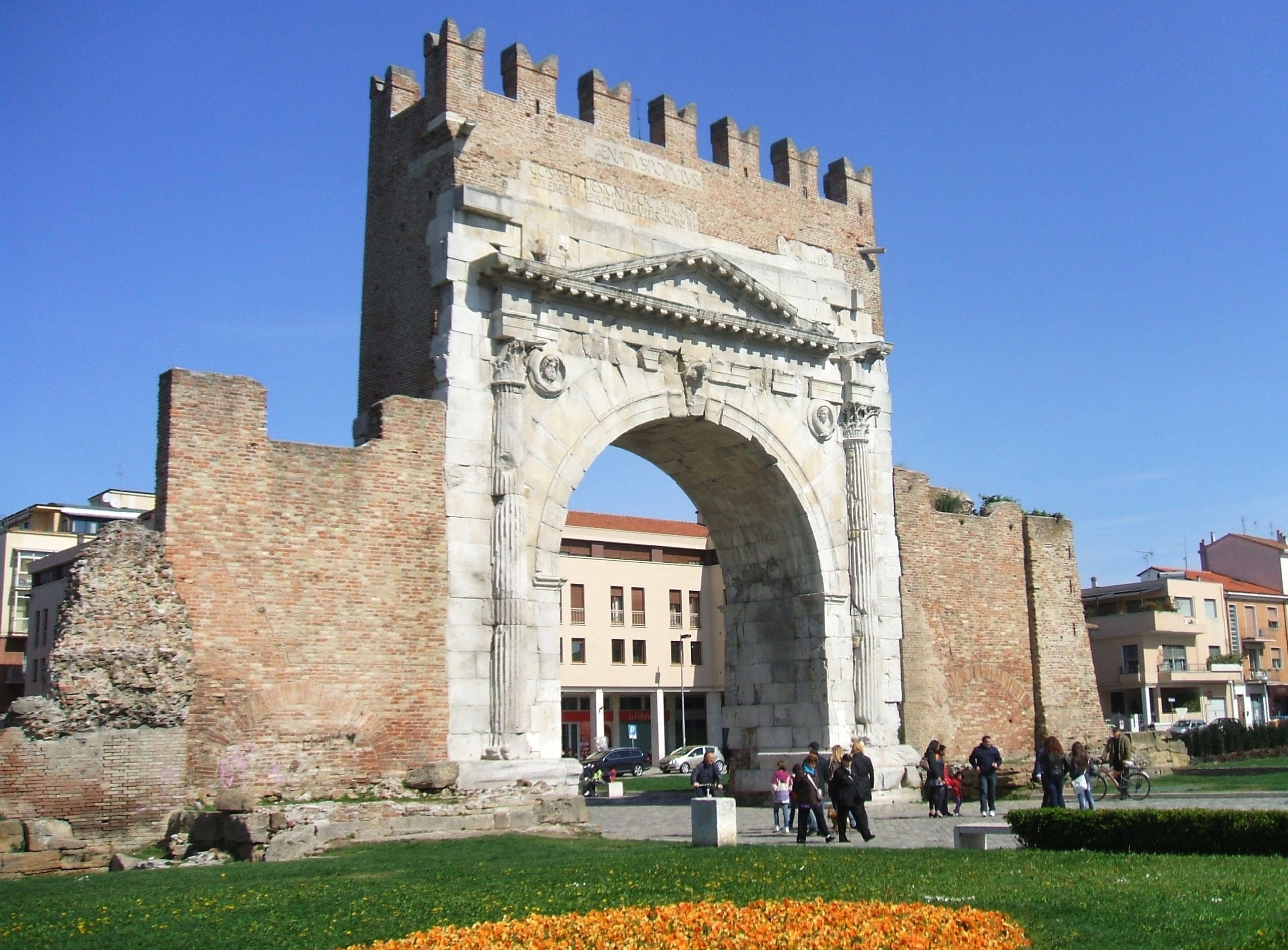
Augustus marks the city with his monuments. Where the Flaminia enters the city, he erects a triumphal arch — still one of the entrances to the old town today. It had no gates. It couldn't be closed. It was a message carved in stone: no more danger. Come in.
On top stood a gilded bronze quadriga, with Augustus himself holding the reins. Then came the Ponte di Tiberio — five arches spanning the Marecchia, still standing, still used every day.
This was the city where Eutiche opened his practice.
Eutiche's Rimini
Picture the city in the 3rd century AD.
The forum is packed. Merchants selling fabrics, spices, ceramics. Orators debating politics. Retired soldiers telling stories of wars in distant provinces.
There's a theater — capable of holding thousands of spectators. Thermal baths where people meet, do business, talk. An amphitheater for the games.
Rimini at that point had an estimated population of 20,000 to 30,000 — one of the largest cities on the peninsula. Paved streets, sewers, aqueducts. Temples dedicated to deities from across the empire. And with trade came cultures, religions, languages.
And doctors.
A Greek surgeon in a 3rd century Roman city wasn't unusual. It was the norm. The Romans weren't ashamed to acknowledge the superiority of Greek medicine. Julius Caesar's personal physician was Greek. Augustus's was Greek. The Empire's medical tradition was almost entirely of Greek or Greek-Eastern origin.
In this context, Eutiche was a respected professional. A man with a reputation to maintain.
And an inscription on a wall tells us he succeeded.
The discovery beneath the square
It's 1989. The municipality of Rimini authorizes renovation works in Piazza Ferrari.
The workers begin to dig. And find themselves face-to-face with something unexpected.
Layer by layer, signs of a buried city emerge. Mosaics. Walls. Objects. A stratification of overlapping centuries — like flipping through a book where each page is a different era.
What we call the Domus del Chirurgo — the Surgeon's House — is not one house. It's two houses built on top of each other at different times.
The more recent one dates to the 5th–6th century AD. It belonged to a wealthy family. Its geometric mosaics are extraordinary: elaborate patterns, vivid colors, some tesserae in glass paste. This family had money, taste, the kind of refinement that comes when you can afford the best.
But they didn't know they were building their home on top of something even more precious.
Because beneath it, deeper still, Eutiche's house had been sleeping for centuries.
3rd century AD. Today you step in through the glass structure in Piazza Ferrari and in a few steps you travel seven hundred years of history.
Who was Eutiche
We know his name thanks to that grateful patient — the one who scratched the letters into the plaster. He gives us the name: Eutiche. Says he lives there. And calls him a good man.
Eutiche. In Greek: fortunate, lucky. A very common name among doctors in ancient Rome — and almost all of them came from the eastern Mediterranean, where the world's most advanced medical schools were found.
He was Greek-Eastern. We're almost certain of it.
From the pinax — a small painted glass panel with an Eros and a dolphin, probably from a Corinthian workshop. From the statuette of an Epicurean philosopher. From the objects of the cult of Jupiter Dolichenus — a deity of Syrian origin. And from the breadth of knowledge his instruments reveal, formed only in the great schools of the eastern Mediterranean: Alexandria, Pergamon, Cos — the island of Hippocrates.
There's also a telling silence: among his instruments, gynecological tools are completely absent. Which suggests military training. A field medic, used to battle wounds, arrows to extract, fractures to reset.
Every morning the waiting room filled up. People with eye problems. Foot pain. Battle veterans. Those needing dental work.
And some who, once healed, took a stylus and carved his name into a wall.
The room of Orpheus
The room where Eutiche operated is called the room with the Orpheus mosaic.
The mosaic is beautiful. Elaborate, colorful, with glass paste tesserae that still shimmer after seventeen centuries. At the center: Orpheus — the poet of Greek mythology who with his lyre could calm every creature, even the fiercest. The one who challenged death and descended into the Underworld. The one who, for a moment, won.
It wasn't a random decorative choice.
It was a message to the patients entering that room: Orpheus defeats death. And the doctor who operates here trained in the world's finest schools.
Part reassurance. Part propaganda. And maybe a little superstition too.
150 instruments and a spoon that saved lives
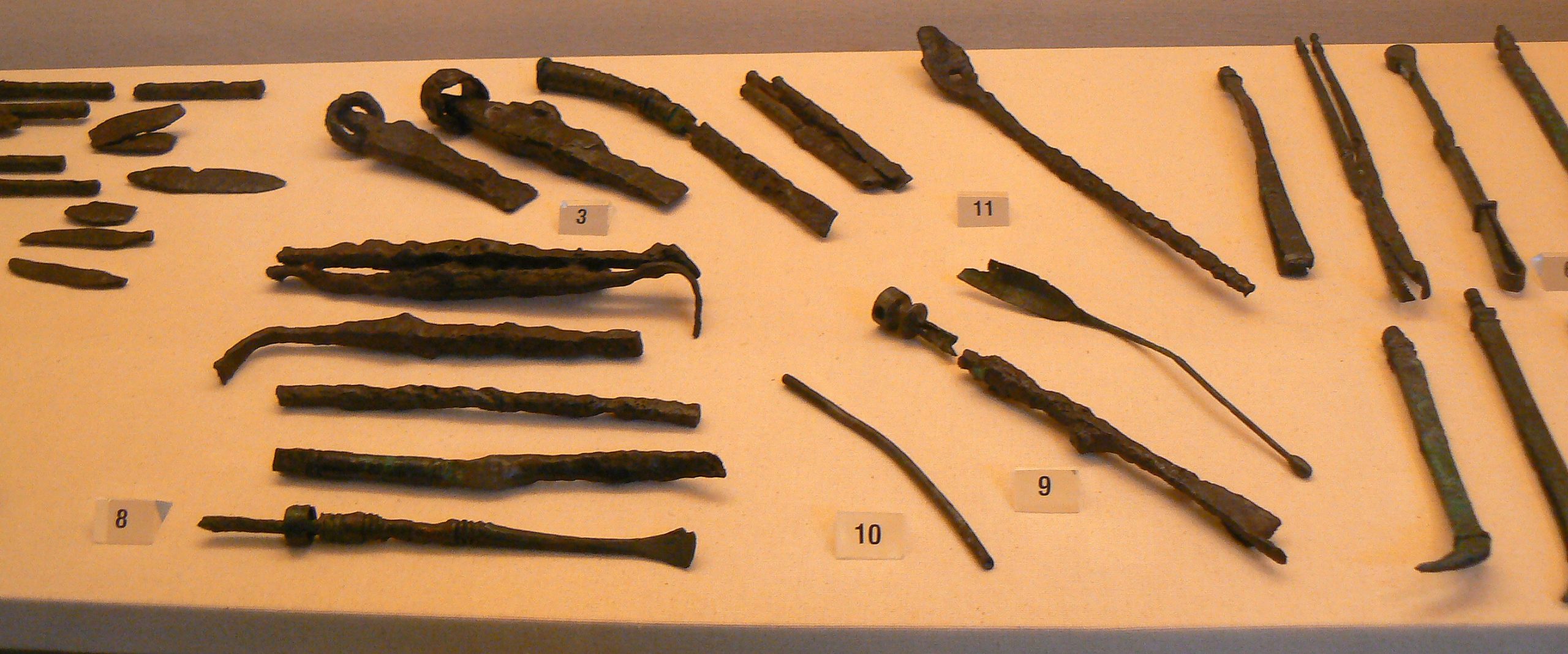
More than 150 surgical instruments. In bronze. In iron. Still in their cylindrical cases, in wooden boxes, wrapped in leather rolls.
When they found them, they were right there. Exactly where Eutiche had left them — or where they'd fallen when the roof collapsed.
Among them: the scalpels. Several types. One is the equivalent of a Swiss Army knife: the handle incised and lifted flaps of skin, the other side cut. The blades were interchangeable — like razor blades, two thousand years before razors existed.
Then the forceps. To hold open the edges of a wound. To remove tonsils. To extract arrows, splinters, infected material. Tools for ophthalmology, orthopedics, dentistry, urology.
Hi-tech objects — produced by specialist craftsmen working to precise surgical specifications, exactly like a medical device company today.
And among all of them, one tells a story by itself.
It looks like a small spoon.
It's called the Diokles spoon — after the Greek physician who invented it in the 4th century BC. And it's practically unique in world archaeology.
The problem: an arrow lodged deep in the body. Pulling it out by force would sever arteries and muscles. Almost certain death.
The solution: insert this long hollow spoon along the arrow shaft, cover the tip, and extract the whole thing with a gentle rotation. The barbs stay protected. They cut nothing.
Simple. Elegant. Brilliant. In 260 AD.
What science didn't know yet
There's something striking when you look at these instruments.
They could perform complex surgical procedures. Extract arrows, reset bones, operate on cataracts. The techniques were refined, the instrumentation precise.
But they didn't know why wounds got infected.
They didn't know about bacteria. Didn't know what a virus was. Had no antibiotics. No general anesthesia — just opium, mandrake, wine, and the surgeon's speed.
Eutiche could do a great deal. And despite what he didn't know, he managed to heal. We know because someone carved his name into a wall.
A doctor who loses all his patients doesn't earn the title of good man.
But surgical mortality was high. And Eutiche knew it. That's why the Orpheus mosaic. That's why the amulets beside the scalpels. Not ignorant superstition. The rational response of an intelligent man to the uncertainty he couldn't eliminate.
The pharmacy and the day hospital
Eutiche wasn't just a surgeon. According to the precepts of ancient medicine, the physician was also the pharmacist. He prepared his own medications.
He extracted them from herbs, mixed them, stored them in terracotta vials with Greek labels. One is still legible: abrotono — southernwood (Artemisia abrotanum). For skin conditions, calluses, wounds. As a tea it had diuretic properties. According to tradition, in certain cases also aphrodisiac.
Adjacent to the practice was the cubiculum — the recovery room. Eutiche's day hospital. Operated patients were kept there for observation: surgery in the morning, a few hours' recovery, discharged in the afternoon. Exactly like a modern day hospital.
Among the finds was an object shaped like a terracotta foot, with an opening on top. An ancient hot water bottle: warm or cold water, placed on the painful area. For arthritis, arthrosis. The same principle as a physiotherapist today.
Two thousand years ago.
The Alemanni fire
In 260 AD, the Empire was going through a deep crisis. The barbarians sensed the moment.
The Alemanni came down from the Alps. Not to conquer. To raid.
Eutiche's house burned.
The roof collapsed.
The instruments, the mosaics, the vials — everything crashed to the floor. Rubble covered everything. Then dust. Then centuries.
We don't know if Eutiche escaped. The archaeologists found no skeletons — but they found spears scattered in the courtyard. His? The attackers'? We'll never know.
It wasn't a catastrophe.
It was a gift.
The collapse sealed the instruments in their cases. Covered the mosaics and protected them. Preserved the vials with their Greek labels. Kept intact the name carved by the grateful patient.
Without that fire, we'd have nothing of all this.
Uomo bonus.
Underground Rimini: a book still being read
Eutiche's story isn't an isolated case.
Rimini is a city that grows over itself. Dig a few meters and you find Roman roads, house foundations, pipes, coins, ceramics. Under the Cathedral there are Roman remains. Under Piazza Tre Martiri the traces of Caesar's forum. Under the Teatro Galli the ruins of the Roman theater.
And this is only the part we know about.
The collaboration between the municipality of Rimini and the Soprintendenza — the Italian heritage authority — has made it possible to open to the public places that would otherwise have stayed buried. The Domus del Chirurgo is the most extraordinary example: instead of building a parking lot on that square, they chose to preserve it. Not obvious. In many Italian cities, discoveries get documented and covered back up because the building site can't stop.
In Rimini, in this case, they chose differently.
And today we can read the story of a good man who operated in the 3rd century.
What to see today
The glass structure in Piazza Ferrari is visible from outside too, with free access. You can see the upper mosaics while heading to grab a coffee.
To truly understand what you're looking at, you need to go inside. The guided tour takes about an hour.
At the Museo della Città (Via Luigi Tonini, 1 — the city museum) the surgeon's studio and the day hospital room have been reconstructed with recreated original furniture. That's where the glass pinax is. Where the hand with Jupiter Dolichenus's snake is. Where the vials with Greek labels are.
That's where Eutiche is. More complete and present than you'd expect for someone who lived seventeen centuries ago.
Practical information
Domus del Chirurgo — Piazza Ferrari, historic center of Rimini.
Hours: Tuesday–Sunday 10:00–13:00 and 16:00–19:00. Closed Monday. In summer (June–August) evening opening Wednesday and Friday, 21:00–23:00.
Prices: €7 full price, €5 reduced (over 65, university students, groups of 12+). Guided tours with booking 7 days in advance: €35 weekdays, €45 weekends.
Museo della Città — Via Luigi Tonini, 1. Worth visiting as a complement.
Every time I walk through Rimini's historic center, I think about this.
Beneath our feet is an entire city.
There are mosaics, surgical instruments, names scratched by people who lived here before us. There's a Greek doctor from the 3rd century who every morning opened his practice, lit a lamp, and waited for his patients. There's a grateful patient who took something sharp and carved into a wall the simplest and most powerful words you can write about someone.
A good man.
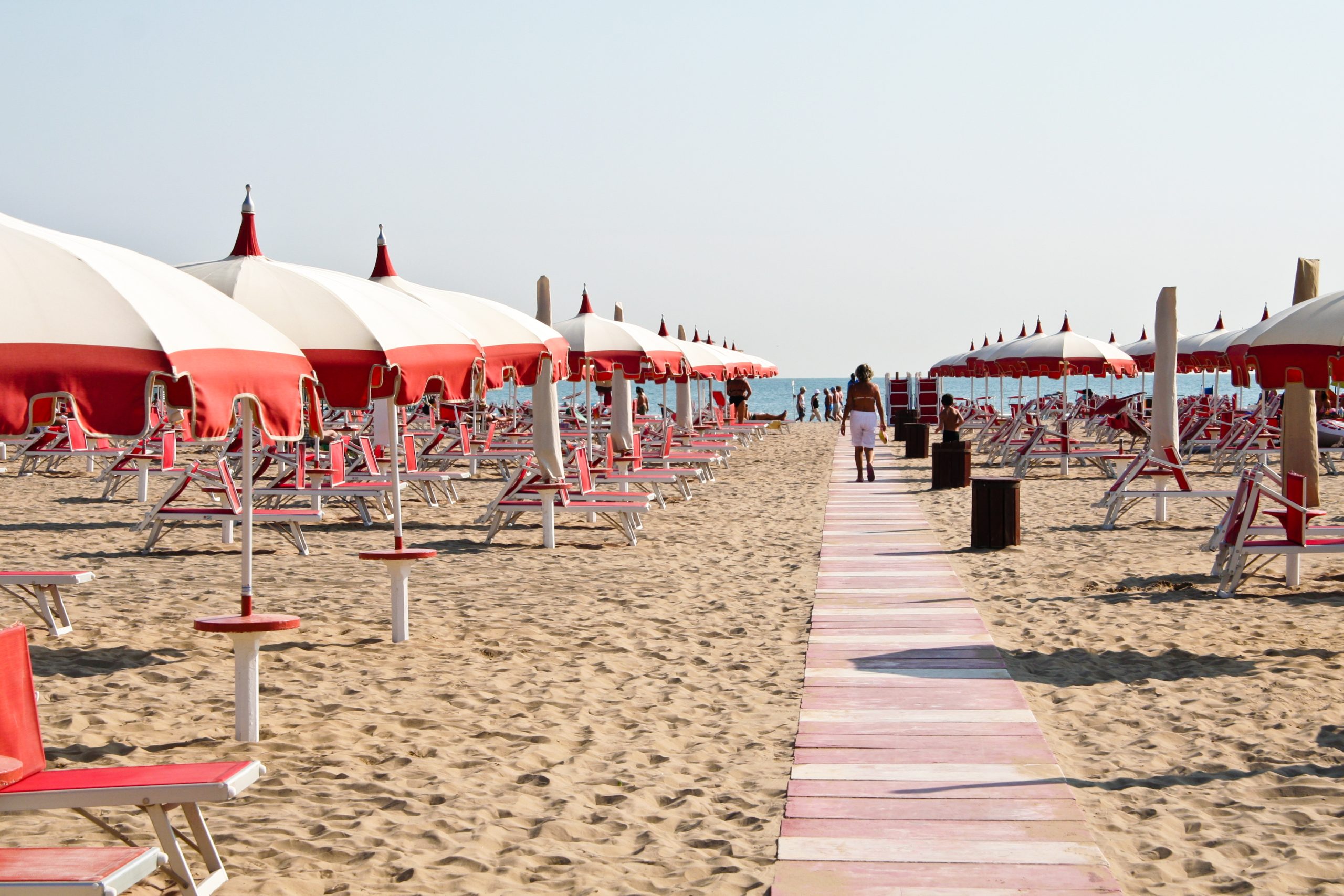
Rimini isn't just the sea.
It's this. It's two thousand years of history sleeping beneath our steps, ready to wake whenever someone is curious enough to dig a little deeper.
And if you want to see it like this — through the eyes of someone who's known it from the inside, twenty years of work alongside the people who arrive and leave — you know where to find me.
Click here for Aqua Hotel offers if you want to come back to Rimini.
That's where I work. That's where every morning, looking out at the historic center from that terrace, I think I'll never finish discovering this city.
Every guest who leaves with something new in their eyes — a story, a place, a name scratched into a wall — is the reason ScopriRimini.it exists.