Every day, hundreds of people walk past Largo Giulio Cesare without looking up.
They check their phone. Wait for the traffic light. Head into Parco Cervi, sit on a bench, drink a coffee.
Two steps from the Arch of Augustus — two thousand years of stone that nobody ignores — there’s a plaque that almost nobody reads.
Yet carved into that stone is the exact moment Rimini stopped being at war.
The morning of September 21st, 1944.
7:30 a.m.
The signature nobody expected — written in Greek
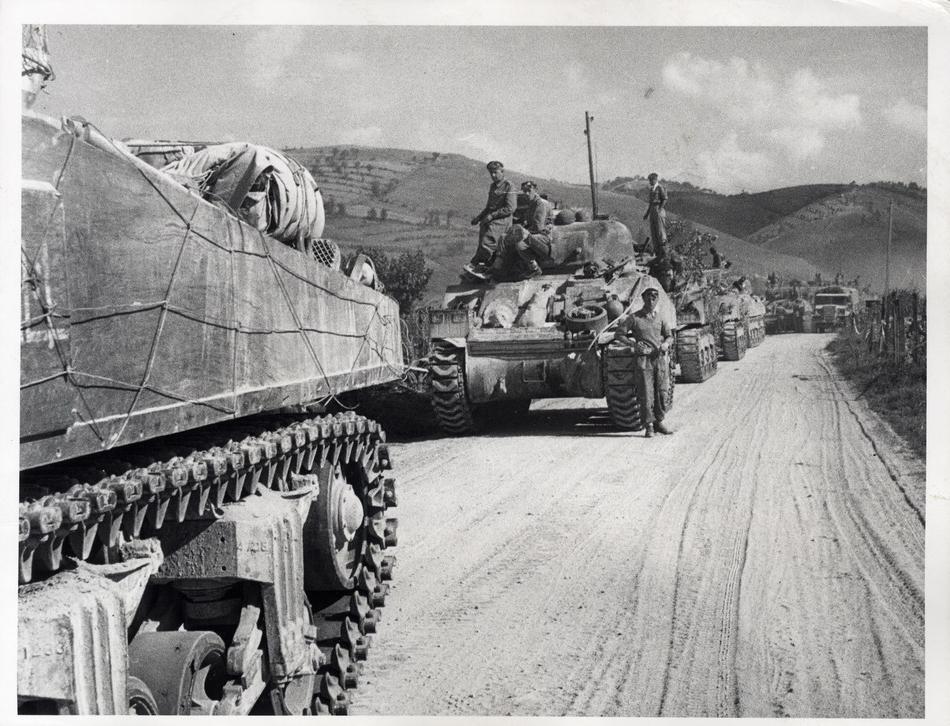
September 1944. The German Gothic Line cuts across the Apennines like an open wound. From Pesaro to Rimini, Allied troops push north. The Germans hold firm. Every hill, every house, every bridge becomes a battle.
On September 20th, at 4:00 p.m., the 1st Battalion of the 3rd Greek Mountain Brigade attacks German positions south of Rimini. Thirty minutes later, the 2nd Battalion follows. They fight through the night.
At dawn on September 21st, the German resistance breaks.
At 7:30 in the morning, in a room still reeking of war, Captain Michael Apostolakis receives the city’s surrender.
The capitulation document is written in three languages: Greek, Italian, English.
In that order.
Greek first.
Because the 3rd Greek Mountain Brigade was the first Allied force to enter the city. This was their moment. Their signature.
Who were these Greeks — and why were they here
Nobody teaches you this in school. No travel guide mentions it.
The 3rd Greek Mountain Brigade was formed on May 31st, 1944, in Lebanon. Three thousand four hundred and fifty soldiers — Greek survivors who had fled Nazi occupation, volunteers from the Greek community in Egypt — trained at the Insariyyeh camp near Beirut.
Their commander was Colonel Thrasyvoulos Tsakalotos.
Training ended July 28th, 1944. On August 8th the brigade sailed from Haifa. On August 11th they landed at Taranto.
They weren’t there by chance. Greece had been invaded by Italy on October 28th, 1940. Then by the Germans. The Greek government in exile wanted a prestigious military victory — something to prove that Greece was fighting, that Greece existed, that Greece would recover.
Rimini would be that victory.
On September 3rd, 1944 the brigade was assigned to the 1st Canadian Division. Eighteen days later they would be the first to enter the city.
What happened between September 20th and 21st
On the night of September 19th-20th, Canadian troops broke through at the hill of Covignano, near the Church of Santa Maria della Colonnella.
On the afternoon of September 20th, the Greeks attack from the south. The 1st Battalion at 4:00 p.m. The 2nd Battalion at 4:30. They push through destroyed streets, collapsed buildings, minefields.
The Germans had held Rimini for months. Every building was a fortified position. Every bell tower, an observation post.
The Greeks fight through the night.
At dawn on September 21st, the resistance breaks.
At 7:30 — two and a half hours before the summer sun rises — Captain Apostolakis enters the room where Rimini’s National Liberation Committee waits. Gomberto Bordoni, committee president, signs for the city. Romolo Bordoni, Biagio Del Prato, Remo Samaritani, Umberto Antoni are present.
The document passes from hand to hand.
Greek. Italian. English.
Rimini is free.
At 9:00 a.m., the Greek flag rises on the balcony of Palazzo Garampi, in Piazza Cavour.
The arch that saw everything — two thousand years of history in one spot
Largo Giulio Cesare, at the entrance to Parco Cervi, facing the Arch of Augustus.
The arch was built in 27 BC, during the reign of Gaius Julius Caesar Octavianus — the first Roman emperor. It is the oldest Roman monument in northern Italy still standing. Two thousand years of history compressed into a travertine marble arch.
It watched Roman legions march north along the via Flaminia.
It watched the barbarian invasions of the 5th and 6th centuries.
It watched Frederick II and the Malatesta family.
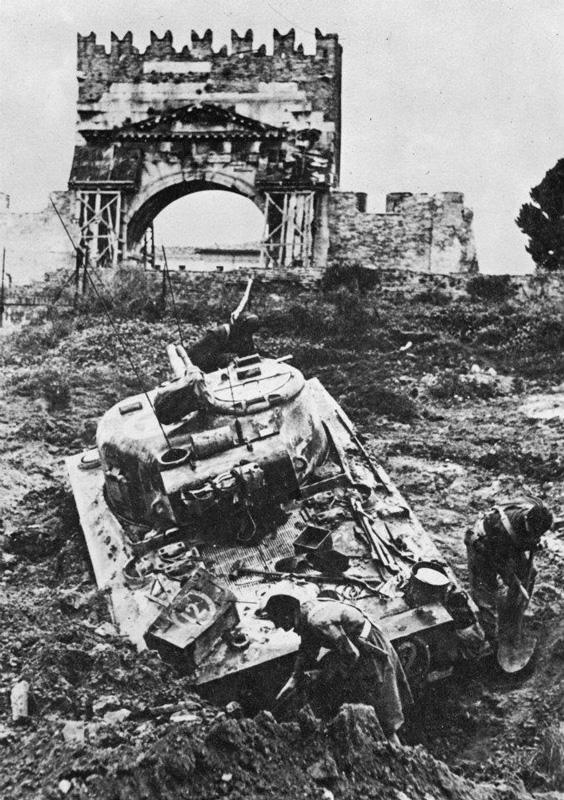
It watched Rimini burn under the bombings of 1943 and 1944.
And it watched, that September morning, a Greek captain walk toward the city with a surrender document in his pocket.
Next to the arch, a few steps away, stands the plaque that remembers all of this.
The inscription placed by Rimini’s Municipal Administration reads: “Gothic Line offensive September 21st 1944 liberation of Rimini as a warning of peace for future generations”.
Twenty-six words.
Tourists walk past it every day.
Almost none of them stop.
The price — 114 names in the Riccione cemetery
That signature wasn’t free.
At the Greek military cemetery in Riccione, along the Adriatic coast road, 114 Greek soldiers rest.
Throughout the Italian campaign, the 3rd Greek Mountain Brigade lost 433 men — 33 of them officers.
They had sailed from Haifa in August. They died in September, a few kilometers from the Adriatic Sea, for a city that wasn’t theirs.
For a freedom that was ours.
After the war, the Italian and Greek governments formally recognized the brigade’s contribution: the 3rd Greek Mountain Brigade received the honorary designation Rimini Brigade.
A name. A city. A debt that is never truly repaid.
How to find it — the plaque, the park, the arch
The commemorative plaque is at Largo Giulio Cesare, at the entrance to Parco Cervi, in Rimini. It stands in front of the Arch of Augustus — impossible to miss the arch, easy to miss the plaque.
Access is free, at any hour of the day.
Parco Cervi is open during daylight hours. Three minutes on foot from the historic center, less than one kilometer from Rimini station.
The Greek Military Cemetery in Riccione, where the 114 Greek fallen rest, is along the Adriatic coast road between Rimini and Riccione. Access is also free.
Frequently asked questions
When was Rimini liberated in World War II and who liberated it?
Rimini was liberated on September 21st, 1944. The 3rd Greek Mountain Brigade — 3,450 soldiers commanded by Colonel Thrasyvoulos Tsakalotos — was the first Allied force to enter the city. The surrender document was signed at 7:30 a.m., written in Greek, Italian, and English. Captain Michael Apostolakis received it on behalf of the Allied forces.
Where is the Gothic Line plaque near the Arch of Augustus in Rimini?
The commemorative plaque is at Largo Giulio Cesare, at the entrance to Parco Cervi, facing the Arch of Augustus. It is freely accessible at any hour. It is about a three-minute walk from Rimini’s historic center.
What is the “Rimini Brigade” and why do the Greeks have this name?
The “Rimini Brigade” is the honorary name given after the war to the 3rd Greek Mountain Brigade, in recognition of its decisive role in liberating Rimini on September 21st, 1944. It was the first Allied force to enter the city and receive the German surrender.
How many Greek soldiers died in the Battle of Rimini?
The Greek military cemetery in Riccione holds 114 Greek soldiers who died in the Battle of Rimini. Throughout the Italian campaign, the 3rd Greek Mountain Brigade lost a total of 433 men (33 officers and 400 enlisted soldiers).
When was the Arch of Augustus in Rimini built?
The Arch of Augustus in Rimini was built in 27 BC, during the reign of the first Roman emperor, Augustus. It is the oldest Roman monument in northern Italy still standing, erected at the beginning of the via Flaminia connecting Rimini to Rome.
When you’re in Rimini, walk to Largo Giulio Cesare. Read that plaque.
Then sit in Parco Cervi for a moment.
You know where to find me. At the Aqua Hotel, two steps from the sea — and twenty minutes’ walk from that stone plaque still waiting to be read.