On September 22, 1944, someone came back to Rimini.
Maybe they had left months before, like almost everyone else. Maybe they had waited for it all to end in some inland village, sleeping in haylofts, eating little, listening to the distant rumble of artillery as though it were a storm that would never pass.
That morning, word had spread: the Germans were gone.
Rimini was free.
They came back. And found a city that no longer existed.
What the sea doesn’t tell you
Rimini in summer is a near-perfect machine.
Beach umbrellas, lemon slushies, families passing sunscreen back and forth, children building sandcastles that the evening tide will take. There’s something hypnotic about that rhythm — and I understand why people get lost in it.
But Rimini is also something else.
It’s a city with two thousand years of history above its head and eighty-one years of silence beneath its feet.
The silence of those who never came back.
I’ve worked here for more than thirty years. I’ve walked thousands of guests through the historic center, past the Arch of Augustus, the Bridge of Tiberius. And every time we pass Largo Giulio Cesare, I stop for just a second.
There’s a bronze plaque there that almost nobody reads.
It tells of an army that entered this city one night. And of a city that was barely there to welcome it.
The city before the storm
To understand what September 1944 meant, you have to understand what Rimini was before.
Not just any city. A city with two thousand years of history written in marble and stone. The Arch of Augustus — the oldest Roman arch still standing in the world — had already been here for two thousand years when Hitler came to power. The Bridge of Tiberius, built between 14 and 21 AD, had watched so many armies pass that it had lost count.
Rimini was a city of forty thousand people. It had a port, an important railway junction, a military airfield. It was a strategic node on the Via Emilia and along the Adriatic coast.
And it was, simply, a living city.
Women buying bread. Boys kicking footballs in the squares. Fishermen leaving at dawn and returning with fresh catch that ended up in the harbour trattorias. Children going to school — or at least they did before the war made even that impossible.
Then the bombers came.
Three hundred and seventy-three
That’s not just any number.
Three hundred and seventy-three is the number of raids — air, naval and land — that Rimini endured between November 1943 and September 1944.
Almost one attack every single day, for ten months.
Think about what that means. Think about what it’s like to wake up every morning not knowing whether this is the day your kitchen ceiling comes down. Think about the air raid shelters, the cellars, the basements where people pressed together in the dark every time the sirens started to scream.
The Germans used Rimini as a crucial logistics hub to supply their defences on the Gothic Line — the vast military wall cutting across Italy from Pesaro to Massa, three hundred kilometres of bunkers, machine gun nests, trenches carved into the hills. The Allies knew it. And they struck.
On top of the air raids, one million four hundred and seventy thousand artillery shells fell on Rimini.
One million four hundred and seventy thousand.
Every shell left a hole. Every hole was a wall that no longer existed, a roof that came down, a life changed forever.
And the city — one of the most devastated in Italy relative to its size — held on, emptied out, crumbled.

The operation that changed everything
On August 25, 1944, Operation Olive was launched.
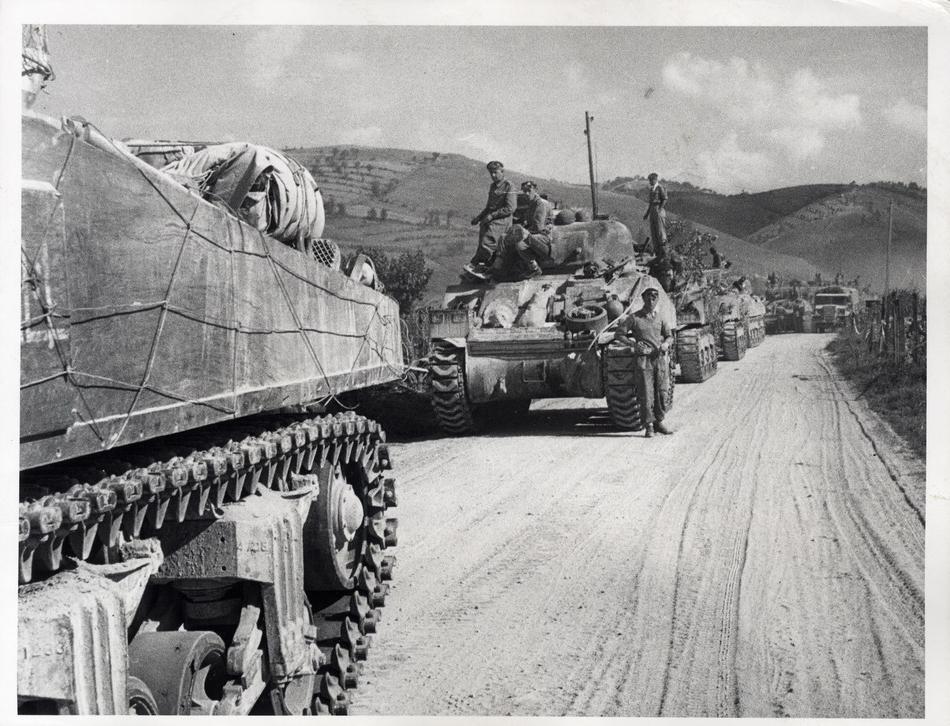
The British Eighth Army — over one million men in the field across the Italian front — attacked the Gothic Line on the Adriatic flank. The objective: break through Field Marshal Albert Kesselring’s defences, cross the Po Valley, and bring the war in Italy to an end.
Everything converged on Rimini.
The 1st Canadian Corps pushed from the south. The 2nd New Zealand Division pressed on the flanks. The 3rd Greek Mountain Brigade — three hundred and fifty kilometres of marching behind them, veterans of Africa and Greece — drove straight for the centre.
The Germans defended with what they had. The 1st Parachute Regiment, the 2nd Parachute Division, units of the Turkestan Legion. Hard men, experienced, who knew every centimetre of those defences.
The battle for Rimini officially began on September 13, 1944.
It lasted eight days.
Each day another piece of the city was liberated — and another piece became rubble. The airfield fell on September 15. The San Fortunato Ridge — the Germans’ last stronghold dominating the plain — on the 19th. On September 20, Canadian soldiers reached the outskirts.
On September 21, 1944, at 7:45 in the morning, Rimini’s mayor signed the surrender.
He signed it in three languages: Greek, English, Italian.
Because it was a Greek officer who received it.
The morning of September 22
Those who returned to Rimini the day after the liberation found a city that existed only in memory.
82% of buildings had been destroyed or severely damaged.
Only 2% — two in a hundred — had been left unharmed.
Think of any city you know. Remove eight buildings out of ten. Leave standing only one in fifty. What remains isn’t a city — it’s a lunar landscape of collapsed walls, burned beams, streets blocked by rubble, the smell of dust and ash mixed with salt from the Adriatic.
The streets were empty.
The population had dwindled to a handful of people — those who couldn’t evacuate, those who had stayed to protect what remained, those who simply had no other choice. Almost everyone else had fled months before, taking with them whatever they could carry.
Official casualties stood at 6,668 — civilians and military combined.
They weren’t a number. They were people with names, homes, families, morning habits — a coffee, a newspaper, a greeting to the neighbour who’d lived next door for twenty years.
The Arch of Augustus was still standing.
The Bridge of Tiberius was still standing.
The Germans had discussed blowing everything up before retreating — as they had done in so many other cities. They didn’t. And these ancient structures survived what the men of the twentieth century had not been able to build with anywhere near the same durability.
But the rest — the living fabric of the city, the houses, the palaces, the churches, the shops, the harbour warehouses — was gone.
What remains today
There are places in this city where memory can be touched.
Not in tourist guides. Not on illuminated signs. In places you have to look for, places you have to want to find.
The first is at Largo Giulio Cesare, at the entrance to Parco Cervi, in front of the Arch of Augustus.
There’s a bronze plaque there.
You see it as you walk toward the arch, perhaps with your phone out to take a photo. It’s at eye level. It’s not enormous. It doesn’t shout. But when you stop to read it, you stand still for a moment longer than expected.
It commemorates the Canadian soldiers who broke through the Gothic Line and liberated Rimini. It was unveiled in October 2004, sixty years after the events. Two hundred Canadian veterans were there — men who had fought here as young men and returned as old men to see what had become of the city they had freed. Canada’s Governor General, Adrienne Clarkson, was also present.
Two hundred boys returned as old men.
Two hundred stories that had begun on these streets and never truly ended.
A little further on, inside Parco Cervi, there’s a teardrop-shaped monument.
It dates from 2004. It has 54 tank-tread wheels set into the stone — one for each metre of the history that battlefield has crossed. The park was cleared of landmines that were still there. In 2015, a monument to Blessed Don Carlo Gnocchi was added — the military chaplain who, throughout those years of war, gathered thousands of orphaned and disabled children.

The memorial on the Via Emilia
There’s another place worth the detour.
At the junction of Via Emilia and Via Popilia, in a locality called Celle, there’s a concrete marker with a commemorative plaque. It’s not in the city centre. It’s not on any tourist route. It’s there, on a pavement, between the cars speeding past on the main road.
It reads: Gothic Line Offensive — Liberation of Rimini — September 21, 1944 — As a reminder of peace for future generations.
As a reminder of peace.
Not a celebration of victory. Not a glorification of war. A reminder.
That word stays with me every time I take someone to see it. A reminder. As if to say: remember how you get here. Remember what it costs.
Three hundred and seventy-three raids.
One million four hundred and seventy thousand shells.
82% of buildings destroyed.
6,668 dead.
Reconstruction as an act of love
What happened after the liberation is, if anything, even more extraordinary than what came before.
Rimini got back up.
Not in a year. Not in five. But it got back up.
The people of Rimini — people I know. People who work in restaurants, hotels, shops. People who never stop. People who face a problem and find a solution, face a disaster and find a way to start again — rebuilt their city brick by brick, building by building, neighbourhood by neighbourhood.
The port started working again. The trattorias reopened. The beaches became beaches again. The streets were cleared of rubble, asphalted, lit up.
The city you see today — the historic centre, the seafront, the residential neighbourhoods — is almost entirely postwar. The style that defines it, that mix of 1950s and 1960s buildings that can sometimes seem anonymous, is in fact the testament of a generation that built fast because it needed homes, right now, for the families coming back.
But the Arch of Augustus was still there.
The Bridge of Tiberius was still there.
And the new Rimini built around these ancient stones, as if wanting to remind itself — and its children, and their children’s children — that this city had been destroyed but not erased. That it had a history too long to disappear in ten months of war.
Practical information
Bronze plaque to the fallen Canadian soldiers
Largo Giulio Cesare, at the entrance to Parco Cervi, in front of the Arch of Augustus. Always accessible, free of charge. Three minutes on foot from the historic centre.
Teardrop monument with tank-tread wheels
Inside Parco Cervi, a few steps from the bronze plaque. The park is open to the public during daylight hours.
Gothic Line memorial marker, Via Emilia
Junction of Via Emilia / Via Popilia, locality Celle. About fifteen minutes by car from the centre of Rimini. No set hours — it’s on a public pavement.
What remains
On September 22, 1944, those who returned to Rimini found rubble.
Today, almost eighty-two years later, Rimini is one of the most visited cities in Italy.
It’s not a miracle. It’s work. It’s the stubbornness of the Romagna people. It’s that capacity — which I’ve seen at work every day for thirty years — to roll up your sleeves and start again without making too much of a drama.
But beneath the paving stones of the squares, between the foundations of the new buildings, in the walls of the Arch of Augustus that has seen everything — that city is still there.
The city that was destroyed.
The city that got back up.
The city that sometimes, on an evening, when the light drops and the tourists go to dinner, you can almost hear in the silence.
I listen for it often.
Because I work nearby. And because some stories — the real ones, the ones that cost — you never quite finish telling.
If you want to discover Rimini from this angle — not just the beaches, not just the restaurants, but the real city, the one with broad shoulders and a long memory — you know where to find me. At the Aqua Hotel, steps from the sea and twenty minutes from every corner of a city that still surprises me every day.